📸 Photo Description
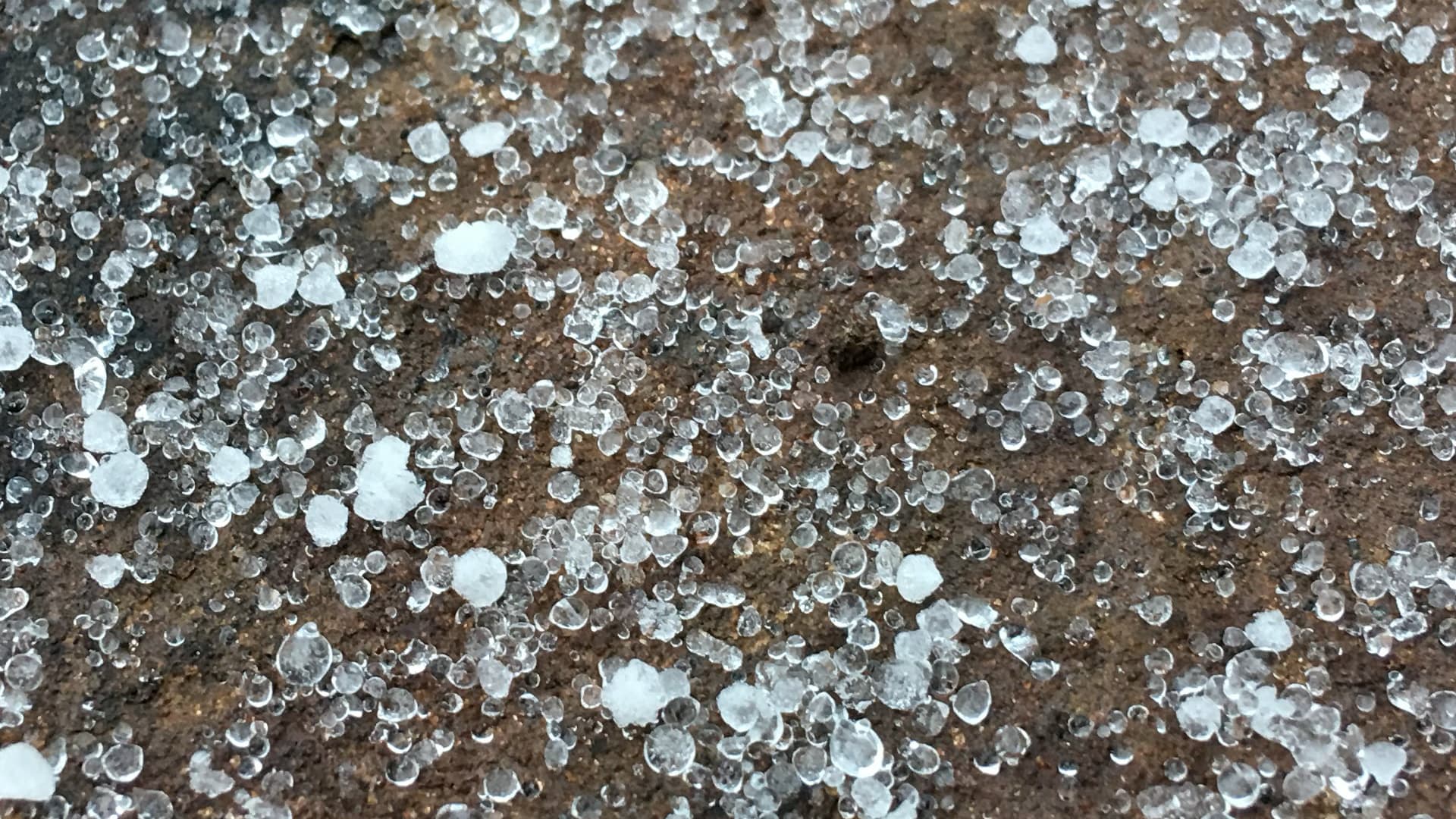
This photograph shows hail—tiny balls of ice scattered across soil and rocks. The clear, round ice pieces of different sizes are piled together on the ground after a hailstorm. Hail is a type of frozen precipitation that falls from clouds during severe weather.
🔬 Scientific Phenomena
This image represents hail formation and precipitation, a weather phenomenon where water in storm clouds freezes into ice balls and falls to Earth. Hail forms when water droplets in very cold parts of clouds freeze, layer by layer, into hard ice spheres. These ice balls become heavy enough to fall through the air and land on the ground, creating the visible evidence of a hailstorm shown here. This demonstrates how Earth's atmosphere and water cycle interact to produce different forms of precipitation.
📚 Core Science Concepts
- Precipitation: Water falls from clouds to Earth's surface in different forms—rain, snow, sleet, and hail—depending on temperature conditions.
- Freezing and Ice Formation: When water gets very cold in high clouds, it changes from liquid to solid (ice), creating hard frozen particles.
- Weather Patterns: Hail is associated with severe thunderstorms and represents a specific type of weather that can be observed and described over time.
- Observable Weather Changes: Hail is evidence that weather changes and can be observed, recorded, and discussed as part of weather patterns.
Pedagogical Tip:
For kindergarteners, use sensory language and direct observation opportunities. Bring in safe ice cubes or crushed ice to help students understand that frozen water is hard and cold. Create a simple weather chart where students can place a hail picture or symbol when hail occurs, building the habit of weather observation and pattern recognition early.
UDL Suggestions:
Offer multiple means of representation: Show the photograph alongside video clips of actual hailstorms, pictures of hail up close, and drawings. Use tactile materials like ice cubes or foam balls to represent hail so students with visual impairments can understand the concept. Provide a simple, repeatable weather recording sheet with pictures students can point to or mark to document when hail occurs.
🔍 Zoom In / Zoom Out Concepts
Zoom In (Microscopic):
At a very small level, each hail ball is made of many, many tiny water molecules frozen solid together. These molecules were originally floating as invisible water vapor in the air high up in the clouds. As they cooled down, the molecules slowed down and stuck together, forming ice—which is why hail is so hard and heavy.
Zoom Out (Larger System):
Hail is part of Earth's water cycle and weather systems. Water evaporates from oceans, lakes, and land; rises into the atmosphere; forms clouds; and returns to Earth as different types of precipitation depending on temperature. Hailstorms connect to larger weather patterns and seasons, affecting plants, animals, and humans in the local environment.
🤔 Potential Student Misconceptions
- Misconception: "Hail is frozen rain that already fell and froze on the ground."
- Clarification: Hail forms high up in cold clouds before it falls. The ice balls freeze while floating in the air, then fall to the ground as ice—it's not rain that froze after landing.
- Misconception: "Hail only happens in winter."
- Clarification: Hail can happen at any time of year when conditions are right, but it's most common in spring and early summer when there are strong, severe storms.
- Misconception: "Hail is the same as sleet or snow."
- Clarification: Hail forms in thunderstorms as hard ice balls. Snow and sleet form differently. Hail is usually bigger and rounder than sleet, and different from snow's crystal shapes.
🎓 NGSS Connections
K-ESS2-1: Use and share observations of local weather conditions to describe patterns over time.
- Students observe and record hail as a weather condition; create simple weather charts tracking when hail occurs.
K-ESS3-2: Ask questions to obtain information about the purpose of weather forecasting to prepare for, and respond to, severe weather.
- Students ask: "What is hail?" "When does hail happen?" "Why do people warn us about hailstorms?" This connects hail observation to safety and weather preparation.
K-ESS3-3: Communicate solutions that will reduce the impact of humans on the land, water, air, and/or other living things in the local environment.
- Students discuss how hail affects plants and animals, and what humans can do to stay safe during hailstorms.
Disciplinary Core Ideas:
- - Objects and organisms can affect the processes in the hydrosphere (water cycle, precipitation).
- - Weather is the combination of sunlight, wind, snow or rain, and temperature. Patterns of weather occur in a repeating sequence.
Crosscutting Concepts:
- - Weather conditions repeat in patterns that can be observed and recorded.
- - Hail formation results from specific cold weather conditions in clouds.
💬 Discussion Questions
- "What do you think happened to the water in the sky to make all these hard ice balls?" (Bloom's: Understand | DOK: 1)
- "How is hail different from rain or snow? What do you observe?" (Bloom's: Analyze | DOK: 2)
- "If we had hail fall near our school, how might it affect the plants in the playground or the animals living nearby?" (Bloom's: Evaluate | DOK: 3)
- "Why do you think people listen to weather forecasters when hail storms might come? What should we do to stay safe?" (Bloom's: Apply | DOK: 2)
📖 Vocabulary
- Hail: Ice balls that fall from thunderstorm clouds during severe weather.
- Precipitation: Water that falls from clouds to Earth as rain, snow, sleet, or hail.
- Freezing: When liquid water gets so cold that it turns into solid ice.
- Storm: A strong, dangerous weather event with heavy rain, wind, lightning, and sometimes hail or snow.
- Weather: The condition of the air and atmosphere at a specific time and place—hot, cold, sunny, rainy, windy, or stormy.
🌡️ Extension Activities
- Hail Ice Ball Experiment: Freeze water in round balloons or ice molds to create ice balls similar to hail. Have students observe the ice balls, feel their temperature (safely with gloves), and compare their size and hardness to other objects. Discuss why hail is so hard and why it can damage things.
- Weather Observation Chart: Create a simple, pictorial weather chart on the classroom wall. Each day, students mark whether it was sunny, rainy, snowy, or hail weather using pictures or stickers. Over weeks and months, look for patterns: "When is hail most common in our area?" "Do we see hail more in spring or fall?"
- Dramatic Play: Weather Forecaster: Set up a pretend weather station in the classroom. Students take turns being weather reporters, describing the hail they see in the photograph and warning others about severe weather. Use a toy microphone and a large weather chart so students practice communication and sequencing.
🔗 Cross-Curricular Ideas
Math: Create a simple bar graph showing how many days per month it rains, snows, or hails. Count and compare numbers to build early graphing skills.
Language Arts (ELA): Read the book Listen to the Rain by Bill Martin Jr. to explore different weather sounds. Then have students create simple sentences or drawings about what they hear, see, and feel during a hailstorm.
Social Studies: Discuss how hail affects farmers, construction workers, and gardeners. Talk about how different communities prepare for severe weather and what it means to be safe during a storm.
Art: Create hail scenes using white paint, cotton balls, foam beads, or crumpled paper glued onto blue or gray paper representing storm clouds. Display as a classroom mural showing "Hail Weather."
🚀 STEM Career Connection
- Meteorologist — Studies the atmosphere to work out what the weather will do next.
- Try it: Construct a model of a thunderstorm cloud and explain how hail might form inside it. (Practice: Constructing Explanations and Designing Solutions)
- Tools: weather balloons, radar, rain gauges, computer models
- Where they work: weather stations, airports, television studios, research centres
- Meet one: Marshall Shepherd — Why cities make their own weather, and why some neighbourhoods flood before others.
- Median pay: /year — "Atmospheric and space scientists"
- Climate Scientist — Studies how weather patterns change over many years, and what is driving the change.
- Try it: Collect data on daily temperatures for a week and explain how it changes. (Practice: Constructing Explanations and Designing Solutions)
- Tools: ice cores, satellite data, computer models, long temperature records
- Where they work: research institutes, government climate offices, universities, polar stations
- Meet one: Carlos Nobre — How close the Amazon rainforest is to the point where it stops being a rainforest.
- Median pay: /year — "Atmospheric and space scientists"
Wage figures are median annual wages for the U.S. occupation named after each one, from the U.S. Bureau of Labor Statistics, Occupational Employment and Wage Statistics (OEWS), national, May 2025. Several careers share one occupation, so their figures match.