📸 Photo Description
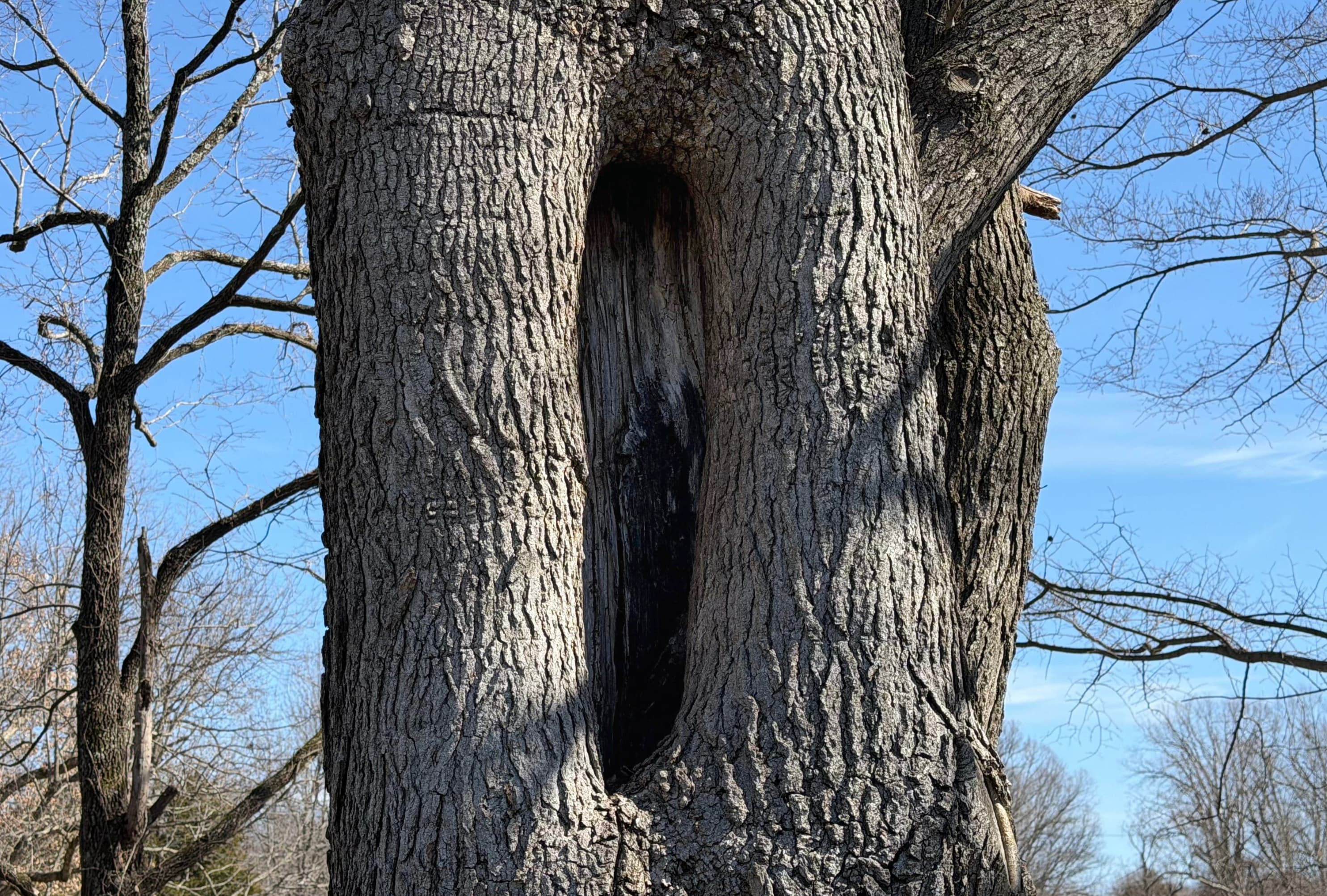
This image shows a large, old tree with a deep, dark hole in its trunk. The tree's bark is thick and gray, and the hole shows where the inside of the tree has decayed over a long time. The tree is still alive and standing tall, even though part of it has broken down.
🔬 Scientific Phenomena
Anchoring Phenomenon: Dead wood decomposition and cavity formation in living trees.
Living organisms called decomposers—including fungi, bacteria, insects, and microorganisms—break down dead or dying wood inside the tree. This natural process recycles nutrients back into the soil and creates hollow spaces (cavities). The tree responds by growing new wood around the damaged area, allowing it to survive despite the decay. This is a critical life process that demonstrates how organisms depend on each other and how matter cycles through ecosystems.
📚 Core Science Concepts
- Decomposition as a Life Process: Decomposers (fungi, bacteria, insects) are living organisms that break down dead plant material. This is a natural and necessary process in all ecosystems.
- Trees as Living Organisms with Needs: Trees need sunlight, water, air, and nutrients from soil to survive. Even when part of a tree dies and decays, the living tree continues to meet its needs and grow.
- Habitats Within Trees: Tree cavities created by decomposition become homes for many animals (birds, squirrels, insects). Dead wood supports diverse life.
- Resilience and Adaptation: Trees can survive and continue growing even when damaged or partially decayed, showing how living things adapt to changes in their environment.
Pedagogical Tip:
For Kindergarten, avoid using the word "decay" in isolation—pair it with "break down" to clarify that this is a normal, helpful process. Use sensory language: "The tree is being broken down into tiny pieces by very small living things we can't see. This helps make soil for new plants to grow!" This reframes decomposition positively rather than as something "bad."
UDL Suggestions:
Multiple Means of Representation: Use pictures, videos, and physical tree cross-sections to show decomposition. Some students may fear "dead" trees; reframe the language as "sleeping trees" or "trees that are changing." Allow students to observe a real tree cavity from a safe distance and touch the rough bark to engage tactile learners. Provide image labels in multiple languages if your classroom is multilingual.
Multiple Means of Action & Expression: Allow students to show understanding through drawing, building with blocks, dramatic play, or dictation—not just through verbal discussion. Create a sensory-safe activity where students feel different types of bark, wood, and soil.
🔍 Zoom In / Zoom Out Concepts
Zoom In: Microscopic Level
At scales too small to see, billions of decomposer organisms (bacteria, fungi, wood-eating insects like termites and beetles) live inside the tree. These tiny organisms secrete enzymes that break down the cellulose and lignin in wood, converting it molecule by molecule into nutrients, water, and carbon dioxide. This invisible work is what creates the visible cavity we see in the photo.
Zoom Out: Ecosystem Level
This single tree cavity is part of a larger forest ecosystem. The nutrients released from decomposing wood fertilize the soil, helping new plants grow. The cavity itself becomes a critical microhabitat—home to woodpeckers, owls, raccoons, beetles, and countless insects. The tree cavity connects to the forest food chain, water cycle, and nutrient cycle. Forest health depends on this decomposition process happening continuously across thousands of trees.
🤔 Potential Student Misconceptions
- Misconception: "The tree is dead and should be cut down."
- Clarification: Even with a big hole, this tree is still alive! It can still drink water through its roots and get energy from the sun. The hole actually helps animals have homes, and the breaking-down process helps make new soil for plants.
- Misconception: "Decomposers are bad because they break things."
- Clarification: Decomposers are helpful! They are living things that do an important job. They break down dead wood so it becomes soil, and soil helps new plants grow. Nothing would grow without decomposers.
- Misconception: "The hole appeared suddenly or is caused by an animal biting it."
- Clarification: The hole happens very, very slowly over many years as tiny living things (too small to see) slowly break down the inside of the tree, piece by tiny piece.
🎓 NGSS Connections
K-LS1-1: Use observations to describe patterns of what plants and animals (including humans) need to survive.
- How this standard connects: Students observe that trees need sunlight, water, and soil nutrients to survive. Even damaged trees continue to survive because they can still get these needs met. Students also learn that decomposer organisms need dead wood to survive, showing how all living things have similar basic needs.
- All organisms have basic needs. For example, animals need air, water, and food; plants need air, water, minerals, and light. Organisms can survive only in environments in which their needs can be met.
- Students observe the pattern: trees need similar things every year to survive, even when damaged.
- The presence of decomposers (cause) leads to the breakdown of wood and cavity formation (effect).
💬 Discussion Questions
- "What do you think is happening inside this hole in the tree?" (Bloom's: Remember | DOK: 1)
- "Why do you think this tree still has leaves and branches growing, even with such a big hole?" (Bloom's: Understand | DOK: 2)
- "If you were a small animal like a bird or squirrel, why might you want to live in a tree cavity like this one?" (Bloom's: Apply | DOK: 2)
- "What do you think would happen if nothing broke down dead wood in the forest?" (Bloom's: Analyze | DOK: 3)
📖 Vocabulary
- Decompose: When living things break down dead plants and animals into smaller pieces that become part of the soil.
- Cavity: A large hole or hollow space inside something, like the hole in this tree.
- Decomposer: A tiny living organism (like bacteria or fungi) that you cannot see but that helps break down dead things.
- Organism: Any living thing, like plants, animals, bugs, or bacteria.
- Nutrients: Special things in soil and food that help living things grow big and strong.
- Survive: To stay alive and healthy by getting what you need.
🌡️ Extension Activities
- Tree Cavity Hunt & Observation Walk
Take students on a safe nature walk to observe different trees. Look for cavities, cracks, peeling bark, or signs of decomposition from a distance. Bring clipboards and have students draw or dictate what they observe. Back in the classroom, sort observations into categories: "Trees with holes," "Trees with different bark," "Trees with new growth." Discuss why different trees might look different.
- Decomposition in a Jar Experiment
Fill clear jars with layers of soil, dead leaves, small wood chips, and water. Place in indirect sunlight and observe over 4-6 weeks. Children draw weekly observations (with teacher documentation). Discuss how the leaves and wood look different each week. This makes the invisible decomposition process more visible and concrete for young learners.
- Animal Homes in Trees Drama & Building Activity
Read a picture book about tree cavities as homes. Then, provide craft materials (paper tubes, blocks, fabric, twigs) and have students build "tree homes" for imaginary forest animals. Students can describe which animals live in their tree and what they need. Connect back to the photo: "The real tree cavity we saw is a home for animals, just like the ones you built!"
🔗 Cross-Curricular Ideas
- ELA/Literacy Connection: Read The Tree House by Jan Lööf or Arboretum by Mick Manning and Brita Granström. Discuss the tree in the story and compare it to the tree in the photo. Students dictate or draw "tree stories" from an animal's perspective living in the cavity.
- Math Connection: Measure the diameter of the tree cavity and the tree trunk using string. Create a bar graph showing "Tree sizes in our school yard" or compare different tree widths observed on a nature walk. Introduce comparative language: "This tree is wider than that tree."
- Social Studies Connection: Discuss how different cultures use trees for homes, food, and tools. Connect to indigenous knowledge about forest stewardship and why healthy forests (with decomposition happening naturally) are important to communities.
- Art Connection: Create "tree art" by rubbing bark with crayons on paper (bark rubbings). Paint or draw trees with cavities. Make a collage using natural materials (leaves, twigs, bark pieces) to show what lives in and around tree cavities. Display alongside the photo for comparison.
🚀 STEM Career Connection
- Conservation Scientist — Looks after land, forests and water so they stay healthy for the people and animals who use them.
- Try it: Design a solution to help protect a hollow tree so that the animals living inside are safe. (Practice: Constructing Explanations and Designing Solutions)
- Tools: soil samplers, aerial photographs, measuring tapes, mapping software
- Where they work: forests and rangelands, parks departments, government agencies, land trusts
- Meet one: Tierra Curry — Which plants and animals are closest to disappearing, and what it takes to save them.
- Median pay: /year — "Conservation scientists"
- Ecologist — Studies how living things depend on each other and on the place they live.
- Try it: Explain how decomposers like fungi help break down a fallen log to return nutrients to the soil. (Practice: Constructing Explanations and Designing Solutions)
- Tools: quadrat frames, measuring tapes, GPS units, a field notebook
- Where they work: forests, grasslands, wetlands, universities
- Meet one: Sandra Díaz — What a plant's leaves, wood and shape tell you about how it lives — and how those traits add up across a whole ecosystem.
- Median pay: /year — "Environmental scientists and specialists, including health"
Wage figures are median annual wages for the U.S. occupation named after each one, from the U.S. Bureau of Labor Statistics, Occupational Employment and Wage Statistics (OEWS), national, May 2025. Several careers share one occupation, so their figures match.
---
Teacher Reflection Tip: This lesson invites students to reframe decomposition from something "gross" or "bad" to something natural, necessary, and wonderful. By starting with direct observation of the tree cavity, you ground abstract concepts in real sensory experience—which is developmentally appropriate for Kindergarten learners.