📸 Photo Description
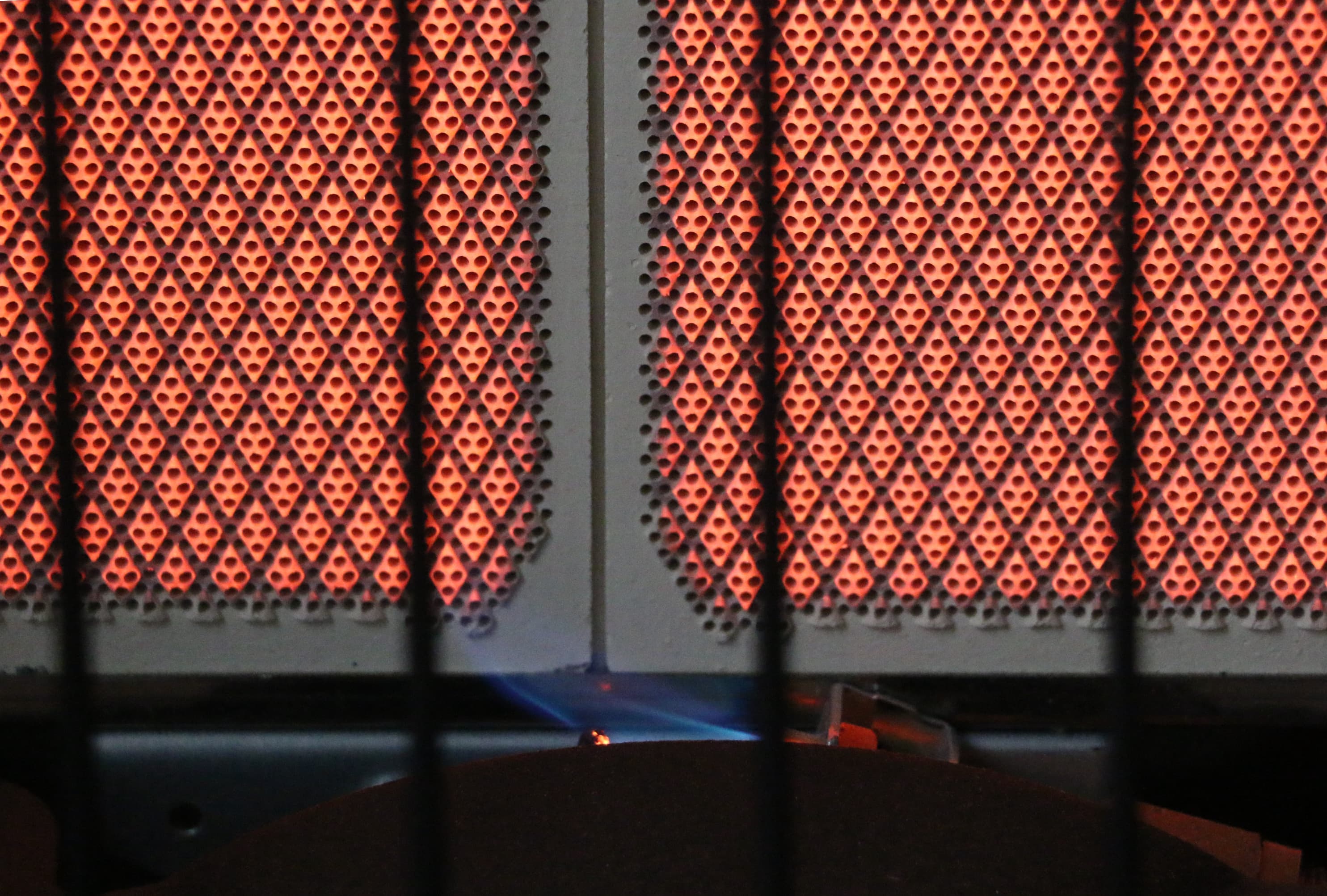
The image shows a close-up of a heater with glowing orange elements behind a metal grate. A small blue flame is visible, indicating that the heater is actively producing heat. This scene demonstrates the process of generating and radiating heat.
🔬 Scientific Phenomena
This image captures the phenomenon of heat transfer through radiation. The glowing orange elements are very hot, and they are emitting thermal energy in the form of infrared radiation. This invisible energy travels outwards and can be felt as warmth, even without direct contact. The blue flame is part of the process that creates this heat, likely by burning a fuel like propane.
📚 Core Science Concepts
- Heat Production: Heat is a form of energy that can be produced through various processes, such as burning fuel. The blue flame shows the combustion occurring, which releases a significant amount of energy as heat.
- Thermal Radiation: Hot objects emit energy as electromagnetic waves, which we perceive as heat. The glowing orange elements are radiating this energy.
- Conduction vs. Radiation: While conduction involves heat transfer through direct contact and convection involves heat transfer through the movement of fluids, radiation allows heat to travel through space without any medium.
Pedagogical Tip: Encourage students to think about where they feel the heat from the heater. Is it only when they touch it, or can they feel it from a distance? This helps differentiate between conduction and radiation.
UDL Suggestions: Provide visual aids such as diagrams or short videos illustrating heat transfer by radiation to support visual learners. Also, offer opportunities for kinesthetic learners to feel the radiant heat from a safe distance or experiment with different materials to see how they absorb or reflect heat.
🔍 Zoom In / Zoom Out Concepts
- Zoom In: At a microscopic level, the atoms and molecules within the glowing elements are vibrating intensely due to the heat. These vibrations cause them to release energy in the form of photons (light and infrared radiation).
- Zoom Out: This heater is part of a larger system designed to warm a space, such as a room or a tent. The heat generated by the device then interacts with the air and objects in the environment, warming them.
🤔 Potential Student Misconceptions
- Misconception: Students might think that heat is something that travels only through touch (conduction) or by air moving (convection).
- Clarification: Heat can also travel through empty space as invisible waves called radiation. This is how the sun warms the Earth, and how this heater warms the area around it without direct contact.
- Misconception: Students might believe that the blue flame is the heat.
- Clarification: The flame is the process that creates heat, but the heat itself is the energy released from that process and then transferred through radiation and convection.
🎓 NGSS Connections
- K-PS3-1: Make observations to determine the effect of sunlight on Earth's surface. (Grade K — foundational connection)
- 4-PS3-2: Make observations to provide evidence that energy can be transferred from place to place by sound, light, heat, and electric currents. (Grade 4 — where this learning leads)
💬 Discussion Questions
- How does the heater make the air around it warmer? (Bloom's: Understand | DOK: 2 | SEP: Constructing Explanations and Designing Solutions)
- What do you think would happen if you placed your hand far away from the heater? What if you placed it close? (Bloom's: Analyze | DOK: 2 | SEP: Asking Questions and Defining Problems)
- Describe how the glowing orange parts of the heater are similar to or different from the sun. (Bloom's: Analyze | DOK: 2 | SEP: Constructing Explanations and Designing Solutions)
📖 Vocabulary
- Heat: Energy that is transferred from a hotter object to a cooler object.
- Flame: A visible, gaseous part of a fire.
- Radiation: Energy that travels as waves, like light and heat, through space.
- Grates: A framework of parallel or crossed bars, used to cover openings or to hold something.
🌡️ Extension Activities
- Feel the Heat: Have students safely feel the radiant heat from the heater from different distances and record their observations. Discuss how the distance affects the amount of heat felt.
- Radiant Heat Obstacles: Experiment with placing different materials (e.g., a piece of cardboard, a metal sheet, a clear plastic shield) at a safe distance between students and the heater. Observe and discuss how different materials block or allow the radiant heat to pass through.
🔗 Cross-Curricular Ideas
- ELA: Read stories about inventions that use heat, such as stoves or furnaces, and discuss the importance of controlling heat for safety and comfort.
- Art: Have students draw or paint pictures of things that produce heat, like fires, the sun, or heaters, focusing on the colors and textures associated with heat.
- Social Studies: Discuss different ways people have historically used heat for warmth and cooking, and how modern heating systems have changed our lives.
🚀 STEM Career Connection
- Materials Engineer — Chooses and shapes the right material for a job, and tests it until it fails.
- Try it: Design a simple container that will keep ice from melting for as long as possible, explaining which materials would work best. (Practice: Constructing Explanations and Designing Solutions)
- Tools: tensile testers, furnaces, microscopes, hardness testers
- Where they work: manufacturing plants, product design firms, testing labs, universities
- Meet one: Ainissa Ramirez — How to make metal stick to glass and ceramics — she invented a solder that does it.
- Median pay: /year — "Materials engineers"
- Solar Panel Installer — Mounts and wires solar panels, working out which angle catches the most sun on that particular roof.
- Try it: Imagine you are installing solar panels; explain how the angle of the sun affects how much heat you feel from a sunny spot. (Practice: Constructing Explanations and Designing Solutions)
- Tools: mounting rails, electrical meters, angle finders, safety harnesses
- Where they work: rooftops, solar farms, installation companies, utility projects
- Median pay: /year — "Solar photovoltaic installers"
Wage figures are median annual wages for the U.S. occupation named after each one, from the U.S. Bureau of Labor Statistics, Occupational Employment and Wage Statistics (OEWS), national, May 2025. Several careers share one occupation, so their figures match.