📸 Photo Description
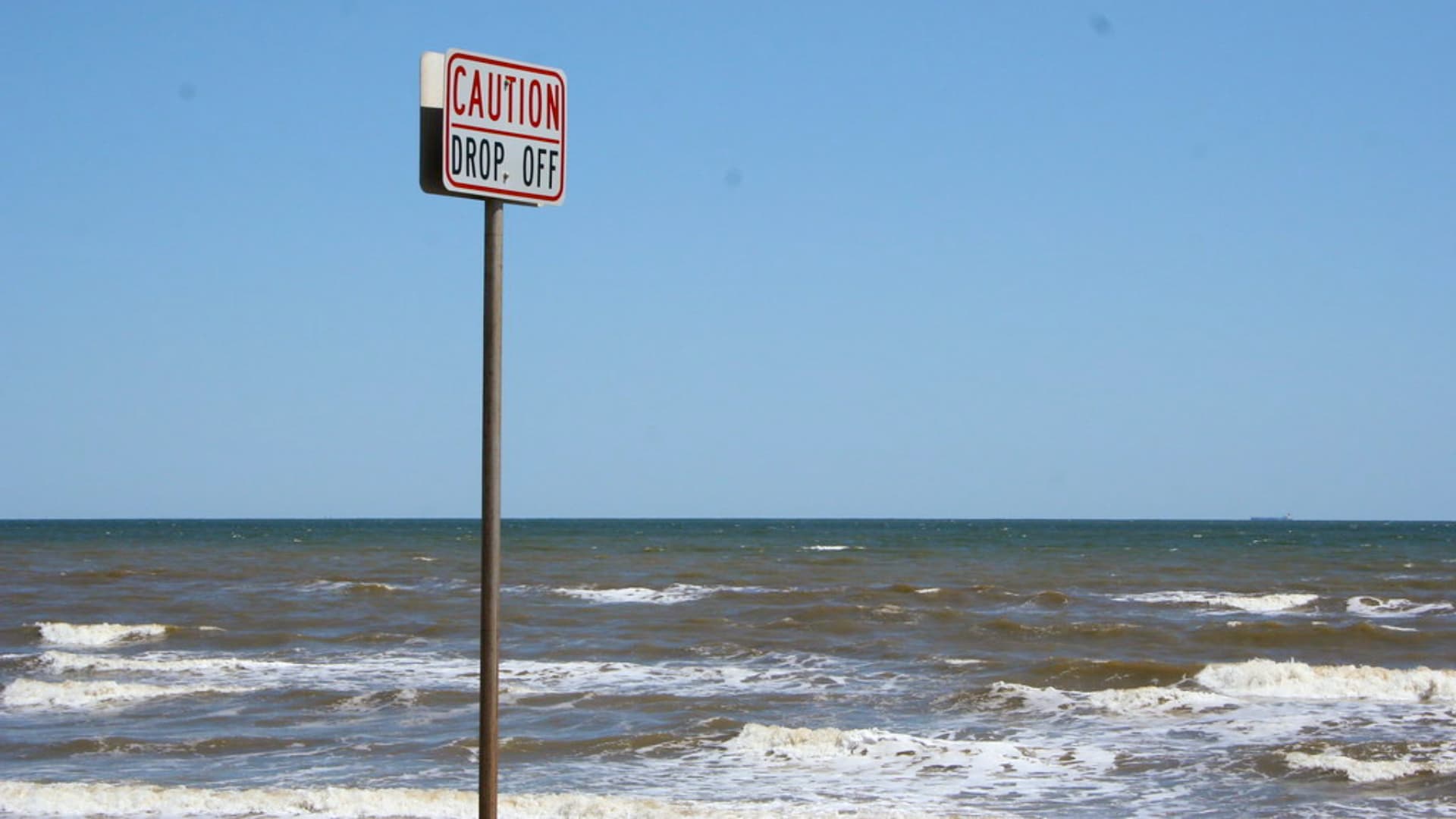
The image shows a sign on a pole at the edge of a large body of water. The sign says "CAUTION DROP OFF." Waves are visible in the water, and the sky is clear and blue.
🔬 Scientific Phenomena
This photo captures the phenomenon of erosion and landform change at the interface between land and a large body of water, like the ocean. The waves are constantly moving and interacting with the shore, which can gradually wear away the land. The "drop off" sign is a warning that the land may suddenly become steeper or disappear into the water, indicating that the shoreline is actively changing due to natural forces.
📚 Core Science Concepts
- Erosion: This is the process where natural forces like wind, water, and ice wear away and carry off rock and soil. In this image, the waves are the primary agent of erosion, gradually shaping the coastline.
- Landforms: These are the natural features of the Earth's surface, such as coastlines, mountains, and valleys. The shoreline in the photo is a dynamic landform that is continually being reshaped by the water.
- Water Cycle: While not directly depicted, the ocean is a major part of the water cycle, and its interaction with the land is influenced by weather patterns and the amount of water present. The waves are a visible manifestation of energy transfer within the hydrosphere.
Pedagogical Tip: When discussing erosion, encourage students to think about what happens to the sand or soil that is worn away. This can lead to discussions about deposition and how landforms are built up as well as worn down.
UDL Suggestions: Provide visual aids such as diagrams or short videos showing wave action and erosion to support learners who benefit from visual input. Offer sentence starters or graphic organizers to help students structure their explanations about erosion and landforms.
- Human Impact: The sign itself represents human interaction with the environment, indicating a hazard that people need to be aware of for safety.
🔍 Zoom In / Zoom Out Concepts
- Zoom In: At a microscopic level, the erosion caused by waves involves the force of water molecules and suspended particles (like sand and small rocks) impacting and dislodging other particles on the shore. This is a constant, powerful yet slow process of molecular and granular movement.
- Zoom Out: This dynamic coastline is part of a larger coastal system. The waves are generated by wind acting on the surface of the ocean, which is itself part of the global water cycle and influenced by weather systems. The shape of this coastline can also impact local weather patterns and marine ecosystems.
🤔 Potential Student Misconceptions
- Misconception: Students might believe that the land at the edge of the water always stays the same.
Clarification: The constant motion of waves is actively changing the shape of the land, wearing away the shore over time. This process is called erosion.
- Misconception: Students might think erosion only happens in dramatic events like floods or storms.
Clarification: While big events can cause a lot of erosion quickly, the gentle, steady action of waves is also a powerful force that changes the land over long periods.
🎓 NGSS Connections
- 2-ESS2-1: Compare multiple solutions designed to slow or prevent wind or water from changing the shape of the land. (Grade 2 — foundational connection)
- 4-ESS2-1: Make observations and/or measurements to provide evidence of the effects of weathering or the rate of erosion by water, ice, wind, or vegetation. (Grade 4 — where this learning leads)
*
*
*
*
💬 Discussion Questions
- What do you think the sign "CAUTION DROP OFF" means? (Bloom's: Understanding | DOK: 1 | SEP: Obtaining Evaluating and Communicating Information)
- How do you think the waves are making the land change? (Bloom's: Analyzing | DOK: 2 | SEP: Constructing Explanations and Designing Solutions)
- What are some ways people try to stop the ocean from washing away the land? (Bloom's: Applying | DOK: 2 | SEP: Constructing Explanations and Designing Solutions)
- Describe a time you have seen the land change near water. (Bloom's: Remembering | DOK: 1 | SEP: Obtaining Evaluating and Communicating Information)
📖 Vocabulary
- Erosion: The process of wearing away land by wind, water, or ice.
- Waves: Moving ridges on the surface of water, usually caused by wind.
- Coastline: The boundary where land meets the sea or ocean.
- Landform: A natural feature of the Earth's surface, like a mountain or a plain.
🌡️ Extension Activities
- Wave Erosion Model: Use a shallow tray filled with sand or soil. Create a sloped "coastline" and use a spray bottle or a small pitcher to simulate waves hitting the shore, observing how the sand is moved.
- Coastal Shape Investigation: Provide students with different materials (sand, pebbles, clay) and have them build a model coastline. Then, use a fan to simulate wind or gently pour water to observe erosion and deposition.
- "What Floats Your Boat?" Buoyancy Experiment: Explore how different objects behave in water, which can lead to discussions about how water interacts with land and the forces involved.
🔗 Cross-Curricular Ideas
- ELA: Write a creative story from the perspective of a wave or a piece of sand being eroded.
- Art: Draw or paint a seascape, focusing on the textures of the water, waves, and shoreline.
- Social Studies: Research coastal communities and how they have adapted to living near the ocean, including building sea walls or other protective structures.
- Math: Measure the changes in a sandcastle or a pile of sand over a set period as it is exposed to simulated waves.
🚀 STEM Career Connection
- Civil Engineer — Designs the things a town runs on — roads, bridges, water pipes and drains.
- Try it: Design and build a simple bridge out of craft sticks that can withstand the force of a fan blowing on it. (Practice: Planning and Carrying Out Investigations)
- Tools: surveying equipment, CAD software, soil tests, load calculations
- Where they work: construction sites, city engineering departments, design firms, transport agencies
- Meet one: Roma Agrawal — How to hold a skyscraper up — she designed the foundations and the spire of the Shard.
- Median pay: /year — "Civil engineers"
- Conservation Scientist — Looks after land, forests and water so they stay healthy for the people and animals who use them.
- Try it: Plant seeds in two different soil types and observe which one grows better after watering. (Practice: Planning and Carrying Out Investigations)
- Tools: soil samplers, aerial photographs, measuring tapes, mapping software
- Where they work: forests and rangelands, parks departments, government agencies, land trusts
- Meet one: Tierra Curry — Which plants and animals are closest to disappearing, and what it takes to save them.
- Median pay: /year — "Conservation scientists"
Wage figures are median annual wages for the U.S. occupation named after each one, from the U.S. Bureau of Labor Statistics, Occupational Employment and Wage Statistics (OEWS), national, May 2025. Several careers share one occupation, so their figures match.