📸 Photo Description
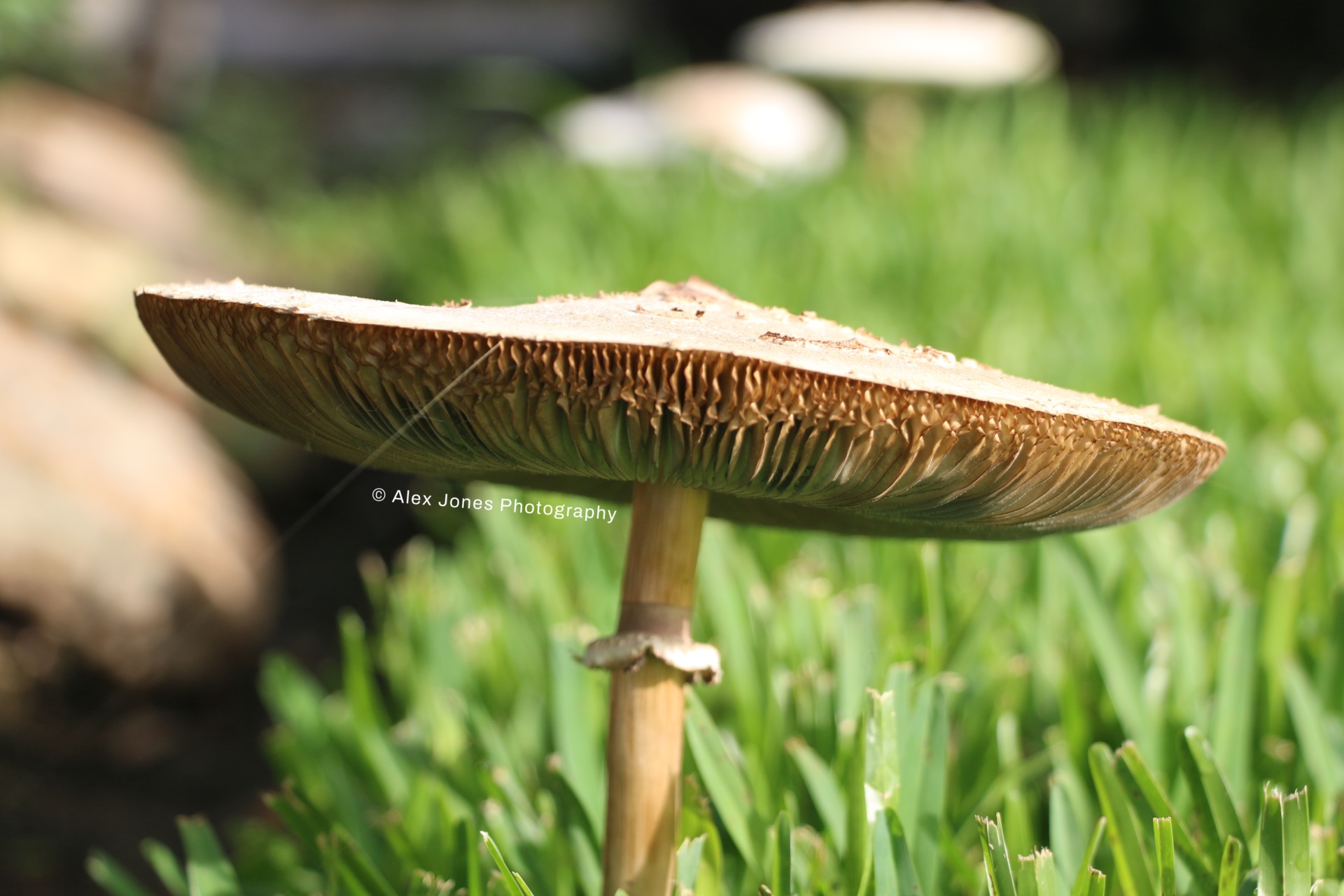
This picture shows a mushroom growing in green grass. The mushroom has a light brown cap with dark lines underneath called gills. You can see other mushrooms growing in the background, and they all have thin stems that hold up their caps.
🔬 Scientific Phenomena
The anchoring phenomenon is fungal reproduction and growth. This mushroom represents the visible fruiting body of a much larger fungal organism living underground. The mushroom appears above ground to release spores (like seeds) into the air for reproduction. The dark gills visible under the cap contain millions of microscopic spores that will be carried by wind to new locations where they can grow into new fungi. This process is essential for the fungus to spread and continue its life cycle.
📚 Core Science Concepts
- Living vs. Non-living Characteristics: Fungi like mushrooms are living organisms that grow, reproduce, and respond to their environment, even though they don't move like animals or make their own food like plants.
- Life Cycles: Mushrooms represent one stage in the fungal life cycle - the reproductive stage that produces spores to create new organisms.
- Habitat Requirements: Fungi need specific conditions to grow, including moisture, nutrients from decaying matter, and appropriate temperature.
- Decomposition Role: Fungi break down dead plant and animal material, recycling nutrients back into the soil for other living things to use.
Pedagogical Tip: Use the "Think-Pair-Share" strategy when introducing fungi. Have students first think individually about what they know about mushrooms, then discuss with a partner, and finally share with the class. This activates prior knowledge and reveals misconceptions early.
UDL Suggestions: Provide multiple ways for students to explore fungi concepts: tactile experiences with safe mushroom models, visual diagrams of fungal life cycles, and audio recordings of fungi facts. This supports diverse learning styles and accessibility needs.
🔍 Zoom In / Zoom Out Concepts
- Zoom In: At the microscopic level, the mushroom's gills contain millions of tiny spores that are released into the air. Underground, thread-like structures called hyphae spread through the soil, absorbing nutrients and water from decaying organic matter.
- Zoom Out: This mushroom is part of a larger forest or grassland ecosystem where fungi serve as nature's recyclers, breaking down dead leaves, wood, and other organic matter to create rich soil that feeds plants, which in turn support animals throughout the food web.
🤔 Potential Student Misconceptions
- Misconception: "Mushrooms are plants because they grow from the ground."
Clarification: Mushrooms are fungi, which are different from plants. Unlike plants, fungi cannot make their own food through photosynthesis and must get nutrients from other sources.
- Misconception: "All mushrooms are dangerous to touch."
Clarification: While we should never eat wild mushrooms, most mushrooms are safe to touch. However, we should always wash our hands after handling any wild organism.
- Misconception: "The mushroom is the whole organism."
Clarification: The mushroom is just the visible part, like fruit on a tree. Most of the fungal organism lives underground as a network of tiny threads.
🎓 NGSS Connections
- Performance Expectation: 3-LS1-1 - Develop models to describe that organisms have unique and diverse life cycles but all have in common birth, growth, reproduction, and death.
- Disciplinary Core Ideas: - Growth and Development of Organisms
- Crosscutting Concepts: in the natural world can be observed and used as evidence
💬 Discussion Questions
- What do you think this mushroom needs to grow and stay healthy? (Bloom's: Apply | DOK: 2)
- How might this mushroom be helpful to other living things in its environment? (Bloom's: Analyze | DOK: 3)
- What patterns do you notice when comparing this mushroom to other living things you know? (Bloom's: Analyze | DOK: 2)
- If you were a tiny spore from this mushroom, what would need to happen for you to grow into a new mushroom? (Bloom's: Create | DOK: 3)
📖 Science Vocabulary
- Fungi: Living things that get their food by breaking down dead plants and animals
- Spores: Tiny parts that fungi use to make new fungi, like seeds for plants
- Gills: The dark lines under a mushroom cap where spores are made
- Decomposer: A living thing that breaks down dead material and returns nutrients to the soil
- Life cycle: All the stages a living thing goes through as it grows and reproduces
- Organism: Any living thing, like plants, animals, or fungi
🔗 Cross-Curricular Ideas
- Math - Measurement and Data: Have students measure the height and width of mushrooms they find (or pictures of mushrooms) using rulers or string. Create a simple bar graph showing the sizes of different mushrooms in your schoolyard or local park. This connects to measurement standards and data representation.
- ELA - Descriptive Writing: Ask students to write a short paragraph describing what they see in a mushroom photograph using sensory words (rough, smooth, tan, brown, damp). They could also write a creative story from the perspective of a spore traveling through the air to find a new home.
- Art - Nature Sketching and Spore Printing: Students can draw detailed sketches of mushrooms, paying attention to the gills underneath. For a hands-on art activity, place a fresh mushroom cap gill-side down on dark paper overnight to create a natural spore print - the spores release and create a beautiful pattern that shows where spores are produced.
- Social Studies - Roles in Communities: Discuss how fungi are "community helpers" in nature by breaking down dead things and making soil healthy for gardens and forests. Connect this to how different people have different jobs that help their community, just like fungi have a special job in nature's community.
🚀 STEM Career Connection
- Mycologist — Studies fungi — mushrooms, moulds and yeasts, and the hidden threads that connect them underground.
- Try it: Compare and contrast two different mushroom pictures, noting similarities and differences in their size, color, and shape. (Practice: Analyzing and Interpreting Data)
- Tools: spore prints, petri dishes, microscopes, collecting baskets
- Where they work: forests, laboratories, botanical gardens, universities
- Meet one: Giuliana Furci — Fungi nobody had catalogued before, and getting them protected the way animals and plants are.
- Median pay: /year — "Microbiologists"
- Ecologist — Studies how living things depend on each other and on the place they live.
- Try it: From pictures, identify what a mushroom seems to be growing on and what other living things are nearby. (Practice: Analyzing and Interpreting Data)
- Tools: quadrat frames, measuring tapes, GPS units, a field notebook
- Where they work: forests, grasslands, wetlands, universities
- Meet one: Sandra Díaz — What a plant's leaves, wood and shape tell you about how it lives — and how those traits add up across a whole ecosystem.
- Median pay: /year — "Environmental scientists and specialists, including health"
Wage figures are median annual wages for the U.S. occupation named after each one, from the U.S. Bureau of Labor Statistics, Occupational Employment and Wage Statistics (OEWS), national, May 2025. Several careers share one occupation, so their figures match.