📸 Photo Description
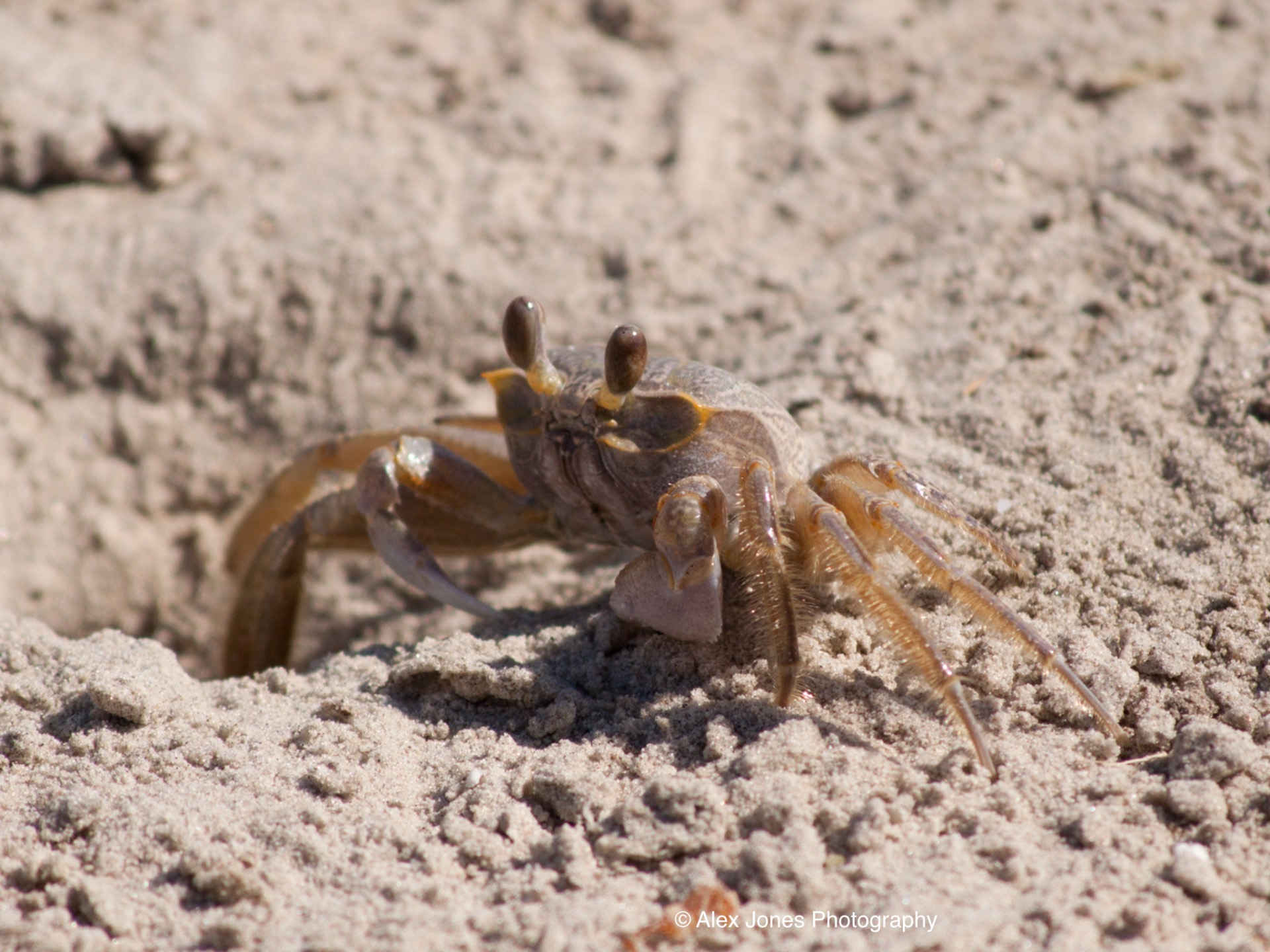
This photo shows a brown crab with two eye stalks and long legs standing on wet sand near the beach. The crab is a living animal that makes its home in sandy areas by the ocean. Crabs have hard shells on the outside of their bodies to protect them.
🔬 Scientific Phenomena
Anchoring Phenomenon: Why does a crab live on the beach and dig in the sand?
Crabs are animals that have adapted to survive in beach and ocean environments. This crab is digging in the sand because it needs to find food, hide from predators, and stay moist—all essential for survival. Crabs are consumers in the ocean food web, hunting for small organisms in the sand. The sandy beach habitat provides everything the crab needs: shelter, moisture, protection, and food sources. This is an example of how animals have special body structures and behaviors that help them survive in their specific environment.
📚 Core Science Concepts
- Body Structures & Adaptations: Crabs have specialized body parts (claws, legs, eye stalks, hard shell) that help them survive in their sandy beach habitat. Their claws help them catch food, their legs help them move through sand, and their hard exoskeleton protects them.
- Habitat & Environment: Crabs live in sandy beach and ocean environments. They need sand for burrowing, water to stay moist, and access to food sources. This specific home is called their habitat.
- Survival Needs: Like all living animals, crabs need food, water, air, and shelter to survive. The beach provides all of these things for a crab.
- Animal Behavior: Crabs dig in sand, hide in burrows, and hunt for food. These behaviors help them find food and stay safe from predators.
Pedagogical Tip:
When teaching about crabs to Kindergarteners, use multisensory language: "Feel the sand with your fingers—the crab digs in sand just like you! Wiggle your fingers like crab legs. Pretend your hand is a crab pinching food." This concrete, body-based learning helps young learners connect abstract concepts to their own experiences.
UDL Suggestions:
Representation: Provide multiple ways to learn about crabs—use real pictures, videos of crabs moving, tactile sandbox activities, and role-play. Some students learn best by seeing, others by doing and touching. Offer a "crab station" with pictures, sand, and toy crabs for exploration.
Action & Expression: Allow students to show understanding through drawing crabs, acting like crabs, building sand burrows in a sensory bin, or telling stories about crabs. Not all students will be comfortable writing or speaking—offer alternatives.
Engagement: Connect crabs to students' own beach experiences or family trips. Ask: "Has anyone seen a crab? What was it doing?" This personal connection motivates learning.
🔍 Zoom In / Zoom Out Concepts
Zoom In: Cellular & Microscopic Level
If we could look very closely at a crab's shell under a microscope, we would see it is made of many tiny layers of material that are hard and protective. Inside the crab's body are tiny organs that help it breathe (gills), digest food, and move its legs. The crab's muscles are connected to its hard skeleton, allowing it to move and dig. Even though we cannot see these tiny parts with our eyes, they are working hard to keep the crab alive!
Zoom Out: Ecosystem & Community Level
A crab is just one part of the beach ecosystem. Crabs eat small organisms, worms, and algae in the sand. Larger animals like birds, fish, and octopuses hunt and eat crabs. The sand, water, rocks, and other creatures all work together to create the beach community. When one animal (like a crab) changes, it affects everything else in the ecosystem. For example, if there were fewer crabs, there would be more worms and fewer birds to eat the crabs.
🤔 Potential Student Misconceptions
- Misconception: "Crabs are fish because they live in the ocean."
- Clarification: Crabs are animals, but they are NOT fish. Crabs have legs and walk on the ground (or sand), while fish have fins and swim. Crabs breathe with gills but come on land; fish stay in water. Both live in the ocean, but they are different types of animals.
- Misconception: "The crab's hard shell is like our skin."
- Clarification: A crab's shell (called an exoskeleton) is VERY different from our skin. It is hard and stiff, like a suit of armor. Our skin is soft and stretchy. The crab's hard shell protects it like a helmet protects a football player.
- Misconception: "Crabs are slow because they walk sideways."
- Clarification: Crabs actually move fast and sideways on purpose! This sideways walking is an adaptation that helps them move quickly across sand and hide in cracks. It is a useful behavior, not a slow one.
🎓 NGSS Connections
K-LS1-1: Use observations to describe patterns of what plants and animals (including humans) need to survive.
- All animals need to eat food, and plants need water and light. Animals can be observed in various habitats, such as land and water. Each plant or animal has different structures that serve different functions in growth, survival, and reproduction.
- The crab shows a pattern of behavior—it digs in sand regularly to find food and shelter, repeating actions that help it survive.
- The crab's claws, legs, eye stalks, and hard shell are structures that have specific functions for catching food, moving, seeing, and staying protected.
💬 Discussion Questions
- "What do you think the crab is doing in the sand, and why?"
- Bloom's: Infer | DOK: 2
- "How does the crab's hard shell help it survive on the beach?"
- Bloom's: Explain | DOK: 2
- "What do you think would happen if a crab could not find any food in the sand?"
- Bloom's: Predict | DOK: 2
- "Where else do you think crabs might live, and what would they need there?"
- Bloom's: Analyze | DOK: 3
📖 Vocabulary
- Crab: A hard-shelled animal with legs and claws that lives on beaches and in the ocean.
- Habitat: The place where an animal lives and finds everything it needs to survive.
- Adaptation: A special body part or behavior that helps an animal survive in its home.
- Shell (Exoskeleton): A hard, tough covering on the outside of a crab's body that protects it, like armor.
- Burrow: A hole or tunnel that an animal digs in sand or soil to live in and hide.
- Survive: To stay alive by finding food, water, shelter, and safety.
🌡️ Extension Activities
- Sand Burrow Sensory Bin: Fill a large bin with kinetic sand or regular sand. Provide toy crabs, small rocks, and shells. Let students dig, hide the toy crabs, and create crab burrows. Ask: "Where would a real crab hide? How deep would it dig?" This hands-on activity reinforces habitat needs and digging behavior.
- Crab Movement Game: Play music and have students move across the classroom like crabs—sideways, with "claws" raised, low to the ground. When the music stops, students "burrow" (crouch down and cover themselves with a blanket or hide under a table). This kinesthetic activity helps students understand crab locomotion and defensive behavior.
- Crab Needs Sorting Activity: Create a chart with pictures of sand, water, food, sunshine, and a shell. Discuss each picture: "Does a crab need this to survive?" Sort images into "Crab Needs" and "Not a Crab Need." This reinforces the concept that all animals have specific survival requirements.
🔗 Cross-Curricular Ideas
- Math & Science: Count the number of crab legs (10), claws (2), and eyes (2). Make simple addition problems: "If one crab has 2 claws, how many claws do 2 crabs have?" Create a bar graph showing different ocean animals and count them.
- ELA & Science: Read aloud crab-themed picture books. Have students draw and label a crab, writing or dictating its body parts. Create a class "All About Crabs" book where each student contributes one page with a sentence and picture.
- Art & Science: Create crab crafts using paper plates, construction paper, and googly eyes. Students can decorate and display their crabs around the classroom. Discuss colors and patterns they observe in the real crab photo.
- Social Studies & Science: Discuss communities and jobs. Ask: "Who lives near the beach? What jobs do people have at the beach?" Connect to how crabs are also part of the beach community and have a "job" (finding food, hiding from predators).
🚀 STEM Career Connection
- Ecologist — Studies how living things depend on each other and on the place they live.
- Try it: Create a diorama of a ghost crab's beach habitat, including other living things it might interact with. (Practice: Developing and Using Models)
- Tools: quadrat frames, measuring tapes, GPS units, a field notebook
- Where they work: forests, grasslands, wetlands, universities
- Meet one: Sandra Díaz — What a plant's leaves, wood and shape tell you about how it lives — and how those traits add up across a whole ecosystem.
- Median pay: /year — "Environmental scientists and specialists, including health"
- Zoologist — Studies animals — their bodies, their behaviour, and how they are related to each other.
- Try it: Make a model of a ghost crab showing its camouflage colors and explain why this helps it survive. (Practice: Developing and Using Models)
- Tools: observation blinds, animal tags, cameras, a field notebook
- Where they work: zoos, research stations, national parks, universities
- Meet one: Rae Wynn-Grant — Where black bears and people run into each other, and how to keep both safe.
- Median pay: /year — "Zoologists and wildlife biologists"
Wage figures are median annual wages for the U.S. occupation named after each one, from the U.S. Bureau of Labor Statistics, Occupational Employment and Wage Statistics (OEWS), national, May 2025. Several careers share one occupation, so their figures match.
---
Teacher Notes: This lesson uses direct observation of a real crab to anchor learning in Kindergarten students' natural curiosity. The emphasis on body structures, habitats, and survival needs aligns with K-LS1-1 while remaining developmentally appropriate. Use the sensory and hands-on activities to engage all learners, and allow ample time for students to ask questions and make personal connections to their own experiences with animals and nature.