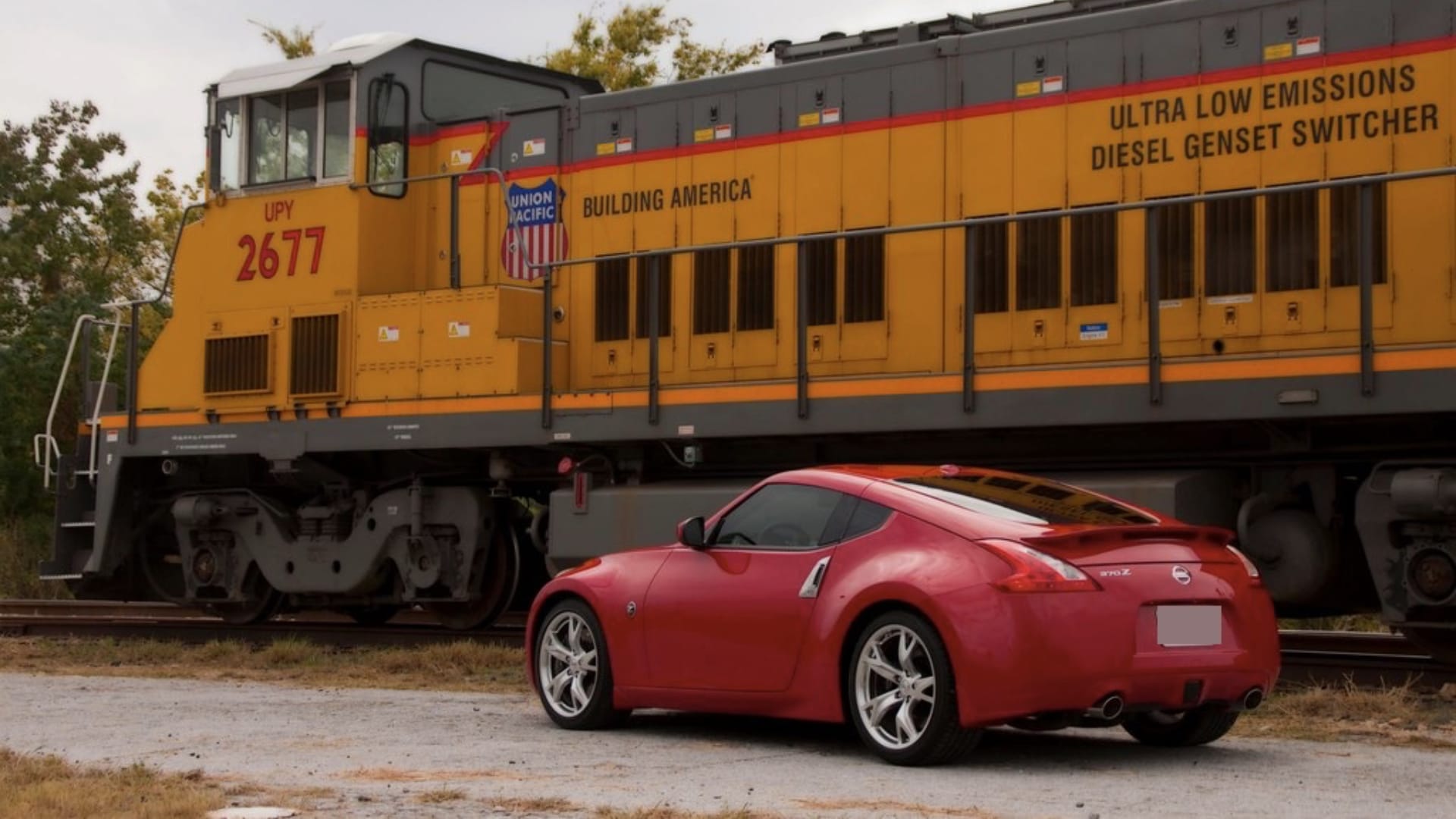
📸 Photo Description
This image shows a big yellow and orange train (called a locomotive) next to a small red car. The train is much heavier and bigger than the car, and both vehicles have engines that use energy to move. You can see that pushes and pulls from engines make these vehicles go fast or slow down the tracks and roads.
🔬 Scientific Phenomena
Anchoring Phenomenon: How do big and small vehicles move using different amounts of energy?
This image illustrates the fundamental concept that all moving objects need a force (push or pull) to start moving, speed up, slow down, or change direction. The locomotive engine creates a powerful push that pulls heavy cargo down the tracks, while the car's engine creates a smaller push that moves the lighter vehicle down the road. Both vehicles demonstrate that energy from fuel (diesel for the train, gasoline for the car) is converted into motion through mechanical forces. The different sizes and weights of these vehicles show that it takes different amounts of force to move objects of different masses—a key principle in understanding motion and energy.
📚 Core Science Concepts
• Forces and Motion: A push or pull from an engine makes vehicles move. Bigger pushes can move heavier things; smaller pushes move lighter things.
• Energy Conversion: The diesel fuel in the train's engine and gasoline in the car's engine contain stored energy that is released and transformed into motion (kinetic energy) and heat.
• Mass and Force Relationship: The heavy train needs a much stronger force (more powerful engine) to move than the lighter car needs, showing that heavier objects require greater forces to create motion.
• Direction and Speed: Forces can make objects go faster, slower, or change direction—the locomotive moves forward on its tracks, and the car moves forward on the road.
Pedagogical Tip:
For Kindergarten, focus on the observable, hands-on experience of pushes and pulls rather than the abstract concept of energy. Use the image to prompt physical demonstrations: "Show me how you would push a toy car. Now show me how you would push a heavy box. Is one push harder than the other?" This concrete approach helps students internalize the relationship between force and motion before introducing energy concepts.
UDL Suggestions:
Provide multiple means of engagement by allowing students to explore pushes and pulls through kinesthetic activities (actually pushing toy cars and blocks). Use visual supports by pointing to the train's engine and asking "Where is the force coming from?" Use multiple means of representation by showing both static images and, if possible, a short video of a train moving so students can see motion in action. For students with motor skill challenges, allow them to observe peers or use adaptive switches to trigger toy vehicles.
🔍 Zoom In / Zoom Out Concepts
Zoom In - Molecular/Atomic Level:
Inside the diesel fuel and gasoline are tiny particles (molecules) that are held together by chemical energy. When the engine burns this fuel, the bonds between these molecules break apart, releasing energy as heat and motion. This combustion process happens in tiny cylinders inside the engine, where fuel ignites and creates explosions that push pistons back and forth—these pushes are then transferred to the wheels to create motion.
Zoom Out - Transportation Systems & Infrastructure:
This image represents part of a larger human transportation network. Trains and cars are both part of how people and goods move across communities, states, and countries. Trains typically move heavy cargo long distances on tracks with less resistance, while cars move people and lighter loads on roads. Together, these vehicles are part of an interconnected system that relies on energy resources (fossil fuels), infrastructure (tracks and roads), and mechanical engineering to function. Understanding how individual vehicles work (pushes, pulls, forces) helps us understand how entire transportation networks move goods and people efficiently.
🤔 Potential Student Misconceptions
Misconception 1: "The bigger vehicle will always go faster."
Clarification: Size and speed are not the same thing. While the train is bigger and heavier, it may move slower than the car depending on how much force (engine power) each has. A heavy truck with a small engine might go slower than a light car with a powerful engine. Speed depends on the balance between the force applied and the weight of the object.
Misconception 2: "Vehicles move because they have wheels."
Clarification: Wheels help vehicles roll easily, but wheels alone don't create motion. The engine creates a pushing force that makes the wheels turn. Without an engine pushing, wheels wouldn't move. Students should understand that the force (push/pull) from the engine is what causes motion, and wheels are just the tool that helps that motion happen smoothly.
Misconception 3: "Bigger things need bigger pushes, but it doesn't matter how much bigger."
Clarification: The relationship between an object's mass and the force needed to move it is proportional and measurable. A train weighing 100 tons needs a much, much stronger engine than a car weighing 1 ton. This introduces the foundational idea that heavier objects require proportionally greater forces to achieve similar accelerations.
🎓 NGSS Connections
K-PS2-1: Plan and conduct an investigation to compare the effects of different strengths or different directions of pushes and pulls on the motion of an object.
- A push or pull affects how an object moves or whether it moves.
-
K-PS2-2: Analyze data to determine if a design solution works as intended to change the speed or direction of an object with a push or a pull.
- There are different kinds of motion: straight-line motion, zig-zag motion, and rotating motion of objects; people are also lookers.
-
K-PS3-1: Make observations to determine the effect of sunlight on Earth's surface.
- Sunlight warms Earth's surface.
-
(Note: While this standard focuses on sunlight, the train in the image displays reflective surfaces that show how light interacts with materials—a precursor to understanding energy transfer.)
K-PS3-2: Use tools and materials to design and build a structure that will reduce the warming effect of sunlight on an area.
- People design and build structures to provide shelter or shade.
-
💬 Discussion Questions
- "What makes the train move down the tracks?" (Bloom's: Understand | DOK: 1)
This basic recall question helps assess foundational understanding of force.
- "Why do you think the train's engine has to be much stronger/bigger than the car's engine?" (Bloom's: Analyze | DOK: 2)
This question prompts students to think about the relationship between mass, force, and motion.
- "If we wanted to make the car go faster, what could we do?" (Bloom's: Apply | DOK: 2)
Students apply their understanding of pushes/pulls to a hypothetical scenario.
- "How are the train and the car the same? How are they different in terms of moving?" (Bloom's: Evaluate | DOK: 3)
This question encourages higher-order thinking about how different vehicles use forces and energy.
📖 Vocabulary
- Force: A push or pull that makes something move, stop, or change direction.
- Motion: When something moves or changes position from one place to another.
- Engine: The part of a vehicle that uses fuel to create the power (force) needed to make it move.
- Speed: How fast or slow something is moving.
- Energy: The power to make things move or change; it comes from fuel like gasoline and diesel.
- Locomotive: A very large, powerful train engine that pulls heavy cars and cargo along railroad tracks.
🌡️ Extension Activities
Activity 1: Push and Pull Investigation Station
Set up stations with toy cars, blocks, and ramps. Give students different toy vehicles (light cars, heavier trucks) and have them push each one with the same amount of force. Ask: "Which one moves faster? Which one is harder to push?" Students collect observations and create a simple chart (with pictures or marks) showing which objects moved far, medium, or short distances. This directly connects to K-PS2-1.
Activity 2: Design a "Fast Track" Challenge
Provide students with toy cars, cardboard tubes, blocks, and ramps. Challenge them to design a track or ramp that makes their car go as fast or as far as possible using only gravity (a ramp-based push). Have them predict, test, and observe how the angle or height of the ramp changes the car's speed and distance traveled. Students record observations through drawings or photos.
Activity 3: Engine Sound and Vibration Exploration
If possible (safely and with parental consent), take a short virtual or real-world field trip near a train track or road to observe vehicles at a distance. Have students listen to the sounds and feel vibrations from moving vehicles. Discuss: "What do you hear? What do you feel? That energy and force is what makes big vehicles move." Create a "Sound Map" where students draw or mark where they felt or heard the most energy/vibration.
🔗 Cross-Curricular Ideas
Math: Create a simple comparison graph showing the size and weight of different vehicles. Use measuring tools to measure toy cars and the lengths of tracks. Count: "How many toy cars equal the length of the train?" This reinforces measurement, comparison, and data organization.
ELA/Literacy: Read picture books about trains and vehicles (see resources below). Have students dictate or draw stories about where the train or car is going and what forces make them move. Create a "Word Wall" with action words (push, pull, fast, slow, move, stop) and have students act them out dramatically.
Social Studies: Discuss how trains and cars help people in our community. Where do trains go? Who rides or drives them? Why do we need different types of vehicles? Connect to community helpers (engineers, mechanics, train operators) and how transportation moves people and goods.
Art: Have students create colorful collages or paintings of trains and cars, paying attention to bright colors and details. Discuss how the yellow and orange of the locomotive helps people see it from far away (safety connection to forces and motion in real-world contexts).
🚀 STEM Career Connection
- Mechanical Engineer — Designs things that move — engines, turbines, joints and gears — and works out the forces on them.
- Try it: Design and build a simple lever using a ruler and a pencil to lift a small object, then test how the position of the fulcrum affects the effort needed. (Practice: Constructing Explanations and Designing Solutions)
- Tools: CAD software, 3D printers, force sensors, wind tunnels
- Where they work: engineering firms, factories, design studios, research labs
- Meet one: Shini Somara — How air and water flow around things, worked out on a computer before anything is built.
- Median pay: /year — "Mechanical engineers"
- Physicist — Works out the rules that matter and energy follow, from the very small to the whole universe.
- Try it: Roll a ball across the floor and observe how its motion changes when it hits a wall or another object. (Practice: Constructing Explanations and Designing Solutions)
- Tools: lasers, detectors, vacuum chambers, computer simulations
- Where they work: research laboratories, particle accelerators, observatories, universities
- Meet one: Chanda Prescod-Weinstein — Dark matter — the invisible material that makes up most of the universe.
- Median pay: /year — "Physicists"
Wage figures are median annual wages for the U.S. occupation named after each one, from the U.S. Bureau of Labor Statistics, Occupational Employment and Wage Statistics (OEWS), national, May 2025. Several careers share one occupation, so their figures match.
---
This lesson plan connects observable phenomena (real vehicles moving) to foundational physical science concepts (forces, motion, and energy) in ways that are developmentally appropriate, engaging, and aligned with NGSS K-PS standards.