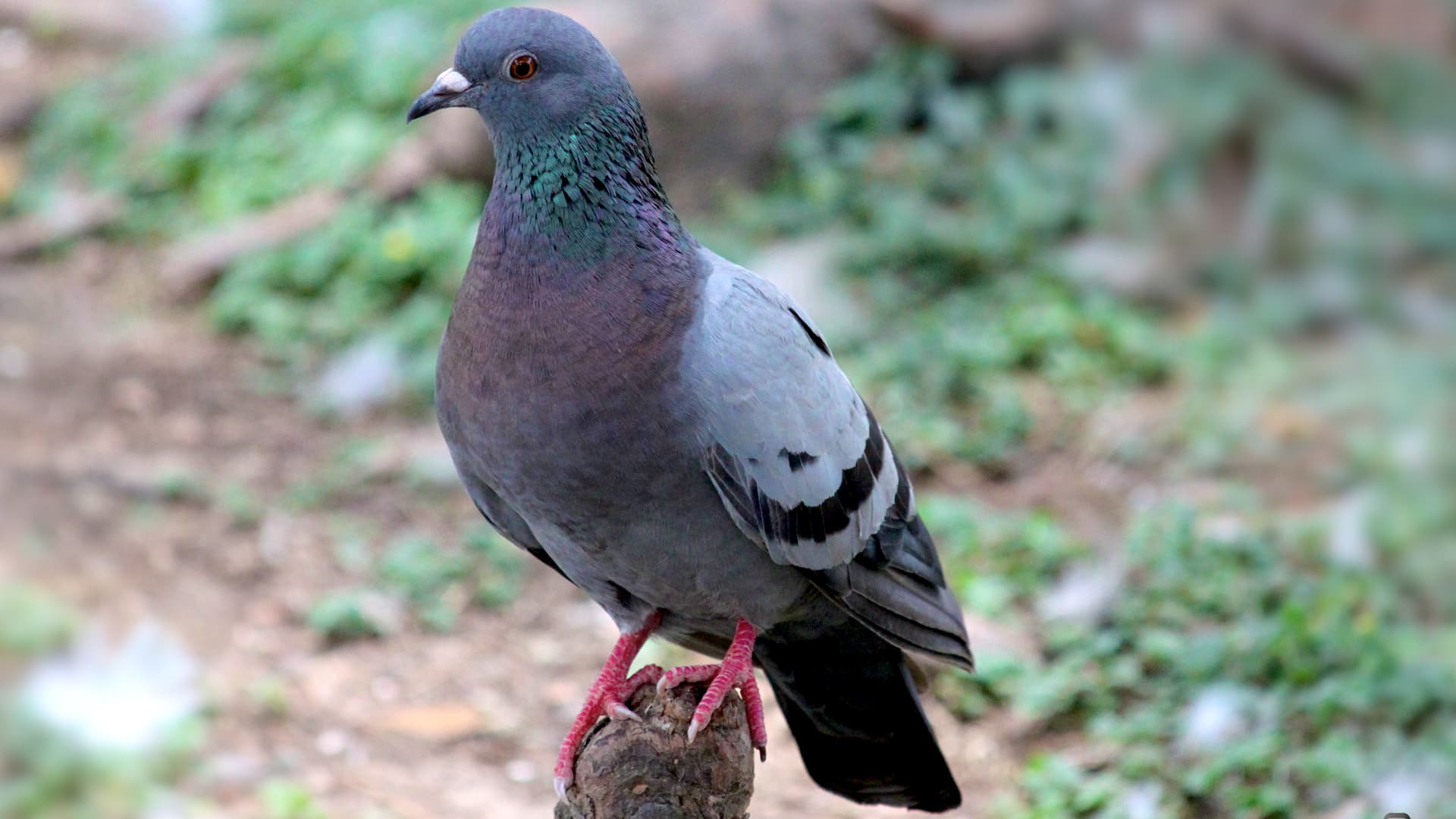
📸 Photo Description
This photograph shows a pigeon standing on the ground. The pigeon has a round body covered in feathers, a small head with a bright eye, and thin legs with red feet. We can see its wings folded against its body and its tail feathers. This is a bird—an animal that lives in our neighborhoods and cities.
🔬 Scientific Phenomena
Anchoring Phenomenon: Why do birds have feathers, feet, and wings?
Birds like this pigeon have special body parts that help them live in their environment. Feathers keep birds warm and dry and help them move through the air. Their legs and feet are designed for standing, walking, and perching on surfaces. Their wings allow them to fly or balance their bodies. These features exist because birds have adapted over time to survive in their specific habitats. This pigeon, in particular, has adapted to living around humans in cities and towns, where it finds food and shelter.
📚 Core Science Concepts
- Body Structures and Their Functions: Birds have specific body parts (feathers, wings, feet, beaks) that help them survive. Each structure has a job—feathers for warmth and waterproofing, wings for flight, feet for balance and gripping.
- Living Organisms Need Specific Things to Survive: This pigeon needs food, water, shelter, and air to stay alive. Its body parts help it find and use these resources.
- Patterns in Nature: All birds share similar features (feathers, wings, beaks, feet), but different birds may look different based on where they live and what they eat.
- Adaptation: This pigeon's gray coloring and ability to eat seeds and breadcrumbs from the ground help it survive in human environments like cities and parks.
Pedagogical Tip:
When teaching Kindergarteners about bird body structures, invite them to act out what each body part does. Have them flap their arms like wings, walk like the pigeon walks, and move their heads to show how birds look around. Kinesthetic experiences help young learners internalize biological concepts. Avoid overly technical language; use words like "helps the bird" and "keeps the bird safe and warm" instead of complex anatomical terms.
UDL Suggestions:
For Universal Design for Learning, provide multiple means of representation: (1) Show the image clearly and point out different body parts with a pointer or your finger; (2) Use real feathers (ethically sourced or molted) for students to touch and feel; (3) Provide a simple labeled diagram showing the pigeon's main body parts (head, wings, feet, tail); (4) Offer a video clip of pigeons moving to show how their body parts work in action. This multi-sensory approach supports learners with different processing styles and abilities.
🔍 Zoom In / Zoom Out Concepts
Zoom In — Cellular Level:
If we could look very closely at the pigeon's feathers under a microscope, we would see tiny structures called barbs and barbules. These tiny pieces lock together like a zipper, trapping air between them. This air layer keeps the bird warm and helps water roll off. The pigeon's skin underneath the feathers is also special—it has glands that produce oil to waterproof the feathers further.
Zoom Out — Ecosystem Level:
The pigeon is part of a larger community of living things in cities and towns. It shares its habitat with humans, insects, plants, other birds, and small mammals. The pigeon eats seeds from plants and scraps left by people. Pigeons also become food for predators like hawks and falcons. The pigeon's presence affects the ecosystem—it spreads seeds in its droppings and can crowd out other bird species when there are many pigeons in one area.
🤔 Potential Student Misconceptions
- Misconception: "Birds are not animals because they have feathers instead of fur."
- Clarification: Birds ARE animals! Animals can have different types of skin coverings. Some animals have fur (like dogs), some have scales (like snakes), and some have feathers (like pigeons). Feathers are just a different kind of skin covering that helps birds stay warm and dry.
- Misconception: "All birds can fly really high and far."
- Clarification: While this pigeon can fly, not all birds fly the same way. Some birds, like pigeons, fly medium distances. Other birds, like chickens, fly only short distances or stay mostly on the ground. Some birds, like penguins, cannot fly at all. Different birds have different abilities based on their body shape and where they live.
- Misconception: "Birds don't need to eat or drink like we do."
- Clarification: Birds are living things just like us! They need food, water, and air to survive. This pigeon eats seeds and breadcrumbs and drinks water from puddles or fountains. Without these things, the bird cannot live.
🎓 NGSS Connections
K-LS1-1: Use observations to describe patterns of what plants and animals (including humans) need to survive.
This standard is directly addressed through observation of the pigeon's body structures and how they help the bird meet its survival needs (finding food with its eyes and beak, staying warm with feathers, moving with legs and wings, and perching with feet).
Disciplinary Core Idea Connection: - All animals need food in order to live and grow. They obtain their food from plants or other animals. Plants need water and light to grow.
Crosscutting Concepts:
- - Students observe the pattern that all birds share similar body structures (feathers, wings, beaks, feet).
- - Students understand that the pigeon's feathers, wings, feet, and beak each have specific jobs that help the bird survive.
💬 Discussion Questions
- What body parts do you see on this pigeon, and what do you think each part helps the bird do? (Bloom's: Analyze | DOK: 2)
- Why do you think this pigeon has feathers instead of fur like a puppy? (Bloom's: Evaluate | DOK: 3)
- What does this pigeon need to eat, drink, and where might it sleep at night? (Bloom's: Apply | DOK: 2)
- If you could give this pigeon a superpower to help it survive, what would it be and why? (Bloom's: Create | DOK: 3)
📖 Vocabulary
- Feathers: Soft, light coverings on a bird's body that keep it warm and dry and help it fly.
- Bird: An animal with feathers, wings, a beak, and legs that lays eggs.
- Wings: Body parts that birds use to fly through the air.
- Beak: The hard, pointed mouth part of a bird used to pick up food.
- Adapt: To change or adjust your body or behavior to survive in your home.
- Habitat: The place where an animal lives and finds food, water, and shelter.
🌡️ Extension Activities
- Feather Exploration Station: Bring in real feathers (ethically sourced or naturally molted) for students to examine, touch, and hold. Ask them to describe what the feathers feel like (soft, smooth, light). Invite them to gently blow on the feathers to feel how light they are. Discuss why light feathers help birds fly.
- Bird Movement Scavenger Hunt: Take students outside to a safe area where pigeons or other birds might be visible. Ask them to observe and describe (or act out) how birds move: how they walk, how they turn their heads, how they peck at food. Create a simple class chart showing "What We Saw Birds Do."
- Create a Bird Needs Poster: Provide students with pictures of food, water, shelter, and air to glue onto a large poster titled "What Birds Need to Live." Use the pigeon photo as your example. Discuss how the pigeon finds each of these things in the city (breadcrumbs for food, puddles for water, building ledges for shelter).
🔗 Cross-Curricular Ideas
- Mathematics: Count the pigeons if multiple birds are visible in photos. Practice one-to-one correspondence by matching feathers (real or paper) to different numbers. Sort bird pictures by size or color.
- English Language Arts: Read aloud simple stories about birds (see Suggested Books below). Ask students to retell the story using props or act it out. Create a class list of describing words for pigeons (gray, round, small, fast).
- Social Studies: Discuss where pigeons live in your city or town. Take a neighborhood walk to spot birds and their habitats. Introduce the concept of "city animals" versus "farm animals" or "forest animals." Discuss how humans and birds share spaces.
- Art: Draw or paint pigeons using real feathers as inspiration. Provide gray, blue, and purple paint to match the pigeon's colors. Create a collage using torn paper to show feathers, or use cotton balls to represent fluffy feathers. Display student artwork alongside the pigeon photo.
🚀 STEM Career Connection
- Biologist — Studies living things of every kind and what keeps them alive.
- Try it: Draw a pigeon and label its body parts, then write a sentence about how each part helps it survive. (Practice: Analyzing and Interpreting Data)
- Tools: microscopes, sample jars, measuring tools, a field notebook
- Where they work: laboratories, field sites, museums, universities
- Meet one: Sandra Díaz — What a plant's leaves, wood and shape tell you about how it lives — and how those traits add up across a whole ecosystem.
- Median pay: /year — "Biological scientists, all other"
- Conservation Biologist — Works out which plants and animals are in trouble, and what would help them recover.
- Try it: Compare the traits of a pigeon to another bird that lives in a very different environment and explain why those traits are important. (Practice: Analyzing and Interpreting Data)
- Tools: population surveys, GPS trackers, habitat maps, trail cameras
- Where they work: nature reserves, conservation charities, government agencies, universities
- Meet one: Tierra Curry — Which plants and animals are closest to disappearing, and what it takes to save them.
- Median pay: /year — "Zoologists and wildlife biologists"
Wage figures are median annual wages for the U.S. occupation named after each one, from the U.S. Bureau of Labor Statistics, Occupational Employment and Wage Statistics (OEWS), national, May 2025. Several careers share one occupation, so their figures match.