📸 Photo Description
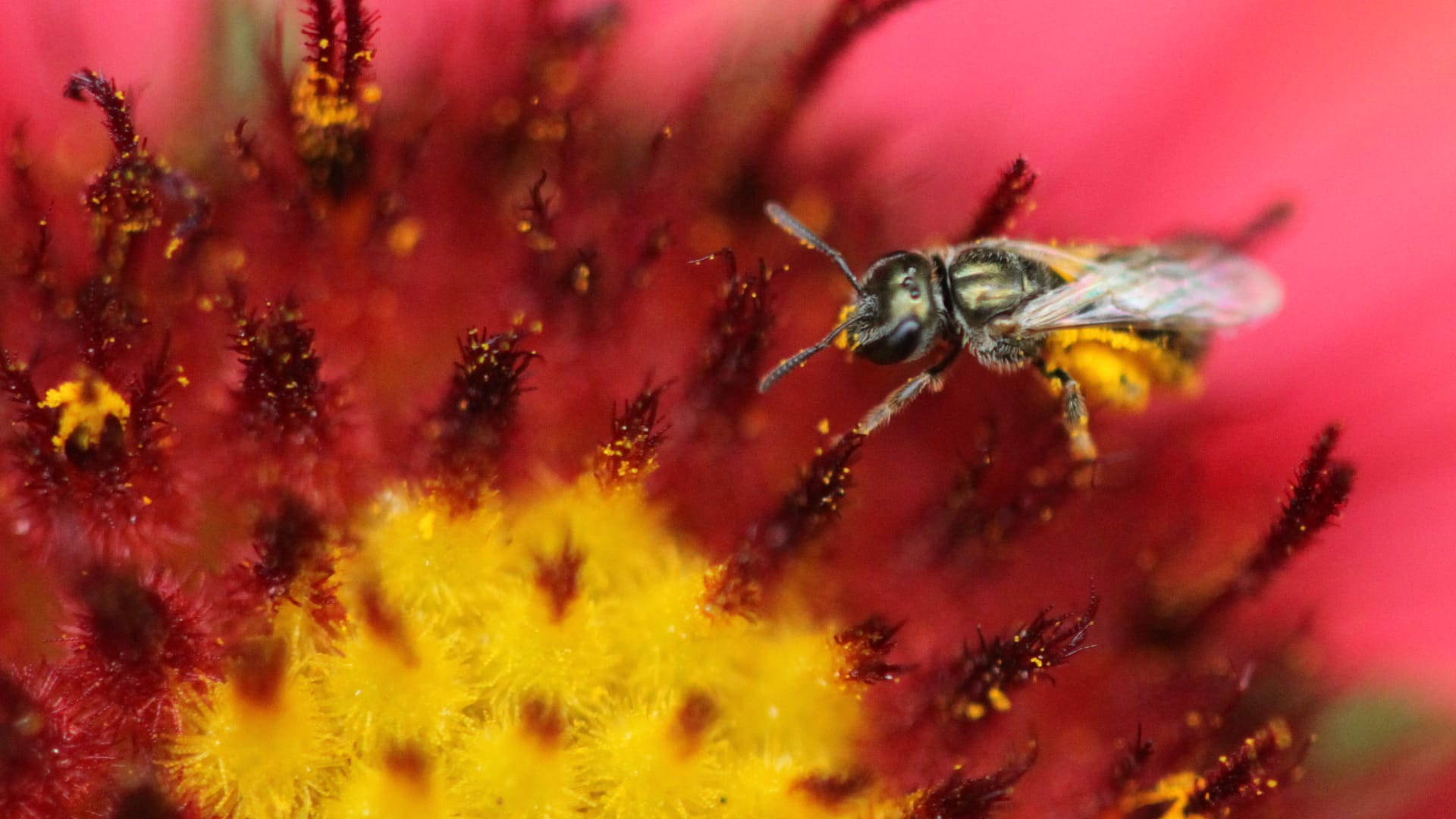
A fuzzy bee with yellow pollen on its back is visiting a bright red and yellow flower. You can see the bee's big eyes and hairy body, and the flower has lots of tiny yellow dust on it. The bee is collecting food from the flower while getting pollen all over itself.
🔬 Scientific Phenomena
Anchoring Phenomenon: Pollination through a bee-flower relationship
This image shows a symbiotic relationship where the bee and flower help each other survive. When the bee visits the flower to drink sweet nectar (food), pollen sticks to its fuzzy body. As the bee moves to the next flower, pollen falls off and helps make seeds. The bee gets food it needs to live, and the flower gets help making babies (seeds). This is an example of how living things in nature depend on each other!
📚 Core Science Concepts
- Living things have basic needs: Bees need food (nectar) to survive, and flowers need pollen to spread and make new plants.
- Animals and plants depend on each other: Bees help flowers make seeds by moving pollen from flower to flower. Flowers give bees food. They work together!
- Body parts help organisms get what they need: The bee's fuzzy body is perfect for carrying pollen. The flower's bright colors and sweet nectar attract bees.
- Patterns in nature: Bees visit many flowers. Flowers bloom when bees are active. These patterns help both the bee and flower survive.
Pedagogical Tip:
When teaching pollination to Kindergarteners, avoid complex vocabulary like "reproduction" and "pollinator." Instead, use simple story language: "The bee is helping the flower make baby plants!" Use hand motions (pretend to be a bee visiting flowers) to help students understand the back-and-forth relationship. Concrete, observable actions are more meaningful than abstract concepts at this age.
UDL Suggestions:
Multiple Means of Engagement: Set up a sensory flower station where students can observe real flowers and touch fuzzy materials (like pipe cleaners) to understand how pollen sticks. This tactile experience supports diverse learners.
Multiple Means of Representation: Use picture cards showing the bee → flower → bee sequence. Read the story with animated voices and movements. Create a simple diagram showing pollen transfer using yarn and pictures.
Multiple Means of Action/Expression: Allow students to show understanding by drawing, acting out the bee-flower dance, or arranging picture cards in order rather than only answering oral questions.
🔍 Zoom In / Zoom Out Concepts
Zoom In (Microscopic): If we could shrink down super tiny, we'd see pollen grains—millions of them—sticking to the bee's hair. Each pollen grain is like a tiny seed that contains male plant cells. These invisible pollen grains travel inside the bee's fuzzy coat and create new plants. At the flower level, we'd see the sticky part of the flower (stigma) that catches the pollen grains.
Zoom Out (Ecosystem): In the wider garden or meadow, many bees visit many flowers. This relationship happens everywhere in nature—in gardens, forests, and fields. Without bees moving pollen, plants wouldn't make seeds and fruit. Without flowers giving nectar, bees wouldn't have food. This bee-flower partnership is part of a bigger web of life where animals, plants, and insects all depend on each other to survive. Birds eat seeds, herbivores eat plants grown from these seeds, and the cycle continues!
🤔 Potential Student Misconceptions
- Misconception: "The bee is stealing food from the flower, and the flower doesn't like it."
- Clarification: The bee and flower are friends! The bee gets food it needs to live. The flower gets help making baby plants. Both of them benefit. It's a helpful relationship, not a harmful one.
- Misconception: "The yellow dust on the bee is just dirt or mess."
- Clarification: That yellow dust is pollen—it's very special! Pollen helps flowers make seeds. When pollen gets on the next flower, it helps that flower grow babies (seeds and fruit). The pollen is the most important thing the bee carries!
- Misconception: "Flowers make food for us; bees just eat it and waste it."
- Clarification: The sweet juice in flowers (nectar) is food for the bee. The bee needs it to have energy to fly and live. The bee doesn't waste it—the bee uses it just like you use lunch to grow and play!
🎓 NGSS Connections
K-LS1-1: Use observations to describe patterns of what plants and animals (including humans) need to survive.
- This standard directly applies because students observe that bees need nectar (food) and flowers need pollen moved to make seeds. Both organisms have survival needs that are met through their relationship.
Disciplinary Core Ideas:
- All animals need food, water, and air to grow and survive. Plants need water and light. (The bee needs nectar from the flower; the flower needs pollen moved by the bee)
Crosscutting Concepts:
- Students observe the pattern: bee visits flower → pollen sticks → bee carries pollen → next flower gets pollen. This repeating pattern helps both organisms survive.
- The cause is the bee visiting the flower for food. The effects are: pollen sticks to the bee, and the flower gets help making seeds.
💬 Discussion Questions
- What do you think the bee is doing at the flower? (Bloom's: Remember | DOK: 1)
- Why do you think the bee has yellow dust all over it? What might happen when it visits the next flower? (Bloom's: Infer | DOK: 2)
- How do the bee and flower help each other? Can you name one thing each one gets from the other? (Bloom's: Analyze | DOK: 2)
- If there were no bees visiting flowers, what do you think would happen to the flowers? (Bloom's: Evaluate | DOK: 3)
📖 Vocabulary
- Pollen: Yellow dust from flowers that helps make new plants and sticks to a bee's fuzzy body.
- Nectar: Sweet juice inside flowers that bees drink for food and energy.
- Pollination: When pollen moves from one flower to another, usually by a bee or other animal, to help make seeds.
- Bee: A fuzzy insect with wings that flies from flower to flower, drinks nectar, and helps plants make seeds.
- Flower: The colorful part of a plant that makes seeds and has sweet juice (nectar) to attract bees and other animals.
- Survive: To stay alive by getting the food, water, and air you need.
🌡️ Extension Activities
Activity 1: Bee and Flower Dance
Students work in pairs—one is a bee, one is a flower. The bee "flies" around the classroom, and the flower stands still. When they meet, the bee gently touches the flower, and we sprinkle colorful confetti or paper bits on the bee to represent pollen. Then the bee flies to another flower and shakes off some "pollen." This kinesthetic activity helps students embody the pollination process.
Activity 2: Make a Flower with Real Pollen
Bring in real flowers (daisies, sunflowers, or lilies work well). Let students gently examine the flower's center and notice the yellow pollen. Using a small paintbrush, have students gently brush pollen from one flower's center to another's. They can observe how sticky and light the pollen is. Discuss: "Why does pollen stick to a bee's fuzzy body?"
Activity 3: Sensory Bee and Flower Station
Set up a discovery table with: pictures of bees and flowers, real flower samples (or pictures), fuzzy pipe cleaners or yarn (to represent bee fur), small pompoms painted yellow (to represent pollen), and construction paper flowers. Students can arrange the materials, stick pollen onto the fuzzy bee, and move it to the next flower.
🔗 Cross-Curricular Ideas
- Math: Count the number of flowers a bee visits in a picture sequence. Create simple addition problems: "If one bee visits 2 flowers and another bee visits 3 flowers, how many flowers did they visit together?" Graph student observations of favorite flower colors.
- ELA: Read The Bee Tree by Patricia Polacco or act out a simple bee-flower story with repeated phrases: "Buzzzz, buzzzz! The bee went to the flower. The bee got pollen. Buzzzz, buzzzz! Off to the next flower!" Create a class innovation on the story where students add their own flowers.
- Art: Create bee and flower collages using tissue paper, paint, and markers. Make a mural showing many bees visiting many flowers. Use the textured materials (fuzzy fabric, sandpaper) to represent the bee's hairy body.
- Social Studies: Discuss how people depend on bees and flowers for food (fruits, vegetables, honey). Take a classroom "nature walk" to observe real flowers, bees (if safe), and discuss what we see. Connect to "helpers in our community"—bees help our gardens and farms!
🚀 STEM Career Connection
- Conservation Biologist — Works out which plants and animals are in trouble, and what would help them recover.
- Try it: Propose a solution to help protect bees if their food sources (flowers) were disappearing. (Practice: Constructing Explanations and Designing Solutions)
- Tools: population surveys, GPS trackers, habitat maps, trail cameras
- Where they work: nature reserves, conservation charities, government agencies, universities
- Meet one: Tierra Curry — Which plants and animals are closest to disappearing, and what it takes to save them.
- Median pay: /year — "Zoologists and wildlife biologists"
- Agricultural Scientist — Works out how to grow more food on the same land without wearing the soil out.
- Try it: Explain how farmers can help ensure there are enough flowers for bees to pollinate their crops. (Practice: Constructing Explanations and Designing Solutions)
- Tools: test plots, soil kits, seed drills, yield monitors
- Where they work: research farms, seed companies, extension services, universities
- Meet one: Segenet Kelemu — How to protect African food crops from disease, and how insects themselves can become food.
- Median pay: /year — "Soil and plant scientists"
Wage figures are median annual wages for the U.S. occupation named after each one, from the U.S. Bureau of Labor Statistics, Occupational Employment and Wage Statistics (OEWS), national, May 2025. Several careers share one occupation, so their figures match.
---
End of Lesson Guide