📸 Photo Description
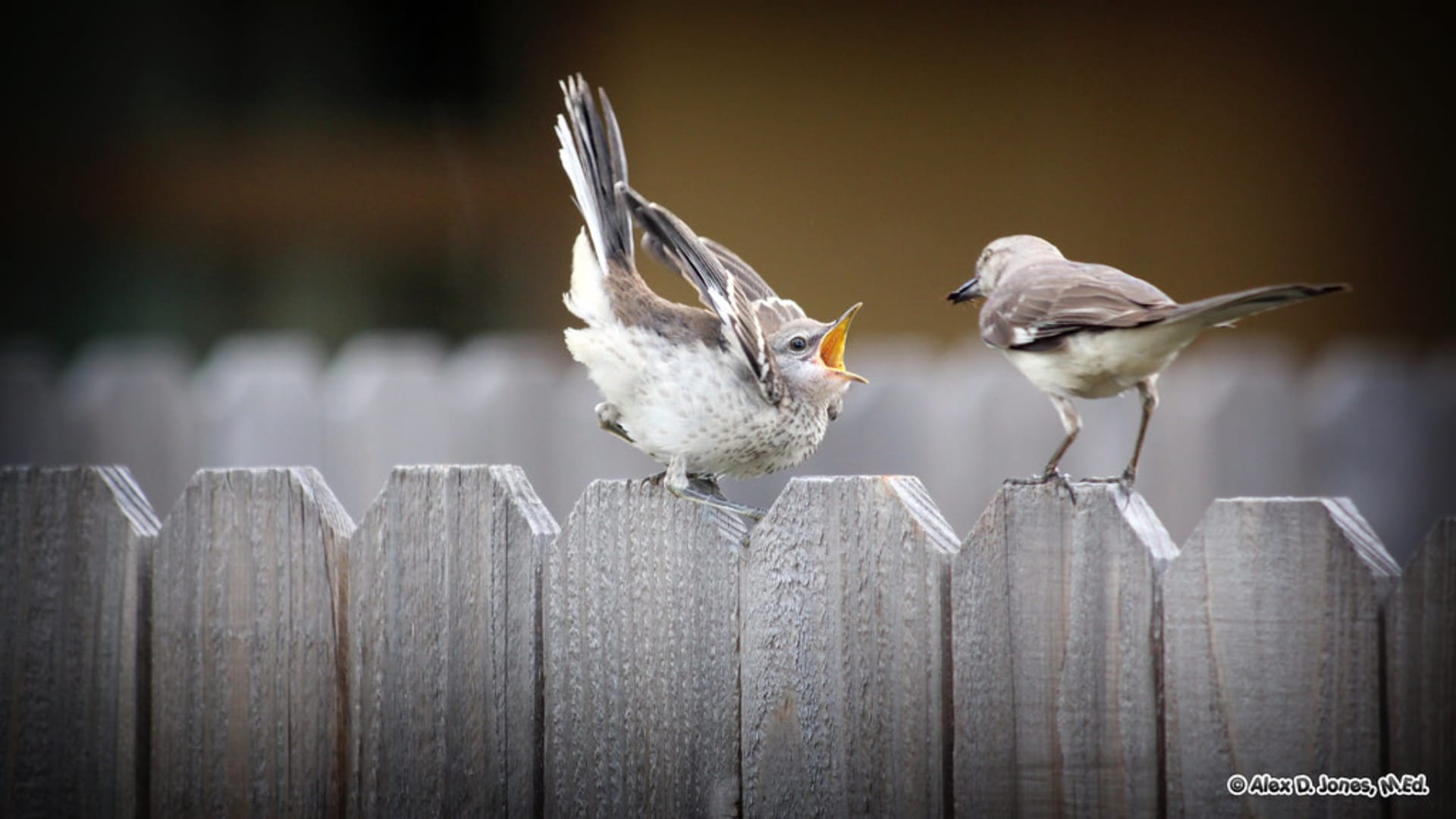
The photo shows two birds on a wooden fence. One bird, likely a young one, has its mouth wide open and wings spread as if calling out. The other bird, possibly an adult, is looking toward the younger bird.
🔬 Scientific Phenomena
This image captures the phenomenon of parental care and communication in birds, specifically a young bird vocalizing for attention and resources from an adult bird. This behavior is driven by the offspring's need for nourishment and protection, and the parent's instinct to provide for its young, ensuring the survival and growth of the next generation.
📚 Core Science Concepts
- Parental Care: Adult birds feed, protect, and care for their young until they are old enough to survive on their own.
- Communication: Young birds communicate their needs, such as hunger, by vocalizing and displaying their bodies. Adult birds respond to these signals.
- Life Cycles: This image is a snapshot of the growth and development stage within a bird's life cycle, where the young are dependent on adults.
*
Pedagogical Tip: Encourage students to observe and record animal behaviors in their schoolyard or local parks. This fosters a sense of scientific inquiry and observation skills.
*
UDL Suggestions: Provide visual aids such as diagrams of bird anatomy or short videos of parent-offspring interactions to support diverse learners.
- Survival Needs: The young bird's loud calls indicate its need for food, a key element for survival and growth.
🔍 Zoom In / Zoom Out Concepts
- Zoom In: Inside the young bird's body, specialized cells in its throat vibrate to create sounds. Its digestive system is working hard to process food it has eaten, or is desperately hoping to eat, to fuel its rapid growth and energy needs.
- Zoom Out: This interaction is part of a larger ecosystem. The birds rely on insects or other food sources in their environment, and their presence impacts the insect population. Their behavior contributes to the continuation of their species within this habitat.
🤔 Potential Student Misconceptions
- Misconception: The birds are fighting.
Clarification: While it might look like an argument, the young bird's open mouth and posture are likely a signal of hunger and a request for food from the adult bird, which is a form of parental care.
- Misconception: All baby birds sound the same.
Clarification: Different bird species have unique calls and vocalizations for communicating with their parents or siblings.
🎓 NGSS Connections
3-LS1-1: Develop models to describe that organisms have unique and diverse life cycles but all have in common birth, growth, reproduction, and death.
1-LS1-2 (Grade 1 — foundational connection): Read texts and use media to determine patterns in behavior of parents and offspring that help offspring survive.
3-LS2-1: Construct an argument that some animals form groups that help members survive.
💬 Discussion Questions
- What do you think the young bird is trying to communicate to the adult bird? (Bloom's: Understand | DOK: 1 | SEP: Obtaining Evaluating and Communicating Information)
- How might the adult bird be responding to the young bird's calls? (Bloom's: Analyze | DOK: 2 | SEP: Constructing Explanations and Designing Solutions)
- What are some reasons why adult birds care for their young? (Bloom's: Analyze | DOK: 2 | SEP: Constructing Explanations and Designing Solutions)
📖 Vocabulary
- Parental Care: The act of adult animals caring for their young, such as feeding and protecting them.
- Offspring: A young organism born from parents.
- Vocalization: Making sounds, especially by animals, to communicate.
- Habitat: The natural home or environment of an animal.
🌡️ Extension Activities
- Bird Feeder Observation: Set up a bird feeder outside the classroom window and have students observe the types of birds that visit, what they eat, and how they interact with each other. They can draw pictures or take notes on their observations.
- Life Cycle Models: Have students create dioramas or drawings depicting the different stages of a bird's life cycle, from egg to adult.
- Bird Call Matching: Play recordings of different bird calls and have students try to identify the birds or match the calls to pictures of birds.
🔗 Cross-Curricular Ideas
- ELA: Read stories or poems about birds and discuss the characters' actions and motivations. Students can also write their own stories from the perspective of a bird.
- Art: Students can draw or paint pictures of birds, focusing on their colors, shapes, and the environment they live in. They can also create sculptures using clay or recycled materials.
- Social Studies: Discuss how different cultures view birds and their symbolism. Research local birds and their importance to the community.
🚀 STEM Career Connection
- Animal Behaviourist — Watches what animals do and works out why they do it.
- Try it: Research and share with the class one example of a specific vocalization a baby animal makes to communicate its needs to its parent. (Practice: Obtaining, Evaluating, and Communicating Information)
- Tools: observation blinds, video recorders, stopwatches, behaviour checklists
- Where they work: zoos, field research stations, farms, universities
- Meet one: Rae Wynn-Grant — Where black bears and people run into each other, and how to keep both safe.
- Median pay: /year — "Zoologists and wildlife biologists"
- Ornithologist — Studies birds — how they fly, what they eat, where they nest, and where they travel.
- Try it: Find a picture of a bird nest and describe the materials used to build it, and how it helps protect the young. (Practice: Obtaining, Evaluating, and Communicating Information)
- Tools: binoculars, spotting scopes, leg bands, sound recorders
- Where they work: wildlife refuges, bird observatories, parks, universities
- Meet one: Corina Newsome — How seaside sparrows in salt marshes lose nests to rising water — nests built higher escape the flooding but become easier for predators to find.
- Median pay: /year — "Zoologists and wildlife biologists"
Wage figures are median annual wages for the U.S. occupation named after each one, from the U.S. Bureau of Labor Statistics, Occupational Employment and Wage Statistics (OEWS), national, May 2025. Several careers share one occupation, so their figures match.