📸 Photo Description
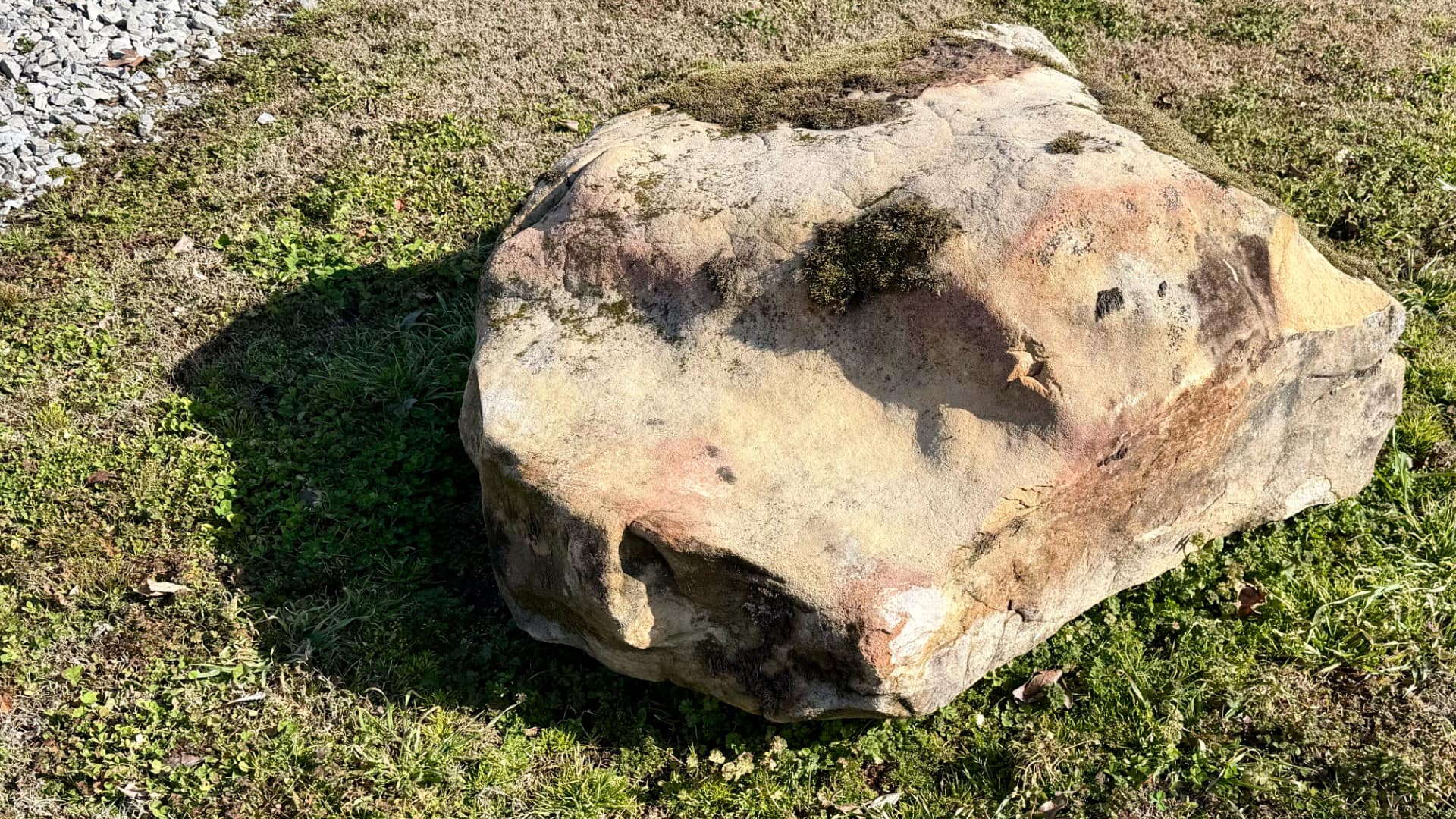
This photograph shows a large, rough boulder sitting on a grassy area. A distinct shadow is cast on the grass next to the boulder. Patches of moss are growing on the surface of the rock, and small pebbles are visible in the upper left corner.
🔬 Scientific Phenomena
The image illustrates the phenomenon of shadows. Shadows are formed when an opaque object, like this boulder, blocks the path of light. The light source, which is the sun in this outdoor setting, is shining from one direction, and the boulder prevents the light from reaching the area behind it, creating a dark shape on the ground.
📚 Core Science Concepts
- Light and Shadow: Light travels in straight lines. When an object blocks light, a shadow is formed on the surface opposite the light source.
- Properties of Objects: Rocks are solid objects that can block light. The size and shape of the shadow depend on the shape of the object and the angle of the light source.
- Cause and Effect: The presence of the boulder (cause) results in the formation of a shadow (effect).
Pedagogical Tip: When discussing shadows, use a flashlight and various objects in a darkened room to allow students to actively manipulate the light source and observe how the shadow changes. This hands-on approach reinforces the cause-and-effect relationship.
UDL Suggestions: Provide visual aids such as diagrams showing light rays and blocked paths to support students who are visual learners. For kinesthetic learners, allow them to physically stand in for the "boulder" and create their own shadows.
🔍 Zoom In / Zoom Out Concepts
- Zoom In: At a microscopic level, light is made of photons, which are packets of energy. When these photons encounter the atoms and molecules of the rock, they are absorbed or reflected, but the rock's density and composition prevent them from passing through, thus creating the shadow.
- Zoom Out: Shadows are a daily phenomenon on Earth, caused by the sun's light interacting with objects on our planet. The changing length and position of shadows throughout the day are patterns that demonstrate Earth's rotation and its orbit around the sun.
🤔 Potential Student Misconceptions
- Misconception: Shadows are "things" that are attached to objects or are a part of the object itself.
Clarification: Shadows are not physical objects; they are areas where light is blocked. They disappear when the light source is removed or when the object is moved out of the light's path.
- Misconception: Shadows have a "mind of their own" and can move independently.
Clarification: Shadows move because the light source (like the sun) or the object casting the shadow is moving. The shadow itself does not have independent movement.
🎓 NGSS Connections
3-PS2-1: Plan and conduct an investigation to provide evidence of the effects of balanced and unbalanced forces on the motion of an object.
K-PS3-1 (Grade K — foundational connection): Make observations to determine the effect of sunlight on Earth's surface.
1-PS4-2 (Grade 1 — foundational connection): Make observations to construct an evidence-based account that objects in darkness can be seen only when illuminated.
💬 Discussion Questions
- What do you observe about the shadow in the picture? (Bloom's: Remember | DOK: 1 | SEP: Obtaining Evaluating and Communicating Information)
- Why do you think the shadow is shaped like it is? (Bloom's: Analyze | DOK: 2 | SEP: Constructing Explanations and Designing Solutions)
- What would happen to the shadow if the sun moved higher in the sky? (Bloom's: Predict | DOK: 3 | SEP: Asking Questions and Defining Problems)
📖 Vocabulary
- Boulder: A very large rock, typically one that has been shaped by weathering and erosion.
- Shadow: A dark area or shape produced by a body coming between rays of light and a surface.
- Light Source: Something that produces light, such as the sun or a lamp.
- Opaque: Not able to be seen through; not transparent.
🌡️ Extension Activities
- Shadow Puppets: Have students create their own shadow puppets using their hands or cutouts and a flashlight against a wall. They can create a "shadow theater" to tell a simple story.
- Shadow Tracing: Take students outside on a sunny day and have them trace the shadows of different objects (e.g., their own bodies, playground equipment) at different times of the day to observe how shadows change.
🔗 Cross-Curricular Ideas
- ELA: Have students write a short story or poem about a shadow, personifying it or describing its journey.
- Art: Students can create artwork using only shadows, by arranging objects to cast specific shadow shapes on paper or by creating shadow rubbings.
- Math: Measure the length of shadows at different times of the day and create simple bar graphs to show the changes.
🚀 STEM Career Connection
- Architect — Designs buildings that work for the people inside and stand up to the weather outside.
- Try it: Design a small shelter that would create the largest possible shadow to keep a toy cool on a sunny day. (Practice: Constructing explanations and designing solutions)
- Tools: CAD software, scale models, site surveys, material samples
- Where they work: architecture practices, construction sites, city planning offices, design studios
- Meet one: Roma Agrawal — How to hold a skyscraper up — she designed the foundations and the spire of the Shard.
- Median pay: /year — "Architects, except landscape and naval"
- Materials Engineer — Chooses and shapes the right material for a job, and tests it until it fails.
- Try it: Test different materials like paper, cardboard, and plastic wrap to see which ones block light the best and create the darkest shadows. (Practice: Constructing explanations and designing solutions)
- Tools: tensile testers, furnaces, microscopes, hardness testers
- Where they work: manufacturing plants, product design firms, testing labs, universities
- Meet one: Ainissa Ramirez — How to make metal stick to glass and ceramics — she invented a solder that does it.
- Median pay: /year — "Materials engineers"
Wage figures are median annual wages for the U.S. occupation named after each one, from the U.S. Bureau of Labor Statistics, Occupational Employment and Wage Statistics (OEWS), national, May 2025. Several careers share one occupation, so their figures match.