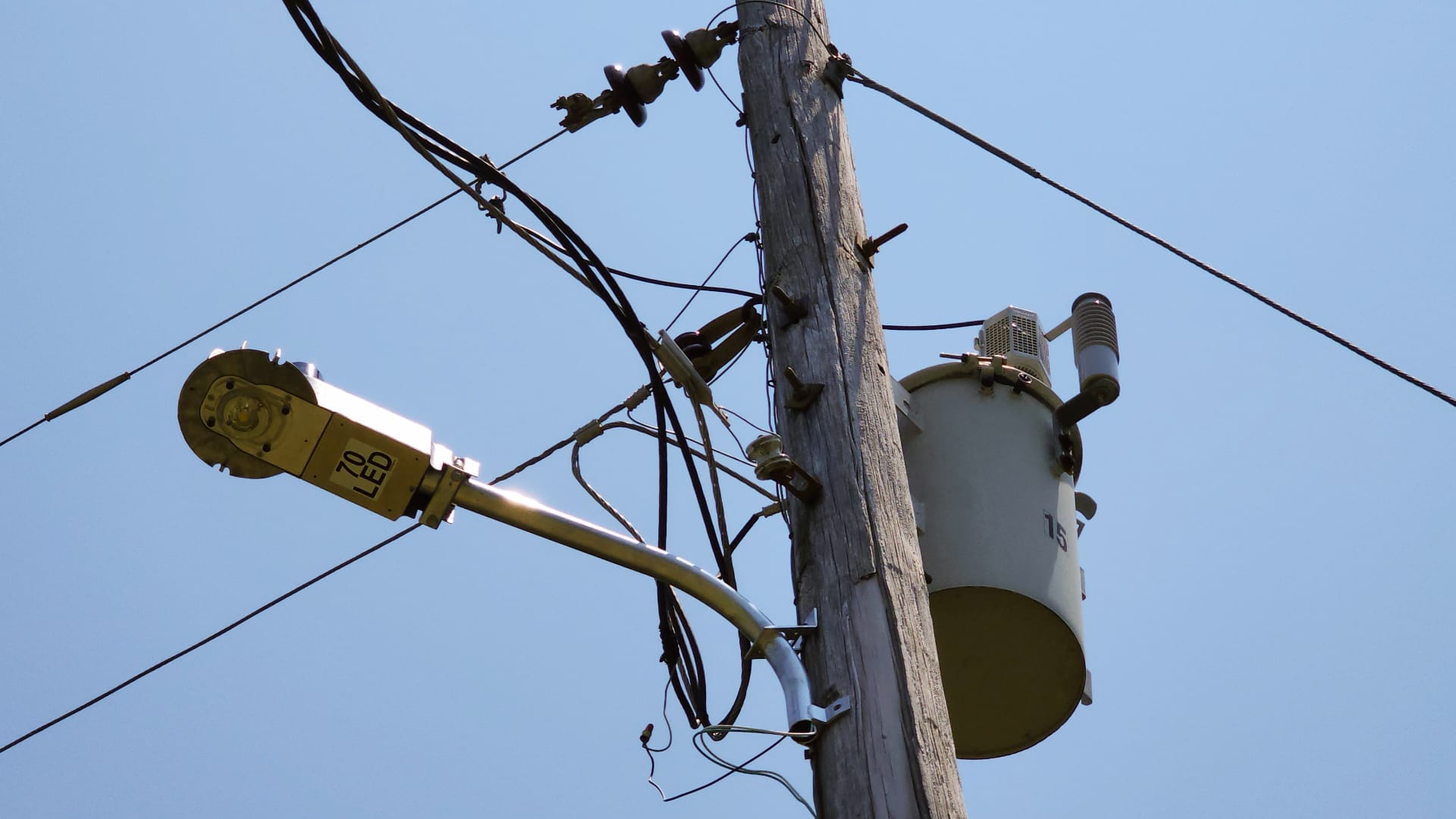
📸 Photo Description
This image shows a tall wooden pole with wires attached to it. The pole holds equipment like a transformer (the large cylindrical tank) and an insulator (the round disc-shaped object) that help bring electricity to homes and buildings. The wires carry invisible electrical energy from far away to the places where we live and work.
🔬 Scientific Phenomena
Anchoring Phenomenon: How does electricity travel from power plants to our homes?
Electricity flows through wires on utility poles to deliver power to buildings. At the power plant, generators create electrical energy by spinning magnets around coils of wire. This energy travels through the transmission lines (the wires) to transformers on poles like this one, which change the voltage so it's safe for homes. The wooden pole serves as a support structure, while insulators (the round ceramic pieces) prevent the electricity from jumping off the wires to the ground or to people who might touch them.
📚 Core Science Concepts
- Energy Transfer: Electricity is a form of energy that moves through wires from where it is made (power plants) to where it is used (homes, schools).
- Pathways & Conductors: Metal wires conduct (carry) electricity safely. The materials matter—copper and aluminum conduct electricity well, while rubber and ceramic do not.
- Safety Through Design: Insulators and transformers are designed to protect people. They keep dangerous electrical currents from touching us.
- Systems & Structure: Poles, wires, and equipment work together as a system to deliver electricity reliably.
Pedagogical Tip:
For Kindergarteners, avoid detailed explanations of voltage or current. Instead, use familiar analogies: "Electricity travels through wires like water flows through pipes. The pole holds up the 'pipes' so electricity can reach your house." Emphasize the safety aspect above all—never touch power lines or poles.
UDL Suggestions:
Representation: Use a large poster or diagram showing a power plant → power lines → home to help visual learners see the "journey" of electricity. Action & Expression: Encourage students to draw or role-play as "electricity traveling through wires" to demonstrate understanding kinesthetically. Engagement: Connect to student experience: "This pole brings electricity to your classroom lights and computer!"
🔍 Zoom In / Zoom Out Concepts
Zoom In (Atomic/Molecular Level):
Inside the metal wires, tiny invisible particles called electrons move very fast. When they move together, that movement is what we call electricity. The metal allows these electrons to move freely, which is why it's a good conductor. Insulators (like rubber) block electrons from moving, keeping them trapped.
Zoom Out (Community/Planetary Systems):
Electricity poles are part of a huge electrical grid—a network of poles, wires, and stations that stretches across cities, counties, and even entire states. Power plants (which might burn coal, use wind, or harness the sun) send electricity through this grid to millions of homes, hospitals, schools, and businesses. Without this interconnected system, modern life would not be possible.
🤔 Potential Student Misconceptions
- Misconception: "Electricity flows out of the wires like water leaks from a pipe, and that's why we see sparks."
- Clarification: Electricity is invisible and stays inside the wires when they're working properly. Sparks only happen when electricity jumps the gap (like during a storm or accident), which is dangerous and why we must never touch power lines.
- Misconception: "The round disc on the pole is the thing that makes electricity."
- Clarification: The transformer and insulators don't make electricity—they help move it safely. Electricity is made at power plants, far away. These pieces help it travel to us.
- Misconception: "If I touch the pole, I'll get electricity."
- Clarification: The wooden pole itself is safe to touch because wood does not conduct electricity. However, the wires and metal equipment are very dangerous, and we should never touch them. The pole is just a holder, like a shelf.
🎓 NGSS Connections
Grade K Performance Expectation:
- K-PS2-1 Plan and conduct investigations to provide evidence that vibrating materials can make sound and that various materials can be used to make different sounds.
- Rationale: While this photo primarily addresses energy, K-PS2-1 connects to understanding how energy moves and changes form.
Relevant Disciplinary Core Ideas:
- Energy can be moved from place to place by sound, light, and electric current.
- Humans use a natural resource (electricity from power plants) to power machines that help them.
Crosscutting Concepts:
- Electricity is a form of energy that flows through systems.
- Power poles are part of a larger electrical system that delivers energy to communities.
💬 Discussion Questions
- "Why do you think the wires are on tall poles instead of on the ground?" (Bloom's: Understand | DOK: 1)
- Expected response: So people don't trip on them / So they're safe / So people can't touch them.
- "Where do you think the electricity comes from before it reaches this pole?" (Bloom's: Analyze | DOK: 2)
- Expected response: A power plant / Far away where they make it.
- "What would happen to our homes and school if these wires didn't work?" (Bloom's: Evaluate | DOK: 2)
- Expected response: No lights / No computers / It would be dark.
- "Why is it dangerous to touch the wires on this pole?" (Bloom's: Understand | DOK: 1)
- Expected response: Electricity could hurt us / We could get shocked.
📖 Vocabulary
- Electricity: Invisible energy that flows through wires and powers lights, computers, and machines in our homes.
- Power Pole (or Utility Pole): A tall wooden or metal post that holds up wires and equipment to carry electricity to towns and homes.
- Wire: A thin metal cord that electricity flows through, like a tiny road for energy.
- Transformer: A big round tank on the pole that changes electricity so it's safe to use in our homes.
- Insulator: A piece of material (like rubber or ceramic) that stops electricity from leaving the wires, keeping it safe.
- Conductor: A material (like metal) that lets electricity flow through it easily.
🌡️ Extension Activities
- "Electricity Path Tracing Walk"
- Take students on a short, supervised outdoor walk to observe power poles in your neighborhood. Ask them to point out the wires, transformers, and insulators. Discuss how electricity travels from far away to reach the school. Safety first: Keep a safe distance and reinforce the "Never touch" rule repeatedly.
- "Build a Simple Circuit Comparison"
- In the classroom, use battery-powered flashlights or simple LED circuits (with teacher supervision) to show how electricity lights a bulb. Explain: "Just like the wires on the pole carry electricity, these wires in our circuit carry electricity to light the bulb. And see—there's a battery like a tiny power plant!"
- "Draw Your Own Power Pole"
- Provide large paper and markers. Students draw their own power poles with wires, transformers, and insulators. Have them draw or cut out pictures of buildings receiving electricity. Create a classroom wall display labeled "Electricity Journey: From Power Plant to Home."
🔗 Cross-Curricular Ideas
- Math: Count the wires, insulators, and pieces of equipment visible on the pole. Sort them by size or color. Measure how tall the pole is using non-standard units (e.g., "as tall as 10 teacher-heights").
- ELA/Literacy: Read picture books about electricity and how it works (see resources below). Have students dictate or write sentences about "What electricity does for me" or "Why we must stay safe around power lines."
- Social Studies: Discuss community helpers like electricians and utility workers who keep the power on and fix broken poles. Talk about how electricity helps the whole community (hospitals, schools, homes).
- Art & Music: Create a collaborative classroom mural showing a full electrical system (power plant, poles, homes, and the sun powering renewables). Use yarn or string to represent wires connecting buildings together.
🚀 STEM Career Connection
- Electrical Engineer — Designs the circuits and systems that move electricity where it is needed.
- Try it: Design and build a model of a power line system using cardboard tubes and string to illustrate energy distribution. (Practice: Developing and Using Models)
- Tools: oscilloscopes, circuit boards, multimeters, simulation software
- Where they work: power companies, electronics firms, research labs, universities
- Meet one: Danielle George — The radio receivers that let giant telescopes hear signals from space.
- Median pay: /year — "Electrical engineers"
- Materials Scientist — Invents and tests new materials — stronger, lighter, or able to do something the old ones could not.
- Try it: Test different materials (like foil, rubber bands, and paper) to see which ones conduct or block a small electrical current from a battery. (Practice: Developing and Using Models)
- Tools: electron microscopes, stress testers, furnaces, X-ray diffractometers
- Where they work: research laboratories, manufacturing companies, national labs, universities
- Meet one: Ainissa Ramirez — How to make metal stick to glass and ceramics — she invented a solder that does it.
- Median pay: /year — "Materials scientists"
Wage figures are median annual wages for the U.S. occupation named after each one, from the U.S. Bureau of Labor Statistics, Occupational Employment and Wage Statistics (OEWS), national, May 2025. Several careers share one occupation, so their figures match.
---
End of Lesson Guide