📸 Photo Description
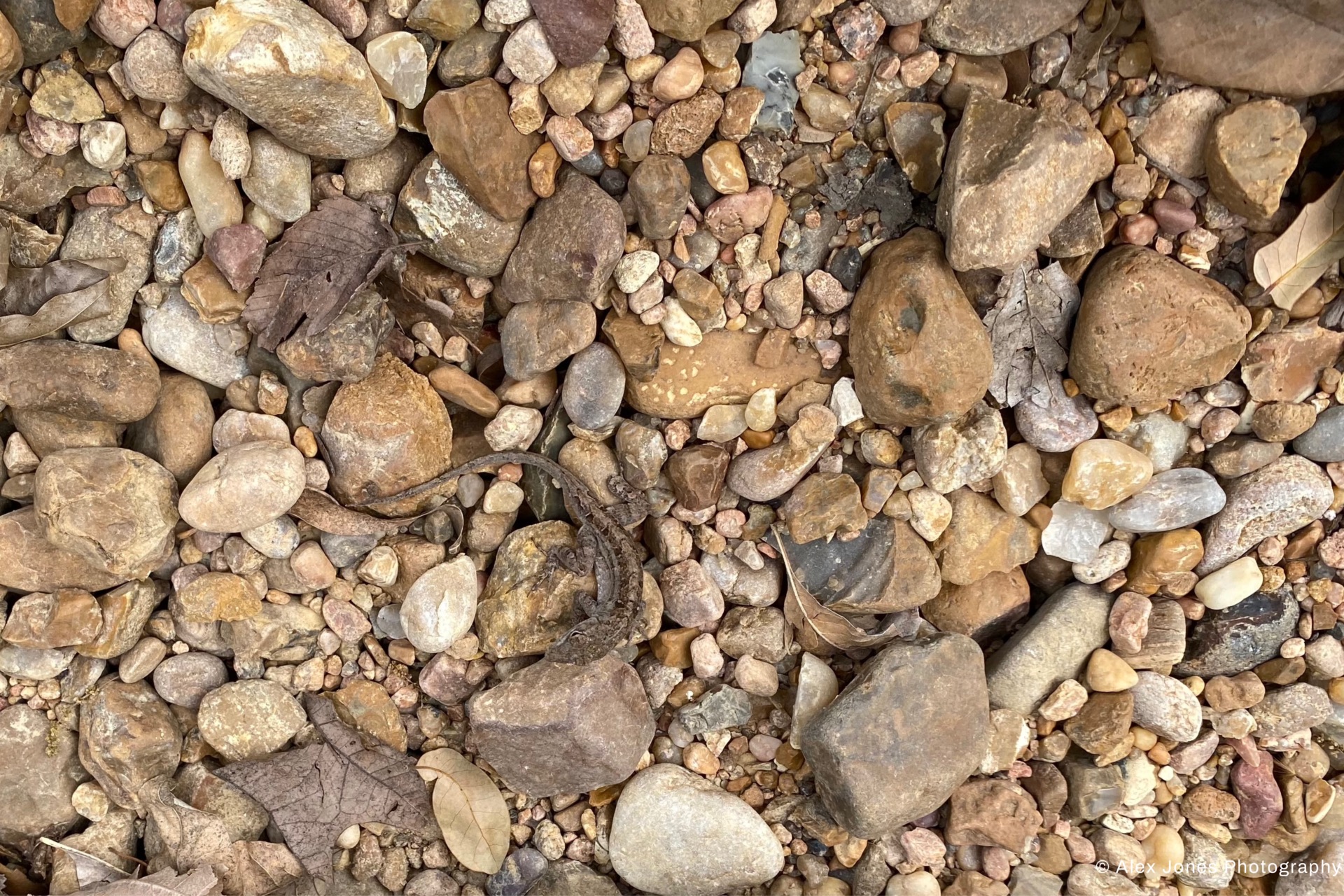
This image shows many rocks, pebbles, and stones of different sizes, colors, and shapes scattered together. Some rocks are smooth and round, while others are rough and bumpy. A snake is camouflaged among the rocks, blending in so well that it's very hard to spot at first glance.
🔬 Scientific Phenomena
The anchoring phenomenon here is camouflage - a survival adaptation where animals blend into their environment to avoid being seen by predators or prey. The snake's coloration, pattern, and texture closely match the surrounding rocks, making it nearly invisible. This happens because over many generations, animals with better camouflage were more likely to survive and pass on their traits to their offspring through natural selection.
📚 Core Science Concepts
- Camouflage as an Adaptation: Animals develop colors, patterns, and behaviors that help them blend into their surroundings for protection and hunting.
- Animal Survival Strategies: Living things have special features called traits that help them meet their basic needs of food, water, shelter, and safety.
- Predator-Prey Relationships: Some animals hunt other animals for food, so prey animals need ways to hide or escape from predators.
- Environmental Matching: Animals that live in specific habitats often have physical features that match their environment.
Pedagogical Tip: Use the "I Notice, I Wonder, It Reminds Me Of" thinking routine when first showing this image. Give students time to really look before revealing there's a hidden animal - this builds observation skills and scientific curiosity.
UDL Suggestions: For students who may have difficulty spotting the camouflaged snake, provide a zoomed-in version or use a pointer to trace its outline. Consider having students work in pairs so they can support each other in making observations.
🔍 Zoom In / Zoom Out Concepts
Zoom In: At the cellular level, the snake's skin contains special cells called chromatophores that contain pigments (colored particles) that create the specific patterns and colors needed for camouflage.
Zoom Out: This camouflage strategy is part of a larger ecosystem where many different animals use various survival strategies - some blend in, others use bright warning colors, and some use speed or size to survive in the rocky desert environment.
🤔 Potential Student Misconceptions
- Misconception: Animals choose to change their colors to hide.
Clarification: Animals are born with camouflage colors and patterns - they don't consciously decide to change them.
- Misconception: All animals that live in the same place look exactly the same.
Clarification: While animals may share similar adaptations for their environment, each species has unique features for their specific needs.
- Misconception: Camouflage always works perfectly.
Clarification: Camouflage helps animals hide but doesn't make them completely invisible - sharp-eyed predators can still spot them.
🎓 NGSS Connections
- Performance Expectation: 3-LS4-3: Construct an argument with evidence that in a particular habitat some organisms can survive well, some survive less well, and some cannot survive at all.
- Disciplinary Core Ideas: - Environmental changes affect organisms and - Variation of traits
- Crosscutting Concepts: and
💬 Discussion Questions
- What advantages does the snake's camouflage give it in this rocky environment? (Bloom's: Analyze | DOK: 2)
- How might this snake's appearance be different if it lived in a grassy meadow instead of rocky ground? (Bloom's: Apply | DOK: 2)
- What other animals can you think of that use camouflage, and how does their camouflage match their habitat? (Bloom's: Remember/Apply | DOK: 1)
- If the rocks in this area changed color over many years, what might happen to the snake population? (Bloom's: Evaluate | DOK: 3)
📖 Science Vocabulary
- Camouflage: When an animal's colors and patterns help it blend in with its surroundings.
- Adaptation: A special trait that helps an animal survive in its environment.
- Predator: An animal that hunts and eats other animals.
- Prey: An animal that is hunted and eaten by other animals.
- Habitat: The natural place where an animal lives and finds everything it needs.
- Trait: A feature or characteristic that an animal has, like color, size, or behavior.
🔗 Cross-Curricular Ideas
- ELA - Descriptive Writing: Have students write or dictate sentences describing the snake using sensory words (rough, bumpy, brown, patterned). They could create a "Found Poem" where they list all the words and colors they observe in the rocky habitat.
- Math - Sorting and Classifying: Students can collect small rocks and sort them by size, color, shape, or texture. They can create graphs showing how many rocks fall into each category, practicing data organization skills.
- Art - Camouflage Collage: Students create their own camouflaged animal by cutting and pasting colored paper onto a background that matches their animal's environment. This reinforces the concept that animals blend in with specific habitats.
- Social Studies - Animal Habitats Around the World: Compare this rocky desert habitat to other habitats (forests, oceans, grasslands) and discuss what animals live in each place and how they're adapted to survive there.
🚀 STEM Career Connection
- Conservation Biologist — Works out which plants and animals are in trouble, and what would help them recover.
- Try it: Imagine an animal that is easy to see and suggest a change to its color or pattern to help it hide. (Practice: Constructing Explanations and Designing Solutions)
- Tools: population surveys, GPS trackers, habitat maps, trail cameras
- Where they work: nature reserves, conservation charities, government agencies, universities
- Meet one: Tierra Curry — Which plants and animals are closest to disappearing, and what it takes to save them.
- Median pay: /year — "Zoologists and wildlife biologists"
- Biologist — Studies living things of every kind and what keeps them alive.
- Try it: Draw an animal and its environment, then explain how the animal's features help it survive. (Practice: Constructing Explanations and Designing Solutions)
- Tools: microscopes, sample jars, measuring tools, a field notebook
- Where they work: laboratories, field sites, museums, universities
- Meet one: Sandra Díaz — What a plant's leaves, wood and shape tell you about how it lives — and how those traits add up across a whole ecosystem.
- Median pay: /year — "Biological scientists, all other"
Wage figures are median annual wages for the U.S. occupation named after each one, from the U.S. Bureau of Labor Statistics, Occupational Employment and Wage Statistics (OEWS), national, May 2025. Several careers share one occupation, so their figures match.