📸 Photo Description
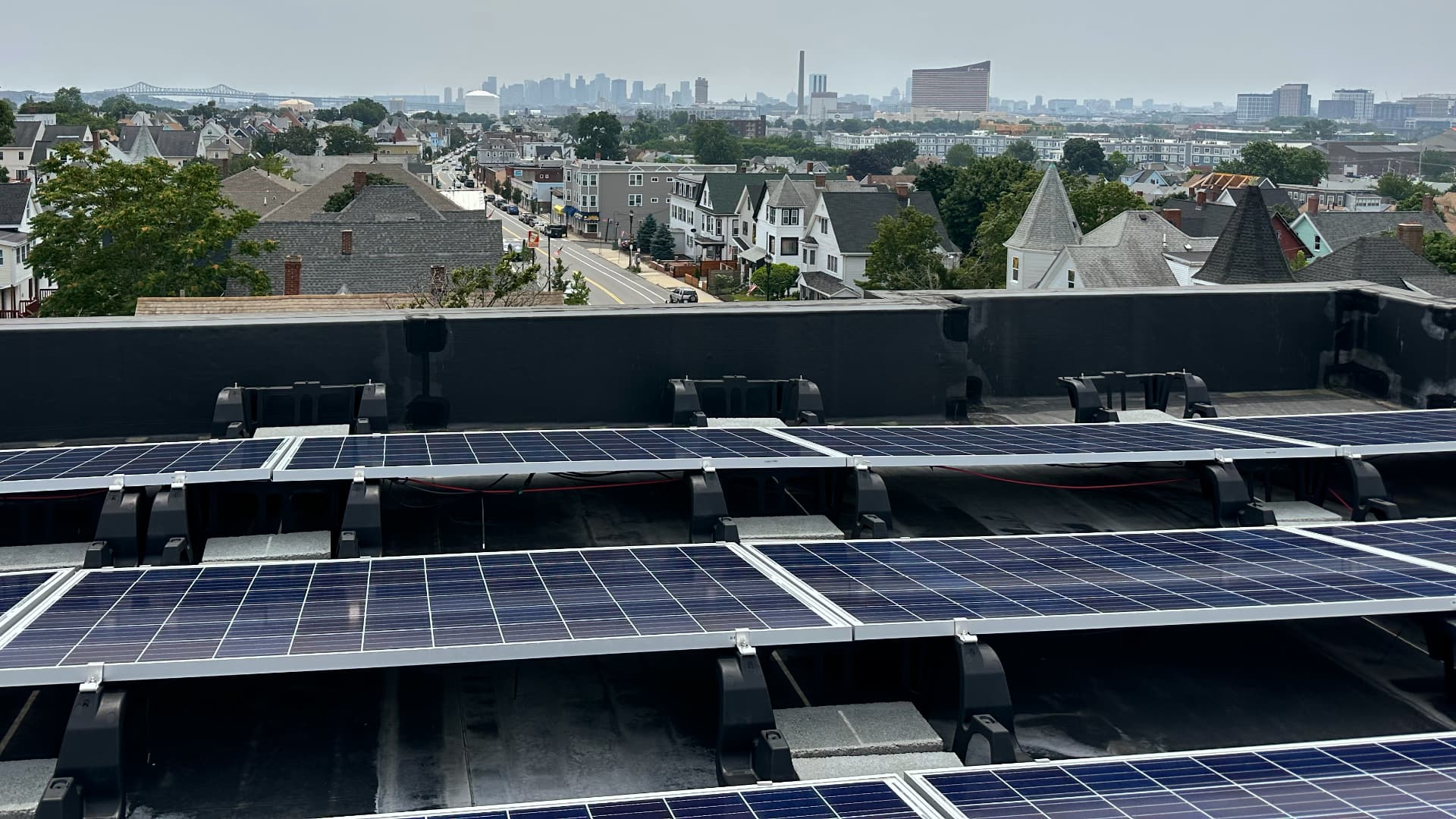
This image shows many dark, shiny square panels on top of a building's roof. These special panels catch sunlight and turn it into electricity that powers homes and buildings. You can see a whole neighborhood with houses and a city in the distance behind the panels.
🔬 Scientific Phenomena
Anchoring Phenomenon: Solar panels capture sunlight energy and convert it into usable electrical energy.
Why This Happens: Solar panels contain special materials (silicon cells) that have electrons. When sunlight hits these cells, the photons (light particles) give energy to the electrons, causing them to move and create an electric current. This is called the photovoltaic effect. The panels are arranged on roofs to maximize sun exposure throughout the day, allowing them to generate the most electricity possible. This is a renewable energy source because the sun continuously provides energy without being depleted.
📚 Core Science Concepts
- Energy Transfer: Sunlight energy is transformed into electrical energy that can power appliances and lights in homes and buildings.
- Light and Matter Interaction: When light (a form of energy) hits the solar panel material, it causes a physical change that produces electricity—demonstrating how light interacts with matter.
- Systems and Efficiency: Solar panels are part of a larger energy system. Multiple panels work together on a roof to generate enough electricity to be useful. The panels must face toward the sun's path to be most efficient.
- Renewable vs. Non-Renewable Energy: Solar energy comes from the sun and will not run out (renewable), unlike fossil fuels that are burned and gone forever (non-renewable).
Pedagogical Tip:
For Kindergarten students, focus on the observable, tangible elements: "The shiny panels catch sunlight and warm up" or "The dark panels get hot when the sun shines on them." Avoid heavy terminology about electrons and photovoltaic effects—instead, use simple cause-and-effect language: "Sunlight → panels → electricity → lights on!" Use real-world connections: "Just like plants need sunlight to grow, solar panels need sunlight to make power."
UDL Suggestions:
Universal Design for Learning (UDL) Strategies:
- Representation: Provide tactile models or sample solar panel materials students can touch and hold. Use bright visuals showing sunny vs. cloudy days to illustrate how weather affects solar energy generation.
- Action & Expression: Allow students to demonstrate understanding through drawing, building with blocks, or role-playing (e.g., "I'm a sunbeam!" "I'm a solar panel!"). Offer multiple ways to show what they learned.
- Engagement: Connect to students' lives—ask if they've seen solar panels on homes or buildings they know. Celebrate solar energy as a "helper" that keeps communities running.
🔍 Zoom In / Zoom Out Concepts
Zoom In: Microscopic Level
At the atomic level, solar cells contain silicon atoms arranged in a crystal structure. When a photon (light particle) strikes the silicon, it transfers energy to an electron, bumping it to a higher energy state. This creates a "hole" (absence of electron) and a "free electron"—both move in opposite directions, generating electric current. This happens billions of times per second in each cell, creating continuous electricity. The process is invisible to the naked eye but is the heart of how solar panels work.
Zoom Out: Planetary System Level
Solar panels are part of Earth's larger energy cycle. The sun provides energy that drives weather, grows plants, and warms the planet. By capturing this solar energy directly, humans reduce the need to burn fossil fuels (coal, oil, natural gas), which release harmful gases into the atmosphere and contribute to climate change. Solar panel installations connect individual homes and buildings to a global shift toward sustainable, clean energy—reducing our impact on the environment and helping protect Earth's future.
🤔 Potential Student Misconceptions
- Misconception: "Solar panels make their own light, like a light bulb."
- Clarification: Solar panels don't create light—they catch sunlight that's already there and change it into electricity. The electricity can then power light bulbs and other things. The panels are helpers that catch energy from the sun!
- Misconception: "Solar panels work the same on cloudy days as sunny days."
- Clarification: Solar panels work best on sunny, bright days. When clouds cover the sun, fewer sunrays reach the panels, so they make less electricity. It's like when you're in a shadow—you feel less warm from the sun!
- Misconception: "The panels heat up because they're making electricity, not because of the sun."
- Clarification: The sun's heat warms the panels, and the sunlight also makes electricity. Both things happen at the same time. The sun's energy does two jobs!
🎓 NGSS Connections
Performance Expectation (K-PS3-1): Make observations to determine the effect of sunlight on Earth's surface.
Disciplinary Core Ideas:
- Light and heat are forms of energy.
- People design and make things.
Crosscutting Concepts:
-
-
💬 Discussion Questions
- "What do you think the solar panels are doing when the sun shines on them?"
- Bloom's: Remember | DOK: 1
- "Why might someone put solar panels on their house instead of just using lights powered another way?"
- Bloom's: Analyze | DOK: 2
- "If it's cloudy outside, what do you think happens to how much electricity the solar panels make? Why?"
- Bloom's: Understand | DOK: 2
- "How is solar energy different from the energy in a battery or a plug in the wall?"
- Bloom's: Analyze | DOK: 3
📖 Vocabulary
- Solar Panel: A flat, dark square that catches sunlight and turns it into power to run lights and machines.
- Sunlight: The bright light and warmth that comes from the sun in the sky.
- Electricity: A form of energy that powers lights, TVs, and other things we use in our homes.
- Energy: Power that makes things work, move, or light up.
- Renewable: Something that can be used again and again without running out, like sunlight.
- Efficient: Doing a job well without wasting energy or materials.
🌡️ Extension Activities
- "Sunshine Catcher Experiment"
- Gather students in a sunny spot outdoors. Have them hold their hands in the sun and feel the warmth, then step into a shadow. Ask them to notice the difference. Explain that solar panels catch sunlight energy just like their skin feels the sun's warmth. Record their observations through drawing or simple sentences. Safety Note: Remind students never to stare at the sun.
- "Build a Simple Solar Collector"
- Fill clear plastic cups with water and place them in the sun for 30 minutes. Have students feel the cups to notice the temperature increase. Explain that solar panels collect the sun's energy like the water collected heat. Students can measure or compare warmth by touch. Safety Note: Ensure the water doesn't get too hot; check temperature before student contact.
- "Solar Panel Sequencing"
- Create a picture sequence showing: (1) Sun in the sky, (2) Sunlight hitting panels, (3) Panels getting warm, (4) Electricity flowing to a house, (5) Lights turning on in the house. Have students arrange pictures in order or retell the story of how solar energy becomes usable power. This supports visual learning and sequencing skills.
🔗 Cross-Curricular Ideas
- Math: Count the number of solar panels visible in the image. Sort pictures of different energy sources (sun, wind, water, coal) and create a simple bar graph or tally chart showing which are renewable and which aren't.
- ELA/Literacy: Read and discuss books about the sun and energy. Have students create a "Solar Panel Journal" where they draw or write about sunny days and what the sun helps do (warm us, grow plants, power panels). Practice sight words like "sun," "light," "warm," and "power."
- Social Studies: Discuss how solar panels help communities. Create a class map showing where solar panels might be found (libraries, schools, homes, businesses). Talk about how clean energy helps keep our neighborhood healthy.
- Art: Create a collaborative mural showing the sun, solar panels, and a powered community. Use yellow, orange, and blue paint or paper to represent sunlight and electricity. Students can make handprints as "sun rays" energizing the panels.
🚀 STEM Career Connection
- Physicist — Works out the rules that matter and energy follow, from the very small to the whole universe.
- Try it: Shine a light through a prism or a glass of water and observe how the light bends and splits into colors. (Practice: Constructing Explanations and Designing Solutions)
- Tools: lasers, detectors, vacuum chambers, computer simulations
- Where they work: research laboratories, particle accelerators, observatories, universities
- Meet one: Chanda Prescod-Weinstein — Dark matter — the invisible material that makes up most of the universe.
- Median pay: /year — "Physicists"
- Electrical Engineer — Designs the circuits and systems that move electricity where it is needed.
- Try it: Design a simple circuit using a battery, wires, and a switch to control a small motor or light. (Practice: Constructing Explanations and Designing Solutions)
- Tools: oscilloscopes, circuit boards, multimeters, simulation software
- Where they work: power companies, electronics firms, research labs, universities
- Meet one: Danielle George — The radio receivers that let giant telescopes hear signals from space.
- Median pay: /year — "Electrical engineers"
Wage figures are median annual wages for the U.S. occupation named after each one, from the U.S. Bureau of Labor Statistics, Occupational Employment and Wage Statistics (OEWS), national, May 2025. Several careers share one occupation, so their figures match.