📸 Photo Description
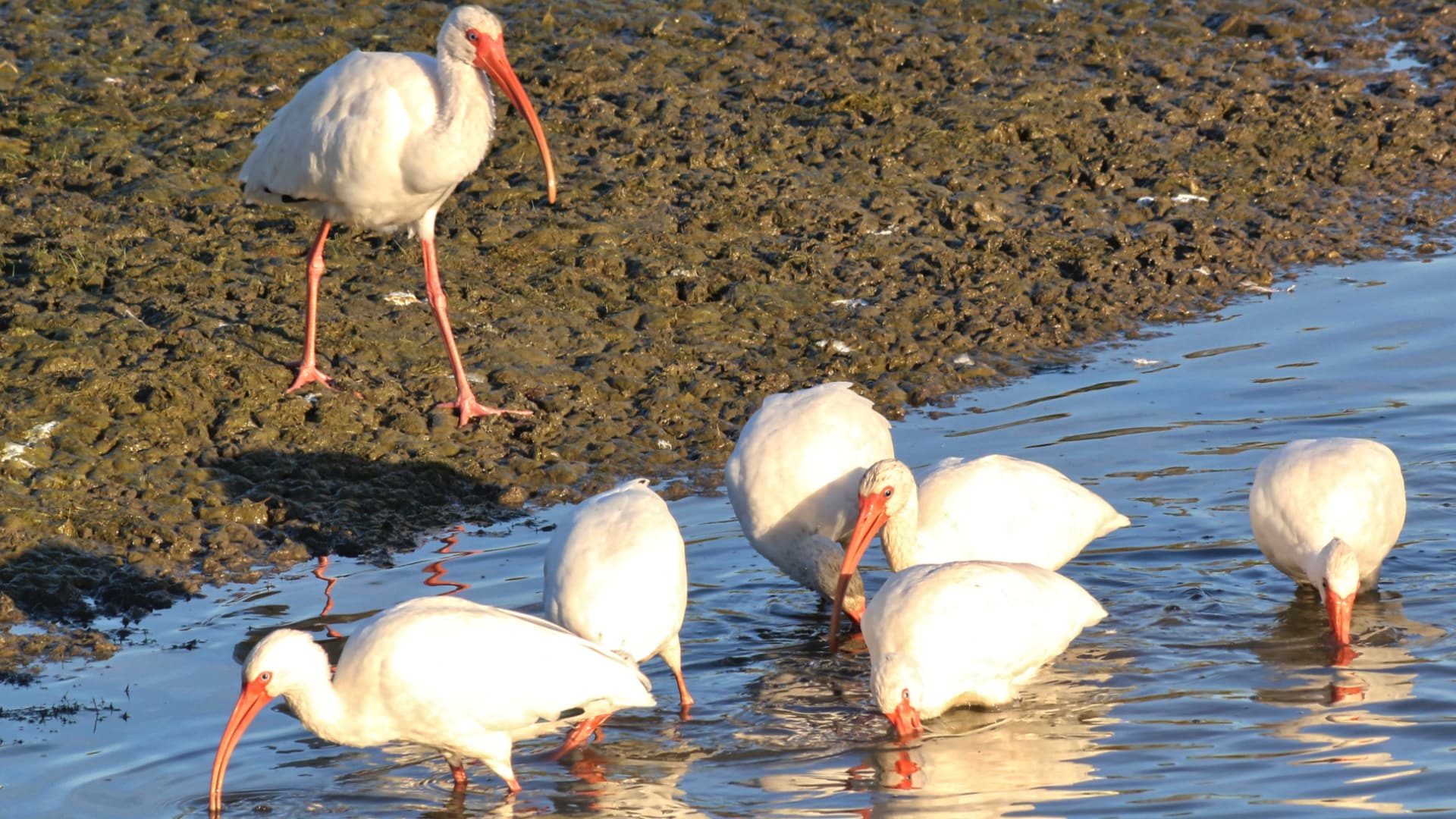
The image shows a group of white ibises wading in shallow water near a muddy bank. These birds have long, curved beaks, which they use to search for food in the mud and water. They are often found in wetland habitats.
🔬 Scientific Phenomena
This image captures the phenomenon of animal adaptation and survival in a specific habitat. The white ibises are well-suited to their wetland environment. Their long, curved beaks are a key adaptation that allows them to forage for invertebrates, small fish, and crustaceans hidden in the mud and shallow water. The group behavior seen in the image also suggests social interaction that may aid in survival.
📚 Core Science Concepts
- Habitat and Niche: The wetland area serves as the habitat for these ibises, providing them with food, water, and shelter. Their specific role in this habitat, like foraging for food, is their niche.
- Adaptations for Survival: The ibises' long, curved beaks are a physical adaptation that helps them survive by accessing food sources that other animals might not be able to reach.
- Behavioral Adaptations: Observing the birds in a group may indicate social behaviors that benefit the species, such as increased safety from predators or more efficient foraging.
Pedagogical Tip: Encourage students to observe animal behaviors and brainstorm how those behaviors might help the animal survive in its environment. This can be done through drawing, writing, or creating skits.
- Interdependence: The ibises depend on the wetland's resources (water, mud, food sources), and their actions can also impact the environment.
UDL Suggestions: Provide students with sentence starters or graphic organizers to help them articulate the relationship between the ibises' adaptations and their survival. For example, "The ibis's long beak helps it to ______, which helps it survive by ______."
🔍 Zoom In / Zoom Out Concepts
- Zoom In: The intricate structure of the ibis's beak, with its sensory receptors, allows it to detect prey buried in the mud, even when out of sight.
- Zoom Out: These ibises are part of a larger wetland ecosystem, which plays a crucial role in filtering water, preventing floods, and supporting a diverse range of plant and animal life.
🤔 Potential Student Misconceptions
- Misconception: All birds have the same type of beak.
- Clarification: Birds have many different beak shapes and sizes, and these are adapted to the specific foods they eat and how they get their food. The ibis's long, curved beak is specialized for probing in mud and shallow water.
- Misconception: Animals live alone.
- Clarification: Many animals, like these ibises, live in groups for various reasons, such as protection from predators, finding food more easily, or raising young together.
🎓 NGSS Connections
3-LS2-1: Construct an argument that some animals form groups that help members survive.
K-LS1-1 (Grade K — foundational connection): Use observations to describe patterns of what plants and animals (including humans) need to survive.
3-LS4-3: Construct an argument with evidence that in a particular habitat some organisms can survive well, some survive less well, and some cannot survive at all.
💬 Discussion Questions
- How do the ibises' beaks help them find food in this habitat? (Bloom's: Understand | DOK: 1 | SEP: Constructing Explanations and Designing Solutions)
- Why do you think the ibises are standing together in the water? (Bloom's: Analyze | DOK: 2 | SEP: Engaging in Argument from Evidence)
- What might happen to the ibises if this wetland habitat dried up? (Bloom's: Analyze | DOK: 2 | SEP: Constructing Explanations and Designing Solutions)
📖 Vocabulary
- Habitat: The natural home or environment of an animal, plant, or other organism.
- Adaptation: A special feature or behavior that helps an organism survive in its environment.
- Forage: To search for food.
- Invertebrates: Animals without a backbone, like insects, worms, and crustaceans.
🌡️ Extension Activities
- Beak Exploration: Provide students with various tools (tweezers, tongs, straws, spoons) and different "food" sources (beads, pasta, small objects, playdough). Have them experiment with how well each tool can collect specific "food" items, mimicking how different beak shapes are suited for different foods.
- Habitat Diorama: Students can create dioramas of a wetland habitat, including the white ibises and other plants and animals that might live there. They should label the different parts of the habitat and explain how the ibises use them.
🔗 Cross-Curricular Ideas
- ELA: Read stories or poems about birds and wetlands. Students can write their own descriptive paragraphs about the ibises, focusing on their physical features and behaviors.
- Art: Students can draw or paint the white ibises, focusing on their distinctive beak shape and coloring.
- Social Studies: Research different wetland habitats around the world and the animals that live in them. Discuss the importance of wetlands to human communities.
🚀 STEM Career Connection
- Wetland Ecologist — Studies marshes, swamps and bogs — places that are neither quite land nor quite water.
- Try it: Based on the picture, list all the living and non-living things that might be part of the white ibis's wetland habitat. (Practice: Constructing Explanations and Designing Solutions)
- Tools: waders, water level gauges, sediment corers, plant keys
- Where they work: marshes and swamps, water agencies, conservation groups, universities
- Meet one: Sandra Díaz — What a plant's leaves, wood and shape tell you about how it lives — and how those traits add up across a whole ecosystem.
- Median pay: /year — "Environmental scientists and specialists, including health"
- Biologist — Studies living things of every kind and what keeps them alive.
- Try it: Observe the white ibis in the picture and explain how its long, curved beak helps it find food in the mud. (Practice: Constructing Explanations and Designing Solutions)
- Tools: microscopes, sample jars, measuring tools, a field notebook
- Where they work: laboratories, field sites, museums, universities
- Meet one: Sandra Díaz — What a plant's leaves, wood and shape tell you about how it lives — and how those traits add up across a whole ecosystem.
- Median pay: /year — "Biological scientists, all other"
Wage figures are median annual wages for the U.S. occupation named after each one, from the U.S. Bureau of Labor Statistics, Occupational Employment and Wage Statistics (OEWS), national, May 2025. Several careers share one occupation, so their figures match.