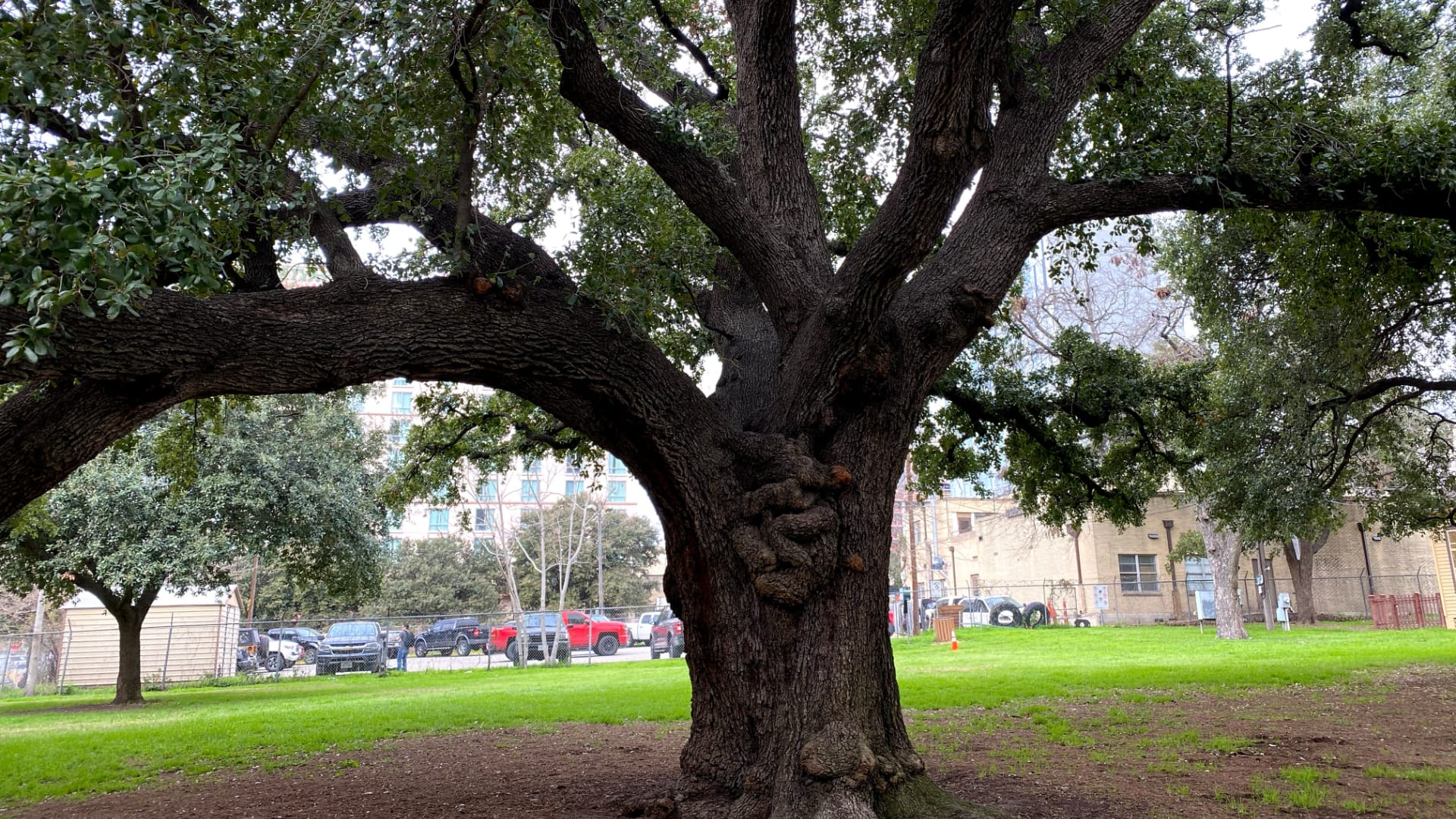
📸 Photo Description
This is a very large, old oak tree with a thick, dark trunk and many strong branches spreading out wide like open arms. The tree has lots of green leaves and is growing in a park near some buildings. You can see that this tree is much, much bigger than the people and cars nearby!
🔬 Scientific Phenomena
Anchoring Phenomenon: Why do trees grow so large and live for such a long time?
Trees grow bigger and bigger each year by adding new layers of wood under their bark. This oak tree is hundreds of years old! It has survived because it gets what it needs from the soil (water and nutrients) through its roots, and energy from the sun through its leaves. The tree's strong trunk and branches support all its leaves, which helps it catch lots of sunlight.
📚 Core Science Concepts
- Growth and Life Cycles: Trees start small and grow bigger over many, many years. This oak tree was once a tiny seed!
- Structure and Function: The thick trunk holds up all the branches and leaves. The roots drink water from the ground. The leaves catch sunlight to make food for the tree.
- Living Things Need Resources: Trees need water from soil, sunlight from the sky, and air to stay alive and grow.
- Interdependence: This tree provides shade, homes for animals, and oxygen for people and other living things in the community.
Pedagogical Tip:
For Kindergarteners, focus on observable features rather than abstract processes. Use sensory language: "rough bark," "strong branches," "bright green leaves." Take students outside to experience the tree with multiple senses when possible, as kinesthetic learning is crucial at this age.
UDL Suggestions:
Provide multiple means of representation by showing the tree in different ways: the photo, a real visit to a tree, a simple diagram showing roots/trunk/leaves, and a story about the tree's life. Allow students to express understanding through drawing, talking, moving (acting like a tree), or building with blocks—not just through writing.
🔍 Zoom In / Zoom Out Concepts
Zoom In (Microscopic):
Inside the tree's trunk, there are tiny tubes thinner than a human hair! These tubes carry water up from the roots to the leaves, and they carry food made by the leaves down to feed the rest of the tree. Under a microscope, you would see these tubes are packed tightly together, which is why the trunk is so strong.
Zoom Out (Ecosystem/Community):
This oak tree is part of a whole neighborhood ecosystem! Birds nest in its branches, squirrels eat its acorns, insects live on its bark, and its shade keeps the grass and other plants cooler. People enjoy sitting under it and playing in its shade. When leaves fall, they become food for soil creatures, which makes the soil better for other plants to grow.
🤔 Potential Student Misconceptions
- Misconception: "Trees don't need to drink water because they're not animals."
Clarification: Trees are living things that need water just like animals do! The water goes into the roots (like a straw) and travels up to all the leaves.
- Misconception: "Trees stop growing once they get big."
Clarification: Trees keep growing bigger and bigger every single year of their lives—they just grow very, very slowly. This oak tree has been growing for hundreds of years!
- Misconception: "A tree's food comes from the soil."
Clarification: Roots bring water and minerals from soil, but trees make their own food using sunlight and air in their leaves. It's like they cook food using sunshine!
🎓 NGSS Connections
Performance Expectation:
K-LS1-1: Use observations to describe patterns of what plants need to grow.
Disciplinary Core Ideas:
- All organisms have basic needs (sunlight, water, air, nutrients)
- Plants need water and light to grow
Crosscutting Concepts:
- - Trees show patterns in growth over time and seasons
- - Tree parts have specific jobs (roots get water, leaves catch sun, trunk holds everything up)
💬 Discussion Questions
- "What do you think this tree needs to stay alive and healthy?" (Bloom's: Remember/Understand | DOK: 1)
- "Why do you think the trunk is so thick and strong, and the branches spread out so wide?" (Bloom's: Analyze | DOK: 2)
- "How do you think this tree grew so big? What would happen if a tree never got sunlight?" (Bloom's: Apply/Analyze | DOK: 2)
- "What animals or bugs do you think might live in or on this tree, and why would they choose to live here?" (Bloom's: Evaluate/Create | DOK: 3)
📖 Vocabulary
- Tree: A very large plant with a thick wooden trunk, branches, and leaves that lives for many, many years.
- Roots: The parts of a plant that grow underground and drink water from the soil to help the plant grow.
- Trunk: The thick, hard part of the tree that holds up all the branches and leaves—like the tree's body.
- Leaves: The green parts of a tree that catch sunlight and help the tree make its own food.
- Growth: When something gets bigger over time by eating, drinking, and getting what it needs.
- Living Things: Animals, plants, and other creatures that are alive, breathe, grow, and need food and water.
🌡️ Extension Activities
- Tree Hugging and Measurement: Take students outside to hug a large tree (this one or another) and count how many children it takes to wrap around the trunk. Ask: "Is our classroom door as wide as this tree trunk?" This builds understanding of size and scale in a concrete, memorable way.
- Root and Branch Exploration: Plant bean seeds in clear cups with wet soil so students can observe roots growing downward. Simultaneously, hang a willow branch in water and let it sprout new roots. Students draw observations daily, making the invisible (root growth) visible.
- Tree Needs Sorting Game: Create picture cards of things trees need (sun, water, soil, air, space) and things they don't need (toys, cars, candy). Students sort the cards and discuss why trees need each item. This reinforces the concept of organism needs in a playful, tactile way.
🔗 Cross-Curricular Ideas
- Math: Measure the tree's shadow at different times of day. Create a simple bar graph showing "morning shadow" vs. "afternoon shadow." Count the branches or estimate how many people it would take to hug the tree.
- ELA/Literacy: Read books about trees (see resources below). Have students dictate or draw a story about a tiny acorn growing into a big oak tree. Create a class "tree poem" with repeated phrases like "Tall tree, green tree, strong tree, kind tree..."
- Social Studies/Community: Discuss how this tree helps the community—shade, beauty, homes for animals, oxygen. Take a "tree walk" around school grounds and identify all the trees. Talk about how people take care of trees and why trees are important to neighborhoods.
- Art: Create textured bark rubbings by placing paper against the tree and rubbing with crayons. Paint or draw pictures of trees in different seasons. Build trees with blocks, sticks, or playdough. Create leaf collages using real fallen leaves.
🚀 STEM Career Connection
- Soil Scientist — Studies dirt seriously — what it is made of, what lives in it, and what will grow in it.
- Try it: Examine soil samples and describe their texture and color, noting what might help a tree grow. (Practice: Analyzing and Interpreting Data)
- Tools: soil augers, pH meters, sieve stacks, sample bags
- Where they work: farms and fields, testing laboratories, government agencies, universities
- Meet one: Asmeret Asefaw Berhe — How soil stores carbon, and why that makes dirt part of the climate story.
- Median pay: /year — "Soil and plant scientists"
- Botanist — Studies plants — how they grow, how they reproduce, and how they survive where they live.
- Try it: Compare diagrams of a young tree and an old live oak tree, noting differences in branch structure and size. (Practice: Analyzing and Interpreting Data)
- Tools: a hand lens, a plant press, a soil probe, field guides
- Where they work: botanical gardens, herbariums, forests and fields, universities
- Meet one: Robin Wall Kimmerer — Mosses — which she calls the coral reefs of the forest — and what Indigenous knowledge teaches about bringing plants back.
- Median pay: /year — "Soil and plant scientists"
Wage figures are median annual wages for the U.S. occupation named after each one, from the U.S. Bureau of Labor Statistics, Occupational Employment and Wage Statistics (OEWS), national, May 2025. Several careers share one occupation, so their figures match.