📸 Photo Description
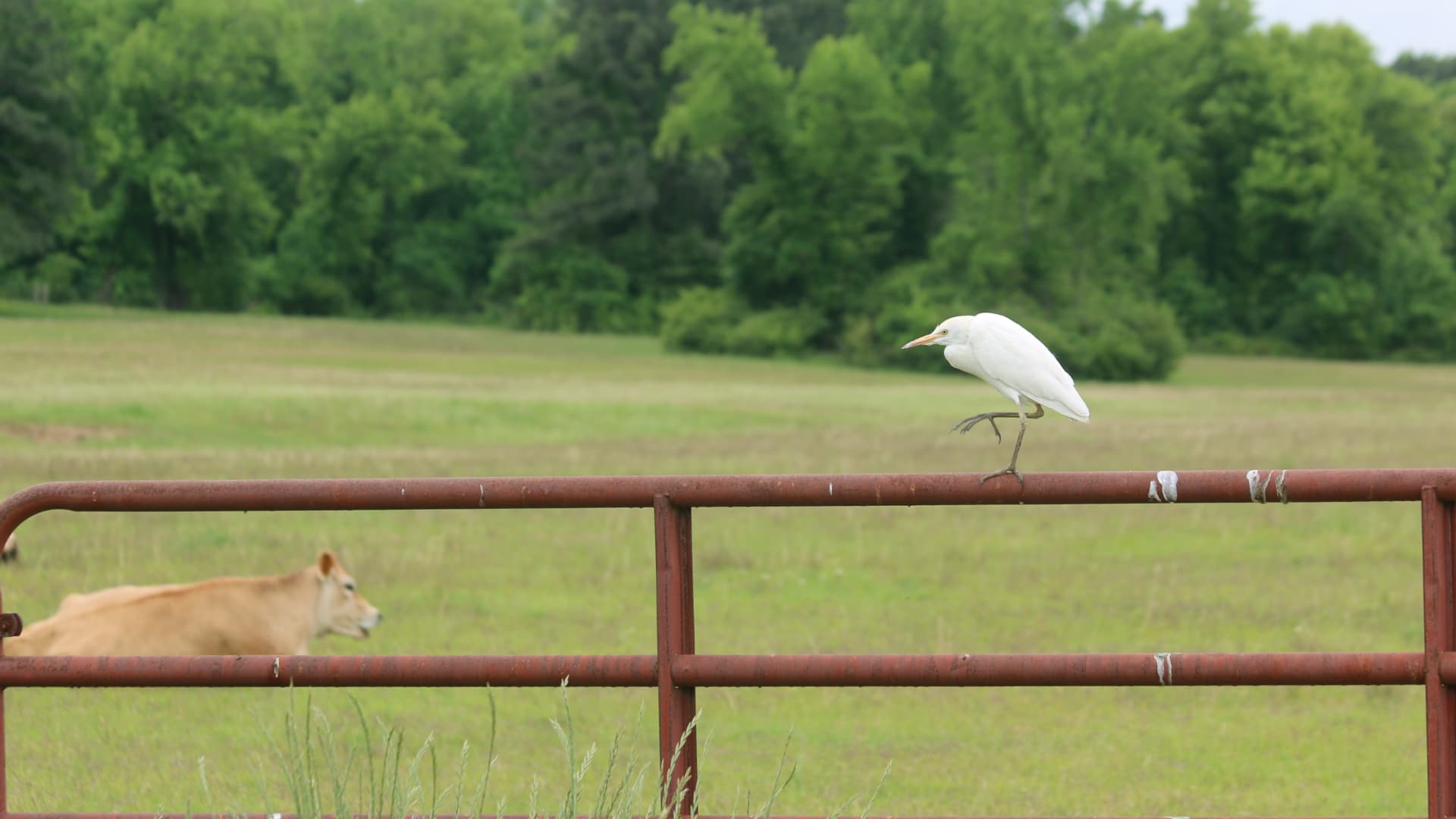
In this picture, a white bird called a cattle egret is standing on a fence near a brown cow. The egret has long, thin legs and a pointed beak. Behind the fence is a big green field with trees in the background. The bird and cow are living together in the same space!
🔬 Scientific Phenomena
Anchoring Phenomenon: This image shows symbiosis in action—specifically, a relationship between a cattle egret and livestock in which the egret benefits and the livestock are not harmed.
Why is this happening? Cattle egrets follow large grazing animals because the movement of the animals through grass stirs up insects that the birds eat. The cow is not helped or harmed. Only the bird really benefits from being together—the bird gets food. This is a natural relationship that has evolved over thousands of years.
📚 Core Science Concepts
- Animals have different body parts for different jobs: The egret's long, thin legs help it walk through grass and mud. Its pointed beak is perfect for catching tiny insects. The cow has a different body shape for eating plants.
- Animals live in communities: Different animals can live near each other, and sometimes one animal helps the other. This is called a relationship or partnership.
- Animals need food to survive: The egret eats insects stirred up by the cow's movement. The cow eats grass. Both animals must eat to stay alive and healthy.
- Observing animals teaches us about nature: By watching animals in their natural environments, we learn how they behave and what they need.
Pedagogical Tip:
For Kindergarten learners, avoid using the term "symbiosis" directly. Instead, emphasize the action and observation: "The cow walks and stirs up bugs. The bird eats the bugs. The cow just keeps eating grass." Use concrete, relatable language and let students act out the relationship physically (one student moves around while another pretends to catch insects).
UDL Suggestions:
Multiple Means of Engagement: Use photos, real or stuffed animals, or videos of cattle egrets and cows to help visual learners. Allow kinesthetic learners to act out the bird and cow relationship. For students who prefer auditory input, read aloud picture books about animal friendships and partnerships.
Multiple Means of Representation: Provide real images, drawings, and simplified diagrams showing the cattle egret on the fence. Use color-coded visuals (highlight the bird in one color, the cow in another) to help students distinguish between the two animals. Offer tactile models if possible.
🔍 Zoom In / Zoom Out Concepts
Zoom In (Microscopic/Unseen):
At a level we can't see without help, the egret uses its sharp eyes to spot insects and its pointed beak to catch them. The cow's skin is made of tiny cells that cover and protect its body. Inside both animals' bodies, food is being broken down and turned into energy so they can move, play, and stay warm.
Zoom Out (Ecosystem & Larger Systems):
This cattle egret and cow relationship is just one small part of a grassland ecosystem. The grass feeds the cow. Insects live in the grass and eat plants. Birds eat those insects. When animals die, they return nutrients to the soil, which helps grass grow again. Farmers create the pasture environment where these animals live together. Everything is connected in a big circle of life!
🤔 Potential Student Misconceptions
- Misconception: "The bird is sitting on the cow to rest, or they are playing together like friends."
- Clarification: This is not playtime. The bird is looking for food, and the cow is just going about its day. The bird gets food from the bugs the cow stirs up.
- Misconception: "The cow is scared of the bird and wants it to leave."
- Clarification: No! The cow does not seem bothered by the bird. The cow doesn't chase the bird away—instead, they live near each other peacefully.
- Misconception: "The bird eats the cow's food (grass)."
- Clarification: The cattle egret doesn't eat grass—it eats insects. The cow eats the grass. They eat different foods, so they don't compete with each other.
🎓 NGSS Connections
Performance Expectation:
K-LS1-1: Use observations to describe patterns of what plants and animals (including humans) need to survive.
Disciplinary Core Ideas:
- : All organisms have basic needs such as water, materials they need to grow, space in which to live, and air. Plants need light and water; animals need food, water, and air. Plants get materials they need from soil and air; animals get materials they need from food they consume, and may move to new places to satisfy their basic needs.
- : All animals have body parts that capture and convey different kinds of information needed for growth and survival.
Crosscutting Concepts:
- : Animals have body parts that help them survive.
- : Animals live together in communities where different organisms interact.
💬 Discussion Questions
- "What do you think the bird is eating from near the cow?" (Bloom's: Remember | DOK: 1)
- "How does the cow help the bird?" (Bloom's: Understand | DOK: 2)
- "What would happen if the cow was not there for the egret?" (Bloom's: Analyze | DOK: 2)
- "Can you think of another animal in your neighborhood that helps another animal?" (Bloom's: Create | DOK: 3)
📖 Vocabulary
- Egret: A tall white bird with long, thin legs that lives near water and animals.
- Livestock: Animals like cows, sheep, and goats that farmers raise for food or to help people.
- Partnership: When two living things stay close together and at least one gets something good from it.
- Parasite: A tiny bug or creature that lives on an animal's body and tries to eat its skin or drink its blood.
- Habitat: The place where an animal lives and finds food, water, and shelter.
- Observe: To look carefully and notice what is happening around you.
🌡️ Extension Activities
- "Create a Bird & Cow Friendship Mobile" (Art + Science)
- Students draw or color pictures of cattle egrets and cows. Hang them from a hanger or stick with string to show that they live together. Students can dictate or write one way the cow helps the bird.
- "Act Out the Partnership" (Movement + Science)
- Divide the class: some students are cows moving slowly through grass, while others are egrets walking nearby. The "cows" move, which stirs up imaginary insects, and the "egrets" pretend to catch and eat them. Switch roles. Discuss which animal gets food from being together.
- "Observe Insects in Our Playground" (Outdoor Exploration)
- Take students outside to observe real insects near plants or grass. Discuss: "What do these insects eat? What eats them? Are there any birds nearby watching for insects?" This connects the lesson to their real-world environment.
🔗 Cross-Curricular Ideas
- Math: Count how many insects a cattle egret might eat in a day (use small objects like beads or crackers as pretend insects). Practice sorting insects by size or type.
- ELA/Literacy: Read picture books about animal friendships and partnerships. Students draw a picture and dictate a simple sentence: "The cow helps the egret by _______."
- Social Studies: Discuss different types of farms and farm animals. Where do cattle egrets live? What countries have cattle farms? Use a simple world map to show where these animals are found.
- Art: Create a pasture scene using green paper for grass, brown for fences, and white feathers or cotton balls for the egret. Display as a classroom mural showing the habitat where both animals live together.
🚀 STEM Career Connection
- Animal Behaviourist — Watches what animals do and works out why they do it.
- Try it: Observe an animal (like a pet or a bird outside) for 15 minutes and record its actions in a journal. (Practice: Constructing Explanations and Designing Solutions)
- Tools: observation blinds, video recorders, stopwatches, behaviour checklists
- Where they work: zoos, field research stations, farms, universities
- Meet one: Rae Wynn-Grant — Where black bears and people run into each other, and how to keep both safe.
- Median pay: /year — "Zoologists and wildlife biologists"
- Ecologist — Studies how living things depend on each other and on the place they live.
- Try it: Draw a diagram showing how a plant and an animal in a local park depend on each other. (Practice: Constructing Explanations and Designing Solutions)
- Tools: quadrat frames, measuring tapes, GPS units, a field notebook
- Where they work: forests, grasslands, wetlands, universities
- Meet one: Sandra Díaz — What a plant's leaves, wood and shape tell you about how it lives — and how those traits add up across a whole ecosystem.
- Median pay: /year — "Environmental scientists and specialists, including health"
Wage figures are median annual wages for the U.S. occupation named after each one, from the U.S. Bureau of Labor Statistics, Occupational Employment and Wage Statistics (OEWS), national, May 2025. Several careers share one occupation, so their figures match.