📸 Photo Description
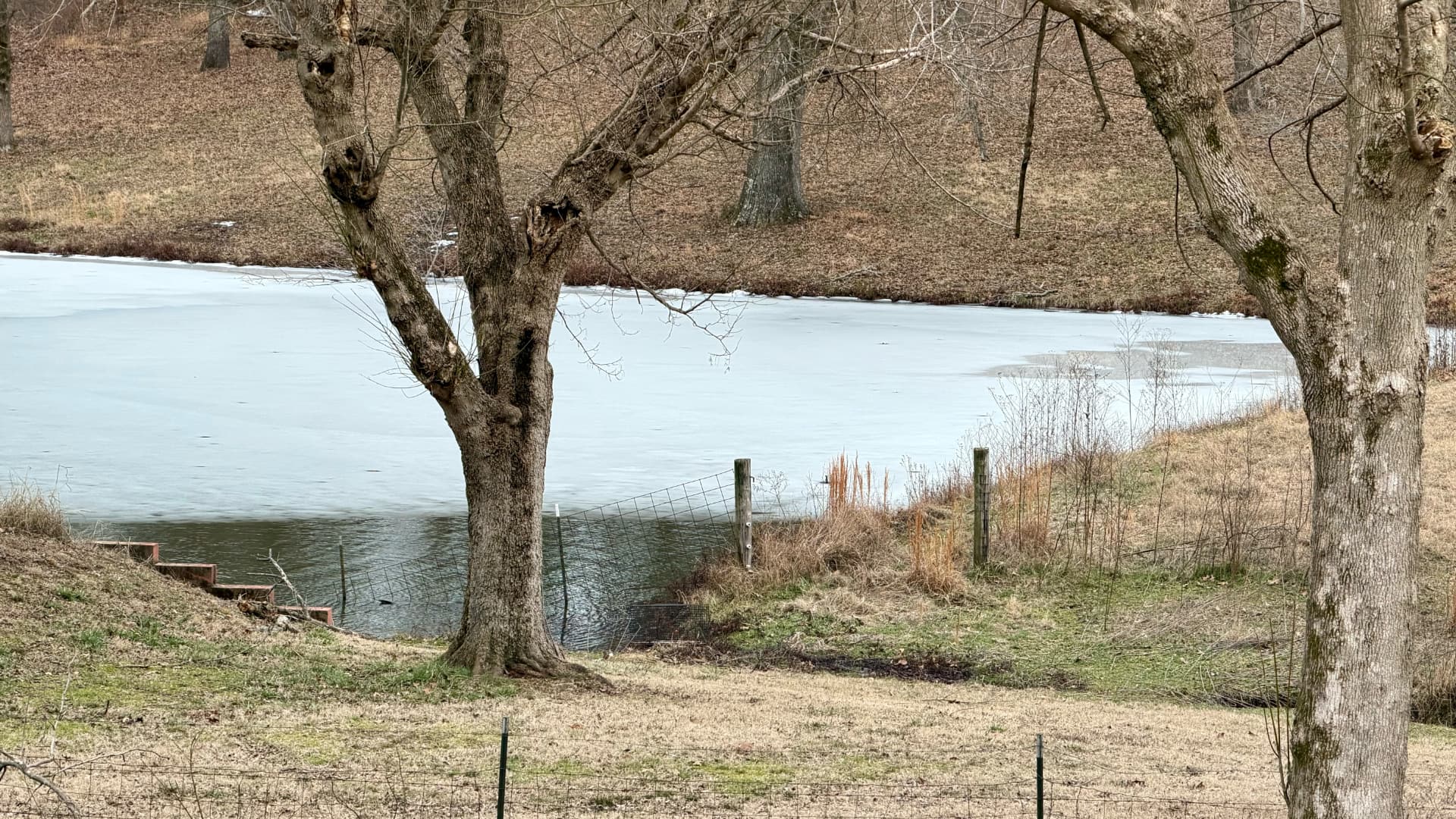
The image shows a body of water that appears to be a pond or lake, partially covered with ice. Bare trees and dry grass indicate that it is likely winter or early spring. The presence of ice suggests that the temperature has been cold enough for water to freeze.
🔬 Scientific Phenomena
This image captures the phenomenon of water freezing and potentially beginning to thaw. This occurs when the temperature of the water drops to its freezing point (0°C or 32°F), causing the water molecules to slow down and arrange themselves into a crystalline structure, forming ice. The partial melting visible at the edges suggests that temperatures may be rising, initiating the transition back to liquid water. This is a direct observation of a change of state driven by temperature.
📚 Core Science Concepts
- States of Matter: Water can exist in different states: solid (ice), liquid (water), and gas (water vapor). The image shows the transition between solid and liquid states.
- Temperature and Weather: Temperature is a key factor in weather. Cold temperatures cause water to freeze, while warmer temperatures cause ice to melt. This relates to seasonal weather patterns.
- Water Cycle: Freezing and melting are part of the natural water cycle, where water moves and changes form.
Pedagogical Tip: Encourage students to observe and record changes in their environment over time, focusing on observable phenomena like the state of water. This builds their scientific observation skills.
UDL Suggestions: Provide visual aids such as diagrams of the water cycle or charts showing temperature changes and their effects on water to support diverse learners.
🔍 Zoom In / Zoom Out Concepts
- Zoom In: At a microscopic level, freezing occurs when water molecules lose enough kinetic energy (due to cold temperatures) to slow down. They then arrange themselves into a regular, hexagonal crystal lattice structure, forming ice.
- Zoom Out: This frozen pond is part of a larger watershed, which is a system of land and water that collects and drains rainwater and snowmelt. The freezing and thawing of the pond affects the flow of water in the watershed and the habitats of aquatic life. (Grade 5 — where this learning leads)
🤔 Potential Student Misconceptions
- Misconception: Ice is a different substance than water.
- Clarification: Ice is simply water in its solid state. The molecules are the same, but they are arranged differently and moving slower.
- Misconception: All bodies of water freeze completely solid.
- Clarification: While the surface of a body of water freezes, the water at the bottom often remains liquid because ice is less dense than water and insulates the water below. Also, the rate of freezing depends on the depth of the water and ambient temperature.
🎓 NGSS Connections
3-ESS2-1: Represent data in tables and graphical displays to describe typical weather conditions expected during a particular season.
K-ESS2-1 (Grade K — foundational connection): Use and share observations of local weather conditions to describe patterns over time.
2-ESS2-3 (Grade 2 — foundational connection): Obtain information to identify where water is found on Earth and that it can be solid or liquid.
💬 Discussion Questions
- What do you observe happening to the pond in the picture? (Bloom's: Remember | DOK: 1 | SEP: Obtaining, Evaluating, and Communicating Information)
- Why do you think the pond is frozen? What does this tell us about the weather? (Bloom's: Analyze | DOK: 2 | SEP: Constructing Explanations and Designing Solutions)
- How is the ice on the pond like the water in the pond? How is it different? (Bloom's: Analyze | DOK: 2 | SEP: Constructing Explanations and Designing Solutions)
- What might happen to the pond if the weather gets warmer? (Bloom's: Predict | DOK: 2 | SEP: Constructing Explanations and Designing Solutions)
📖 Vocabulary
- Frozen: When a liquid turns into a solid because it gets very cold.
- Thawing: When ice or something frozen begins to melt and turn back into a liquid.
- State of Matter: How a substance exists, such as a solid, liquid, or gas.
- Temperature: How hot or cold something is.
🌡️ Extension Activities
- Ice Melting Race: Place equal amounts of ice in identical containers. Place one container in a sunny spot, one in a shady spot, and one near a heat source (like a warm vent). Students observe and record which ice melts fastest and why.
- Water Cycle in a Bag: Create a mini water cycle by sealing water in a plastic bag and taping it to a sunny window. Students observe evaporation, condensation, and precipitation over time.
- Observing Local Water Bodies: Visit a local pond, lake, or stream during different seasons and record observations about the water's state, temperature, and surrounding environment.
🔗 Cross-Curricular Ideas
- ELA: Read books about seasons, weather, and water. Students can write descriptive paragraphs about the frozen pond or create poems about winter.
- Math: Measure the temperature of water as it freezes and thaws. Create simple bar graphs to compare melting rates in different locations.
- Art: Draw or paint the scene of the frozen pond, focusing on colors and textures associated with winter.
🚀 STEM Career Connection
- Mechanical Engineer — Designs things that move — engines, turbines, joints and gears — and works out the forces on them.
- Try it: Design a simple tool that could help melt ice faster using everyday classroom materials. (Practice: Constructing Explanations and Designing Solutions)
- Tools: CAD software, 3D printers, force sensors, wind tunnels
- Where they work: engineering firms, factories, design studios, research labs
- Meet one: Shini Somara — How air and water flow around things, worked out on a computer before anything is built.
- Median pay: /year — "Mechanical engineers"
- Physicist — Works out the rules that matter and energy follow, from the very small to the whole universe.
- Try it: Explain why ice melts when it gets warmer, using the idea that heat makes water move faster. (Practice: Constructing Explanations and Designing Solutions)
- Tools: lasers, detectors, vacuum chambers, computer simulations
- Where they work: research laboratories, particle accelerators, observatories, universities
- Meet one: Chanda Prescod-Weinstein — Dark matter — the invisible material that makes up most of the universe.
- Median pay: /year — "Physicists"
Wage figures are median annual wages for the U.S. occupation named after each one, from the U.S. Bureau of Labor Statistics, Occupational Employment and Wage Statistics (OEWS), national, May 2025. Several careers share one occupation, so their figures match.