📸 Photo Description
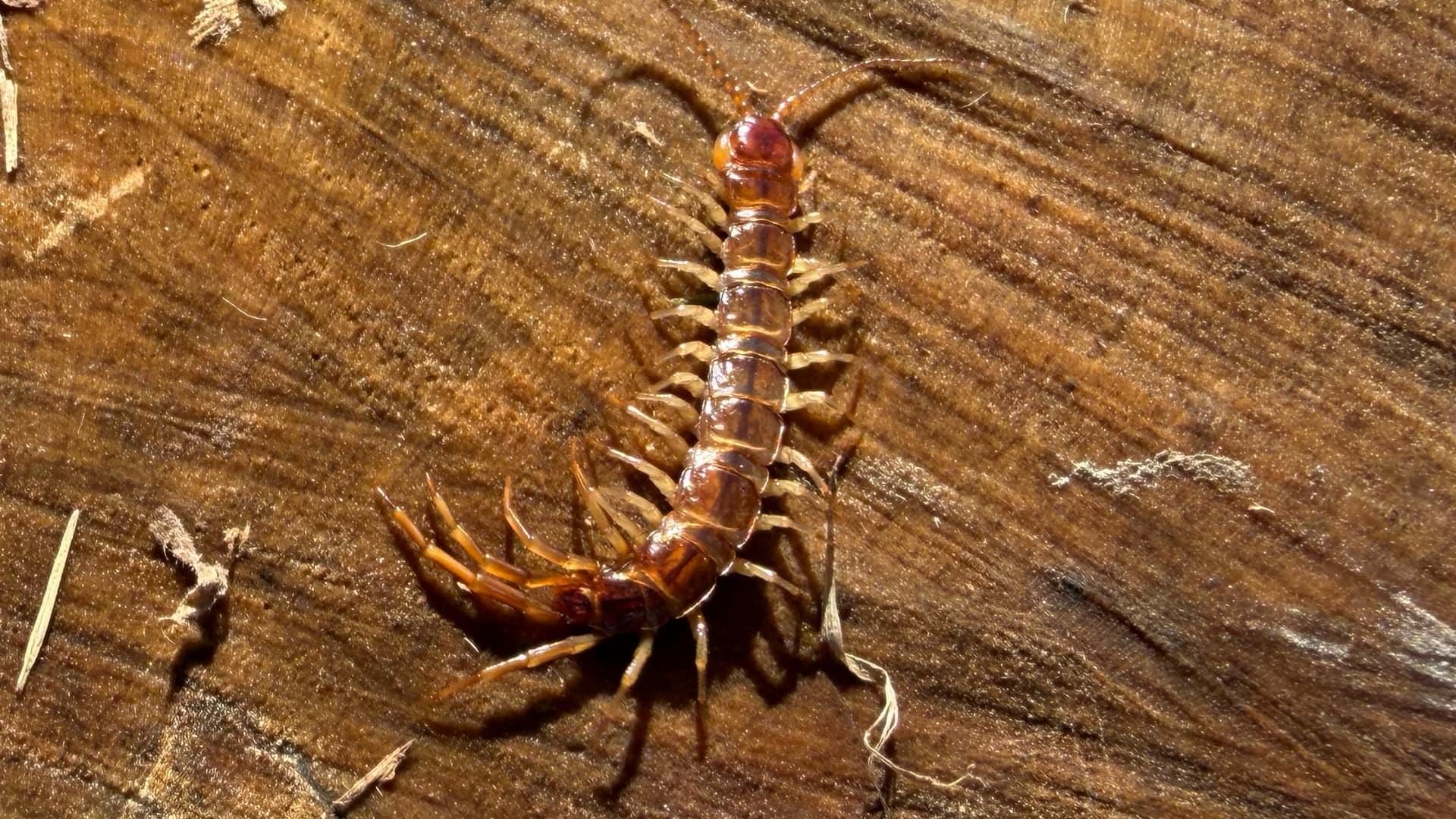
This image shows a centipede on a piece of wood or bark. You can see its long, flat brown body made up of many segments lined up in a row, with legs sticking out from the sides of each segment. The centipede has a rounded head at the front with antennae and appears to be in a defensive posture.
🔬 Scientific Phenomena
Anchoring Phenomenon: Why does a centipede have so many legs?
Centipedes have evolved segmented bodies with paired legs on almost every segment as an adaptation for speed and maneuverability through soil, leaf litter, and tight spaces. Each body segment (called a somite) carries one pair of jointed legs, allowing the centipede to move quickly and navigate complex environments while hunting for small prey like insects. This body design is the result of millions of years of evolution that made centipedes successful predators in their ecosystems.
📚 Core Science Concepts
- Body Segmentation: Centipedes have bodies divided into many similar sections (segments), and each segment has a pair of legs attached to it. This repeating pattern helps them move smoothly and bend easily.
- Adaptation and Survival: The centipede's many legs and flat body shape are special features that help it survive—they allow it to move quickly to catch food and escape danger, and to squeeze into tight spaces.
- Animal Classification: Centipedes are arthropods, a large group of animals with jointed legs, hard outer skeletons, and segmented bodies. They are different from insects because insects have six legs while centipedes have many more.
- Predator Behavior: Centipedes are carnivores (meat-eaters) that hunt small creatures like insects and spiders. Their speed, powered by their many legs, helps them be successful hunters.
Pedagogical Tip:
Third graders benefit from direct observation and comparison. Consider bringing in pictures of other arthropods (ants, beetles, spiders) so students can count legs and compare body structures. This concrete visual comparison builds understanding of why centipedes are different from six-legged insects.
UDL Suggestions:
To support diverse learners, provide multiple representations: use actual photos or videos of centipedes moving, diagrams labeling body parts, and tactile models students can handle. Allow students to express learning through drawings, written descriptions, or verbal explanations based on their strengths. For English learners, provide a vocabulary anchor chart with pictures.
🎓 NGSS Connections
Performance Expectation: 3-LS1-1 Develop models to describe that organisms have unique and diverse life structures that aid in growth, survival, and reproduction.
Disciplinary Core Ideas:
- —Structure and Function: Plants and animals have both internal and external structures that serve various functions in growth, survival, behavior, and reproduction.
Crosscutting Concepts:
- —The way an organism is shaped and structured relates directly to what it can do and how it survives.
- —Repeating patterns in body segments and leg pairs show us how centipedes are organized.
💬 Discussion Questions
- How many legs do you think a centipede needs to move quickly through soil and leaves? (Bloom's: Evaluate | DOK: 3)
- Why might having a long, flat body with many legs help a centipede hunt insects better than an animal with four legs? (Bloom's: Analyze | DOK: 2)
- If a centipede lost one of its legs, how do you think it would still be able to move and hunt? (Bloom's: Apply | DOK: 2)
- What other animals do centipedes look similar to, and how are they different? (Bloom's: Compare | DOK: 2)
📖 Vocabulary
- Segment: One of the many sections that make up a centipede's body, each with its own pair of legs.
- Arthropod: A large group of animals with jointed legs, a hard outer skeleton, and segmented bodies (like centipedes, insects, and spiders).
- Predator: An animal that hunts other animals for food.
- Adaptation: A special body part or behavior that helps an animal survive in its environment.
- Antennae: Long, thin feelers on an animal's head that help it sense its surroundings.
🌡️ Extension Activities
- Centipede Movement Simulation: Have students use yarn, pipe cleaners, or string to create a model centipede with multiple segments and legs. Then have them move the model in a wave-like motion to understand how each leg works together. Students can compare this to how they walk on two legs and discuss why the centipede's design is more effective on uneven ground.
- Arthropod Comparison Chart: Provide pictures of different arthropods (ant, beetle, spider, centipede, crab). Have students create a chart or Venn diagram comparing the number of legs, body shape, and habitats. This builds classification skills and deepens understanding of why centipedes are unique.
- Habitat Exploration (Outdoor or Video-Based): If safe and feasible, take students to a garden or wooded area to search for centipedes under logs, rocks, and leaf litter (handling only with permission and care). Alternatively, watch a short nature video of centipedes in their habitat. Students can sketch and describe what they observe about where centipedes live and what they might be hunting.
🔍 Zoom In / Zoom Out Concepts
Zoom In (Microscopic Level):
If we could look at a centipede's leg under a microscope, we would see that each leg is made up of many tiny joints and segments, kind of like a chain! These joints bend and straighten in a wave pattern, one after another, which allows the centipede to move so smoothly and quickly. Inside the leg are tiny muscles and nerves that help the centipede control each movement precisely. This amazing coordination happens automatically—the centipede doesn't have to think about moving each leg individually the way you think about each step you take!
Zoom Out (Ecosystem Level):
In a forest ecosystem, the centipede plays an important role as a predator. It hunts insects and other small arthropods, which keeps those populations from growing too large. At the same time, centipedes are prey for larger animals like birds, toads, and small mammals. This creates a food chain where centipedes help balance the number of insects in the soil and leaf litter. Without centipedes and other predators, insect populations could get out of control and damage plants. So the centipede's many legs and hunting ability make it a key player in keeping its forest home healthy!
🤔 Potential Student Misconceptions
Misconception 1: "Centipedes have exactly 100 legs because 'centi' means 100."
Clarification: While "centi-" does mean 100, most centipedes actually have between 15 and 177 pairs of legs depending on the species—not exactly 100! The name is more of a general description meaning "many legs" rather than a precise count. Different centipedes have different numbers of legs based on how their bodies evolved.
Misconception 2: "Centipedes and millipedes are the same thing, just with different names."
Clarification: Centipedes and millipedes are different animals! Centipedes are fast hunters with one pair of legs per body segment and venomous fangs to catch prey. Millipedes are slower plant-eaters with two pairs of legs per body segment. You can tell them apart by counting legs on a segment and watching how they move.
Misconception 3: "All the legs on a centipede move at the same time, like when we clap our hands together."
Clarification: Centipede legs don't all move together! Instead, they move in a beautiful wave pattern—the front legs move first, then the next pair, then the next, creating a ripple effect down the body. This wave pattern helps the centipede move faster and stay balanced, even on bumpy ground.
🔗 Cross-Curricular Ideas
Math Connection: Counting and Patterns
Have students count the visible leg pairs in the centipede photo and create a pattern prediction chart. For example: "If this centipede has 8 segments visible, and each segment has 2 legs, how many legs does it have?" Students can extend the pattern to predict legs on a 15-segment or 20-segment centipede, building multiplication and pattern recognition skills.
ELA Connection: Descriptive Writing and Vocabulary
Students can write a short descriptive paragraph or poem from the "perspective" of a centipede, describing what it feels like to have so many legs, what the centipede sees while hunting, or how it moves through the forest. This builds sensory language, vocabulary use, and creative thinking while reinforcing scientific content.
Art Connection: Nature Drawing and Segmentation
Have students create detailed drawings of the centipede, carefully counting and sketching each visible body segment and leg pair. They can use colored pencils or markers to show how segments connect and how legs attach. This activity develops fine motor skills, observation abilities, and artistic representation of scientific structures.
Social Studies Connection: Animal Habitats and Human Impact
Explore where centipedes live around the world and how different environments (deserts, rainforests, temperate forests) might affect centipede size and leg count. Discuss how human activities like logging, gardening with chemicals, or building on natural land affect centipede populations and their role in local ecosystems. This builds awareness of interconnections between humans and nature.
🚀 STEM Career Connection
- Biologist — Studies living things of every kind and what keeps them alive.
- Try it: Draw a centipede and label its segments and legs to show how its body is built for movement. (Practice: Structure and Function)
- Tools: microscopes, sample jars, measuring tools, a field notebook
- Where they work: laboratories, field sites, museums, universities
- Meet one: Sandra Díaz — What a plant's leaves, wood and shape tell you about how it lives — and how those traits add up across a whole ecosystem.
- Median pay: /year — "Biological scientists, all other"
- Entomologist — Studies insects — how they live, what they eat, and the jobs they do in an ecosystem.
- Try it: Compare the number of legs on a centipede to the number of legs on an insect and explain the difference. (Practice: Structure and Function)
- Tools: insect nets, a hand lens, pinning boards, microscopes
- Where they work: museums, farms, insect labs, universities
- Meet one: Corrie Moreau — How ants evolved together with the bacteria that live inside them.
- Median pay: /year — "Zoologists and wildlife biologists"
Wage figures are median annual wages for the U.S. occupation named after each one, from the U.S. Bureau of Labor Statistics, Occupational Employment and Wage Statistics (OEWS), national, May 2025. Several careers share one occupation, so their figures match.