📸 Photo Description
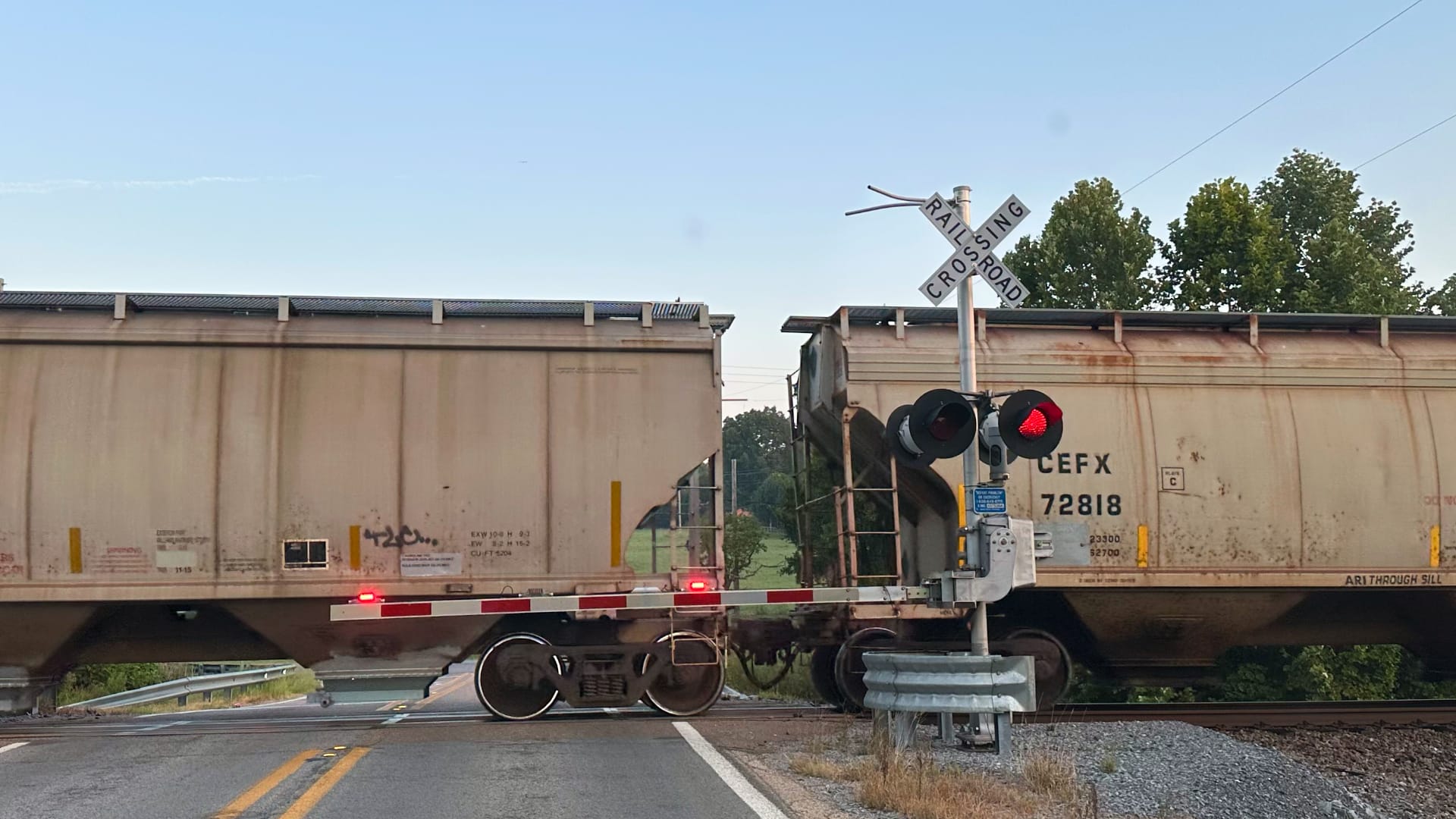
This image shows a long freight train stopped at a railroad crossing with red signal lights flashing. The train cars are large metal boxes on wheels that sit on steel railroad tracks. You can see the crossing sign warning people to stop, and the metal rails that guide the heavy train along the ground.
🔬 Scientific Phenomena
Anchoring Phenomenon: Why does a train need special signals and crossings, and how can something so heavy move so smoothly on metal tracks?
Scientific Explanation: Trains can carry extremely heavy loads because of two key physical principles: (1) Friction reduction—the steel wheels on steel rails create very little friction compared to rubber tires on pavement, allowing enormous weight to move with less force needed, and (2) Weight distribution—the train's heavy load is spread across many wheels and axles, reducing pressure on any single point. The red signal lights exist because trains cannot stop quickly due to their massive momentum (the tendency of a moving object to keep moving). Once a train is in motion, it takes a long distance and time to stop safely, so signals warn vehicles and pedestrians in advance.
📚 Core Science Concepts
- Force and Motion – Trains demonstrate how forces (from the engine) cause objects to move, and how friction between wheels and rails affects that movement.
- Simple Machines (Wheels and Axles) – The train's wheels and axles reduce friction and allow heavy objects to move more easily than they could by sliding.
- Momentum and Inertia – Large, heavy objects like trains take longer to start moving and longer to stop because of their mass. This is why railroad crossings need warning signals.
- Properties of Materials – Steel is chosen for both train cars and rails because it is strong, durable, and creates predictable friction patterns.
Pedagogical Tip:
When teaching about trains, use the concept of "sliding versus rolling" as an anchor. Have students physically experience the difference by comparing how hard it is to push a heavy box across the floor (sliding) versus rolling it on wheels. This tactile experience makes the science of wheels and axles concrete and memorable for third graders.
UDL Suggestions:
Representation: Provide labeled diagrams of train wheels, axles, and track systems. Use videos showing trains in slow motion so students can see how wheels turn and distribute weight.
Action & Expression: Allow students to build model trains with blocks and toy wheels, or create a simple track system with string and cardboard tubes to demonstrate how wheels reduce friction.
Engagement: Connect trains to student experiences—ask if they've heard a train whistle, seen train tracks, or ridden on a train. Personal connections increase motivation and relevance.
🎓 NGSS Connections
Performance Expectation: 3-PS2-1 Plan and conduct an investigation to provide evidence that balanced and unbalanced forces on an object change its motion.
Disciplinary Core Ideas:
- Forces and Motion – The train's heavy cars demonstrate how force from the engine causes motion, and why more force is needed to move very heavy objects.
- Types of Interactions – Friction between steel wheels and steel rails illustrates contact forces that affect how objects move.
Crosscutting Concepts:
- – The engine's force causes the train to move; friction causes it to slow down and stop.
- – The train is a system made of many interconnected parts (engine, cars, wheels, brakes) that work together.
💬 Discussion Questions
- Why do you think the train needs special metal wheels and metal tracks instead of rubber tires like a car? (Bloom's: Understand | DOK: 2)
- If you were standing at this railroad crossing, why would you need to wait even after the train's engine passes by? (Bloom's: Analyze | DOK: 2)
- What would happen if someone tried to push this entire train by hand? What would make it easier to move? (Bloom's: Evaluate | DOK: 3)
- How is the way a train moves on rails similar to or different from the way a toy car moves on the ground? (Bloom's: Analyze | DOK: 3)
📖 Vocabulary
- Friction: A force that slows down or stops objects from sliding or rolling past each other.
- Momentum: The tendency of a heavy, moving object to keep moving and take a long time to stop.
- Axle: A rod or bar that holds wheels in place and allows them to spin.
- Force: A push or pull that can make something move, change direction, or stop.
- Rails: Long steel bars that trains run on, guiding them safely along a specific path.
🌡️ Extension Activities
- Wheels and Friction Investigation: Provide students with toy cars with rubber wheels and toy cars with plastic wheels (or make wheels from clay, foam, and plastic). Have them roll each car down a ramp and measure which one goes farther. Discuss why—connecting to how train wheels are designed for smooth movement on steel rails. Safety note: Use low ramps and a contained space.
- Model Train Track Design: Give students string, tape, and a long table or floor space. Have them design and build a "train track" system using string to outline where trains should go. Ask them: What happens if the track curves too sharply? How would a real train need to slow down? This connects to real engineering decisions.
- Stopping Distance Experiment: Use a toy train or wheeled object and have students predict, then measure, how far it travels after you give it a push. Repeat with different starting forces. Create a chart showing that bigger pushes = longer stopping distances, connecting to why trains need warning signals well in advance of crossings.
🔍 Zoom In / Zoom Out Concepts
Zoom In: The Atomic Level
When steel wheels roll on steel rails, the surfaces look smooth to our eyes, but under a microscope, they're actually bumpy! The tiny bumps on the wheel and the tiny bumps on the rail fit together like puzzle pieces. This creates friction—the invisible force that lets the wheel grip the rail without slipping. If we zoomed in even more to the atomic level, we'd see billions of tiny atoms in the steel that attract each other slightly, helping the wheel and rail "stick" together just enough to prevent sliding. This is why steel on steel works so well for trains!
Zoom Out: The Railroad Network System
One train at one crossing is just one small part of a much larger system. If we zoomed out, we'd see hundreds of miles of railroad tracks connecting cities, farms, factories, and ports across entire states and countries. Trains carry goods like grain, coal, and manufactured products from where they're made to where people need them. The railroad crossing signals we see in this photo are part of a giant communication network—signals, switches, and control centers work together so that many trains can safely travel on the same tracks without crashing. This entire system helps move things that keep our communities running!
🤔 Potential Student Misconceptions
Misconception 1: "Trains stop as quickly as cars do."
Clarification: Many third graders think all vehicles stop the same way. In reality, trains are SO heavy (weighing hundreds of tons) that even with strong brakes, they need a much longer distance to stop—sometimes a mile or more! This is why railroad crossing signals warn people well in advance. A car can stop in seconds, but a train might take several minutes.
Misconception 2: "The train's wheels are sliding along the rails like a pencil sliding across paper."
Clarification: Students often think wheels work by sliding. Actually, wheels roll—they turn in a circle without slipping. This rolling motion is what makes trains so efficient. If wheels were sliding instead of rolling, there would be much more friction, and the train would be very hard to move.
Misconception 3: "The train engine pushes the whole train by being in front of it."
Clarification: Some students imagine the engine like a person pushing a shopping cart. In reality, the engine is connected to the cars with strong metal couplers (like a hook-and-eye). The engine pulls the train cars by being attached to them—it's more like a magnet pulling metal objects than a person pushing something from behind.
🔗 Cross-Curricular Ideas
Mathematics: Measuring and Distance
Have students measure toy train cars and calculate how long a real freight train might be. If one car is 60 feet long and there are 50 cars on a train, how long is the whole train? Create a number line on the classroom floor showing the actual length (in scaled feet or meters) and have students walk it to understand the immense size of real trains.
English Language Arts: Narrative and Descriptive Writing
Ask students to write from the perspective of a train car: "What is it like to be part of a long freight train? What do I see, hear, and feel as I roll down the tracks?" This creative writing exercise helps students apply their scientific knowledge while developing descriptive language skills. Students can illustrate their stories with drawings of trains and railroad crossings.
Social Studies: Transportation and Community
Connect trains to how goods move through communities and across the country. Create a simple map showing where trains go from your local area and what products they might carry (food, toys, building materials). Discuss how trains help people in different towns trade with each other. Visit a local train station or invite a railroad worker to speak to the class about their job.
Art and Engineering Design: Building Model Tracks
Have students design their own railroad systems using craft materials (cardboard tubes for tunnels, blocks for bridges, string for tracks). They can create hills, curves, and crossings, then test how a toy train moves through their design. This combines artistic creativity with engineering thinking—students learn that real railroad engineers have to plan tracks carefully so trains can move safely and efficiently.
🚀 STEM Career Connection
- Mechanical Engineer — Designs things that move — engines, turbines, joints and gears — and works out the forces on them.
- Try it: Design and build a simple pulley system using string and spools to lift a small weight. (Practice: Constructing Explanations and Designing Solutions)
- Tools: CAD software, 3D printers, force sensors, wind tunnels
- Where they work: engineering firms, factories, design studios, research labs
- Meet one: Shini Somara — How air and water flow around things, worked out on a computer before anything is built.
- Median pay: /year — "Mechanical engineers"
- Civil Engineer — Designs the things a town runs on — roads, bridges, water pipes and drains.
- Try it: Draw a plan for a safe railroad crossing, including signs and barriers, to show how to warn drivers. (Practice: Constructing Explanations and Designing Solutions)
- Tools: surveying equipment, CAD software, soil tests, load calculations
- Where they work: construction sites, city engineering departments, design firms, transport agencies
- Meet one: Roma Agrawal — How to hold a skyscraper up — she designed the foundations and the spire of the Shard.
- Median pay: /year — "Civil engineers"
Wage figures are median annual wages for the U.S. occupation named after each one, from the U.S. Bureau of Labor Statistics, Occupational Employment and Wage Statistics (OEWS), national, May 2025. Several careers share one occupation, so their figures match.
---
Teacher Notes: This lesson leverages observable, real-world phenomena that third graders find fascinating. The train crossing is an ideal context for exploring force, motion, and friction because it's something many students have experienced. Scaffold learning by starting with their personal observations, then connecting to the physics principles using hands-on models and investigations.