📸 Photo Description
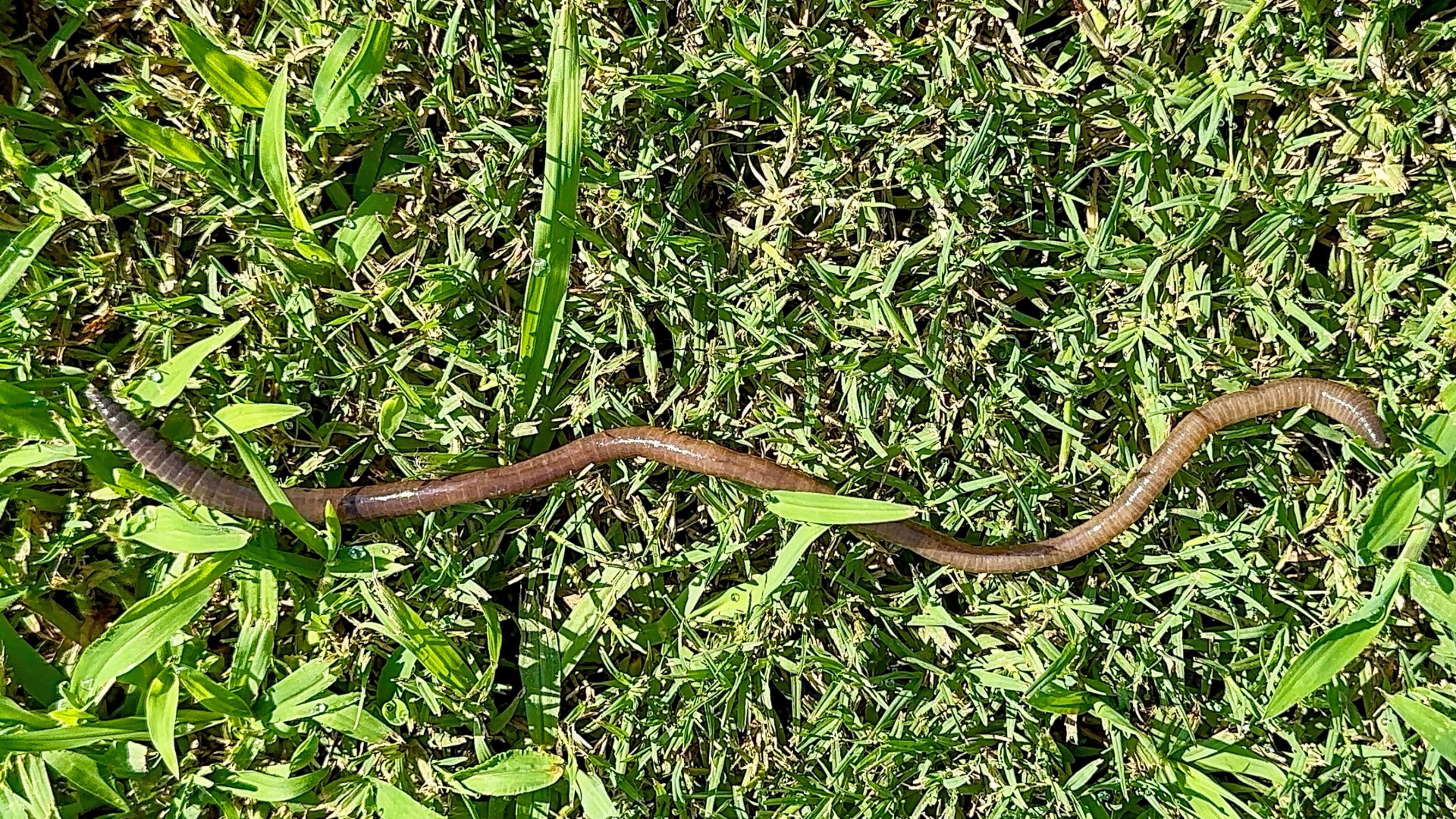
This image shows an earthworm on moist soil and grass. The earthworm has a long, brown body made up of many ring-like segments. You can see the earthworm's smooth, wet skin that helps it move through soil and breathe.
🔬 Scientific Phenomena
Anchoring Phenomenon: Why do earthworms come to the surface after rain?
Earthworms live in soil and breathe through their moist skin. When soil becomes waterlogged after rain, oxygen levels drop in the underground spaces where earthworms live. Earthworms move to the surface where oxygen is more available. This behavior helps them survive, even though it exposes them to new dangers like birds and drying out. This is an example of how organisms respond to changes in their environment.
📚 Core Science Concepts
- Organism Adaptations: Earthworms have segmented bodies and moist skin that help them move through soil and absorb oxygen. Their body shape is perfectly designed for tunnel-making underground.
- Habitat and Environment: Earthworms need dark, moist soil with decomposing plants. They are sensitive to changes in moisture, temperature, and oxygen levels in their habitat.
- Life Cycles and Needs: Like all living things, earthworms need food (decaying plant matter), water, air, and shelter to survive. Understanding these needs helps us care for organisms.
- Decomposition and Soil Health: As earthworms tunnel and eat dead plants, they break down organic matter and create nutrient-rich soil. This process is essential for plant growth and the health of ecosystems.
Pedagogical Tip:
When teaching about earthworms, avoid the common misconception that they are "cut in half and become two worms" if injured. Use this as a teachable moment: earthworms have specialized body segments with different functions. Damage to certain segments cannot be regenerated. This deepens students' understanding of body systems.
UDL Suggestions:
To support diverse learners, provide multiple representations: use actual earthworms in a classroom observation bin (tactile), show labeled diagrams of earthworm anatomy (visual), read aloud descriptions of earthworm behavior (auditory), and allow students to draw or model earthworms with clay (kinesthetic). This multimodal approach ensures all learners can engage with the content.
🎓 NGSS Connections
Performance Expectation:
3-LS1-1: Develop models to describe that organisms have unique and diverse life cycles but all have in common birth, growth, reproduction, and death.
Disciplinary Core Ideas:
- Growth and Development of Organisms
- Adaptation
Crosscutting Concepts:
*
*
💬 Discussion Questions
- What do you think the earthworm needs to stay alive and healthy? (Bloom's: Remember | DOK: 1)
- Why might an earthworm come up to the surface after it rains? What problem is it trying to solve? (Bloom's: Analyze | DOK: 2)
- How do you think the earthworm's long, bendy body helps it survive in the soil? (Bloom's: Explain | DOK: 2)
- If we removed all the earthworms from a garden, what might happen to the soil and plants over time? (Bloom's: Evaluate | DOK: 3)
📖 Vocabulary
- Segment: One of the ring-like sections that make up an earthworm's body; each segment has muscles that help the worm move.
- Moist: Slightly wet; earthworms need moist skin to breathe and absorb oxygen.
- Decompose: To break down or rot; earthworms help decompose dead plants and leaves in the soil.
- Habitat: The place where an animal lives that has everything it needs to survive, like food, water, and shelter.
- Organism: A living thing, like a plant, animal, or insect.
- Adaptation: A special body part or behavior that helps an animal survive in its environment.
🌡️ Extension Activities
- Build an Earthworm Observation Bin: Gather a clear plastic container, layered soil and sand, dead leaves, and a few earthworms. Cover the container with dark paper (earthworms avoid light). Over 1-2 weeks, students observe and sketch the tunnels the earthworms create. Discuss how the worms' activity changes the soil structure. Always return worms to a suitable outdoor habitat afterward.
- Earthworm Movement Investigation: Provide students with earthworms in shallow trays of moist soil. Ask: "How does the earthworm move? What parts of its body move first?" Students observe and record observations using drawings or words. Compare their findings to watch a slow-motion video of earthworm locomotion to deepen understanding.
- Design a Worm Hotel: In small groups, students design and create a "worm habitat" using layers of soil, compost, shredded newspaper, and leaf litter in a see-through container. Students predict what will happen over two weeks, then observe decomposition and tunnel patterns. This connects to environmental stewardship and recycling concepts.
🔍 Zoom In / Zoom Out Concepts
Zoom In: Cellular Respiration Through Skin
Earthworms don't have lungs! Instead, oxygen passes directly through their moist skin into tiny blood vessels just beneath the surface. Inside each cell of the earthworm's body, oxygen helps the worm's cells create energy so the worm can move, eat, and grow. This process happens in billions of microscopic cells all over the earthworm's body. When soil is waterlogged, water blocks oxygen from reaching the soil, so earthworms must come to the surface where air is available for their cells to breathe.
Zoom Out: Earthworms in the Soil Food Web
Earthworms are part of a larger underground community called the soil ecosystem. As earthworms tunnel and eat decaying leaves, they create pathways for water and air to reach plant roots, and they produce nutrient-rich droppings called castings. These nutrients feed plants above ground. Plants feed herbivores, which feed carnivores. If earthworm populations decline, the entire food web is affected—plants grow weaker, animals have less food, and soil quality decreases. Healthy earthworm populations signal a healthy planet.
🤔 Potential Student Misconceptions
Misconception 1: "Earthworms are insects because they wiggle and live in the ground like bugs."
- Scientific Clarification: Earthworms are not insects. Insects have six legs and a hard outer shell (exoskeleton). Earthworms have no legs or hard shell—instead, they have a soft body made of segments with muscles that help them move. They are a different type of animal called an annelid.
Misconception 2: "If you cut an earthworm in half, it becomes two new worms."
- Scientific Clarification: This is only partially true in rare cases. An earthworm has different body parts with different jobs. The head end has a mouth and a brain, while the tail end has reproductive organs. If cut, only the head section might survive and grow a tiny tail. The tail section cannot grow a new head because it doesn't have a brain. The worm cannot truly become "two complete worms."
Misconception 3: "Earthworms come to the surface when it rains because they're drowning in the soil."
- Scientific Clarification: Earthworms don't drown—they actually breathe through their moist skin and can survive in wet soil. However, when soil becomes waterlogged with heavy rain, oxygen levels drop because water fills the air spaces in soil. Earthworms move to the surface where there is more oxygen in the air, not to escape drowning.
🔗 Cross-Curricular Ideas
Math: Measuring and Counting Segments
Have students measure an earthworm (or picture of one) in centimeters and count the number of visible segments. Create a class data chart showing the length and segment count of different earthworms. Students can order earthworms from shortest to longest and practice addition and subtraction by calculating the difference between lengths. Graph the data to compare results.
ELA: Narrative Writing - "A Day in the Life of Worm"
Students write a short narrative story from the earthworm's perspective. "My name is Wiggles, and my day starts when I tunnel through the dark soil..." This creative writing activity helps students practice descriptive language, sequencing, and perspective-taking while reinforcing what they learned about earthworm habitats and behaviors.
Social Studies: Community Helpers - Earthworms in Our Neighborhoods
Connect earthworms to the concept of community helpers. Discuss how earthworms help gardeners, farmers, and parks by improving soil health. Students can create posters or give presentations titled "Earthworms: Nature's Soil Engineers" explaining how these organisms help the human community. This builds understanding of interdependence between humans and nature.
Art: Mixed Media Earthworm Sculptures
Students create three-dimensional earthworm models using paper tubes, brown clay, or rolled paper to show the segmented body structure. They can paint segments in varying brown and reddish tones and add details like mucus-like shine using gloss paint. Display sculptures to show the diversity of earthworm sizes and colors, reinforcing the concept that organisms vary in appearance.
🚀 STEM Career Connection
- Agricultural Scientist — Works out how to grow more food on the same land without wearing the soil out.
- Try it: Design an experiment to test how much decaying leaves an earthworm can eat in one day. (Practice: Constructing Explanations and Designing Solutions)
- Tools: test plots, soil kits, seed drills, yield monitors
- Where they work: research farms, seed companies, extension services, universities
- Meet one: Segenet Kelemu — How to protect African food crops from disease, and how insects themselves can become food.
- Median pay: /year — "Soil and plant scientists"
- Horticulturist — Grows and cares for plants on purpose — choosing what will thrive in a particular place.
- Try it: Explain how adding earthworms to a garden could help plants grow better. (Practice: Constructing Explanations and Designing Solutions)
- Tools: pruning shears, soil test kits, grafting knives, greenhouses
- Where they work: botanical gardens, plant nurseries, city parks, farms and orchards
- Meet one: Carlos Magdalena — How to bring the world's rarest plants back from the edge, including the smallest water lily on Earth after it vanished from the wild.
- Median pay: /year — "Soil and plant scientists"
Wage figures are median annual wages for the U.S. occupation named after each one, from the U.S. Bureau of Labor Statistics, Occupational Employment and Wage Statistics (OEWS), national, May 2025. Several careers share one occupation, so their figures match.