📸 Photo Description
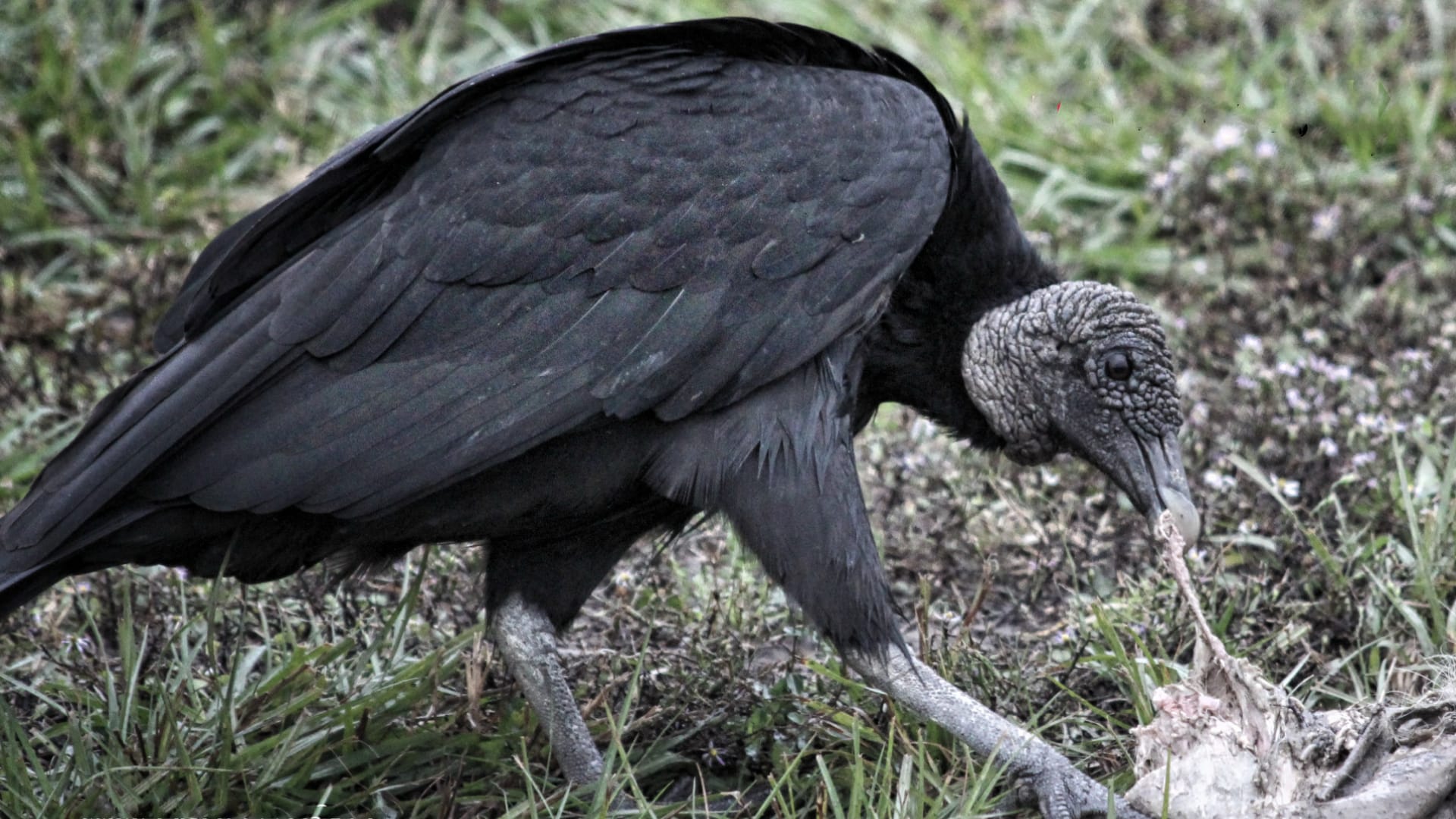
This image shows a large black bird with a bare, wrinkled head and long, thin legs standing on the ground. The bird has dark feathers covering most of its body and appears to be looking down at the ground. This type of bird is a scavenger that eats animals that have already died.
🔬 Scientific Phenomena
Anchoring Phenomenon: Why do some birds have bare heads and eat dead animals?
This bird is a scavenger—an animal that feeds on carrion (dead animals). The bare, featherless head is a key adaptation that prevents feathers from becoming dirty and matted when the bird reaches deep inside dead animal carcasses to eat. Unlike predators that hunt living prey, scavengers play a critical ecological role by removing dead animals from the environment, which prevents disease spread and recycles nutrients back into the soil. This is a survival strategy that has evolved over millions of years because it provides a reliable food source without the danger or energy cost of hunting living animals.
📚 Core Science Concepts
- Adaptation: Body parts (like the bare head) help animals survive in their environment and find food more easily.
- Food Webs and Roles: Scavengers are decomposers that break down dead matter; they occupy a unique and important role in ecosystems different from hunters or herbivores.
- Animal Behavior: Birds have inherited behaviors (instincts) that guide them to find and eat food in specific ways.
- Ecological Relationships: All animals depend on other living and non-living things to survive; scavengers depend on dead animals as their food source.
Pedagogical Tip:
Third graders may initially find scavenging "gross" or negative. Reframe this as a superpower—these birds are nature's cleanup crew! Use language like "nature's recyclers" to help students see the ecological value. This shifts their perspective from disgust to appreciation.
UDL Suggestions:
Representation: Provide images of scavenger birds in their natural habitats alongside diagrams labeling body parts. Use both visual and verbal descriptions. Action & Expression: Allow students to choose how to show learning—some may draw and label adaptations, while others create a food web diagram or act out a scavenger's day. Engagement: Connect to students' prior knowledge by asking, "Who cleans up trash in your neighborhood?" before introducing ecological roles.
🎓 NGSS Connections
Performance Expectation: 3-LS1-1 Develop models to describe that organisms have unique and diverse life cycles but all have in common birth, growth, reproduction, and death.
Disciplinary Core Ideas:
- —Adaptation behaviors and structures that help organisms survive
- —Organisms depend on their environment and each other
Crosscutting Concepts:
- —The bird's bare head is a structure that functions to help it eat efficiently
- —The scavenger is part of a larger food web system
💬 Discussion Questions
- What do you notice about this bird's head compared to other birds you know? (Bloom's: Remember | DOK: 1)
- Why might a bare head be helpful for a bird that eats dead animals? (Bloom's: Infer | DOK: 2)
- How does this bird's role in nature help other living things and the environment? (Bloom's: Analyze | DOK: 3)
- If all the scavenger birds disappeared from an area, what problems might happen? (Bloom's: Evaluate | DOK: 3)
📖 Vocabulary
- Scavenger: An animal that eats dead animals or leftover food instead of hunting living prey.
- Adaptation: A body part or behavior that helps an animal survive and thrive in its environment.
- Carrion: A dead animal's body.
- Ecosystem: All the living and non-living things in an area and how they interact with each other.
- Decomposer: An organism that breaks down dead plants and animals and returns nutrients to the soil.
🌡️ Extension Activities
- Scavenger Bird Adaptation Chart: Students create a two-column chart titled "Adaptations" with drawings and labels of the bird's special features (bare head, long legs, sharp eyes). They write one sentence explaining how each adaptation helps the bird survive. This connects to .
- Food Web Role-Play: Divide the class into groups representing different organisms (plants, herbivores, predators, scavengers, decomposers). Create a physical food web using yarn, with students holding cards, to show how energy and nutrients flow through an ecosystem. Highlight the scavenger's unique position.
- Ecosystem Detective Game: Provide picture cards of various environments (forest, grassland, desert). Students predict which scavenger birds might live there and why. Discuss how scavengers are found in many different habitats because dead animals are everywhere.
🔍 Zoom In / Zoom Out Concepts
Zoom In: Cellular & Digestive Level
When a scavenger bird eats dead animal meat, its stomach acid and special digestive juices break down the protein into tiny, tiny pieces that its body can use for energy and growth. The bird's bare head also has special skin cells that are tougher and easier to clean than feathers would be—kind of like how your hands are easier to wash than your hair!
Zoom Out: Ecosystem & Nutrient Cycling
This single scavenger bird is part of a massive recycling system on Earth. When it eats a dead animal, it's breaking down that body and returning nutrients (like nitrogen and phosphorus) back into the soil through its droppings. Those nutrients feed plants, plants feed herbivores, and the cycle continues. Without scavengers, dead animals would pile up, poison the soil, and spread diseases—the whole ecosystem would get sick!
🤔 Potential Student Misconceptions
Misconception 1: "Scavengers are gross and lazy because they don't hunt."
Clarification: Scavenging is actually a smart survival strategy! It takes less energy than hunting, which means the bird can live in places where food is hard to find. Scavengers are nature's cleanup crew—their job is just as important as a hunter's job. They're not lazy; they're efficient!
Misconception 2: "Dead animals are bad for nature, so scavengers must be bad too."
Clarification: Dead animals are actually really important! Without scavengers eating them, dead animals would rot and spread diseases that could make other animals (and people) very sick. Scavengers prevent this problem. They're helpers, not harmful!
Misconception 3: "This bird looks weird and scary because something is wrong with it."
Clarification: The bare head isn't a problem—it's a perfect design! It's like having special work clothes for a job. Just like a chef wears an apron to stay clean while cooking, this bird's bare head keeps it clean while it eats. It's an adaptation that makes the bird great at its job!
🔗 Cross-Curricular Ideas
ELA Connection: Animal Fact Writing
Students write a short informational paragraph about scavenger birds using the format: "What it is, What it eats, Why it's important to nature." They can practice using transition words like "First," "Next," and "Because" to explain cause-and-effect relationships. This builds non-fiction writing skills while reinforcing science content.
Math Connection: Food Web Counting & Graphing
Create a simple bar graph showing "How many animals does a scavenger bird eat in a week?" Students use given data (e.g., 3 squirrels, 2 rabbits, 1 deer) to practice tallying, counting, and creating pictographs or bar graphs. This makes abstract math concrete through real ecological data.
Social Studies Connection: Community Helpers
Compare scavenger birds to human community workers (garbage collectors, sanitation workers, recycling centers). Discuss how both remove waste and keep communities clean and healthy. Students can create a Venn diagram showing similarities and differences, building appreciation for all types of helpful workers.
Art Connection: Adaptation Illustration & Labeling
Students create a large, detailed colored drawing of the scavenger bird, labeling its special adaptations (bare head, long legs, sharp eyes, strong beak). They use this as a centerpiece for a classroom "Nature's Helpers" bulletin board, combining art skills with scientific observation and vocabulary building.
🚀 STEM Career Connection
- Ecologist — Studies how living things depend on each other and on the place they live.
- Try it: Draw a food web that includes a scavenger and explain its role in connecting different parts of the ecosystem. (Practice: Constructing Explanations and Designing Solutions)
- Tools: quadrat frames, measuring tapes, GPS units, a field notebook
- Where they work: forests, grasslands, wetlands, universities
- Meet one: Sandra Díaz — What a plant's leaves, wood and shape tell you about how it lives — and how those traits add up across a whole ecosystem.
- Median pay: /year — "Environmental scientists and specialists, including health"
- Conservation Biologist — Works out which plants and animals are in trouble, and what would help them recover.
- Try it: Design a poster explaining why scavenger birds are important for keeping the environment clean and healthy. (Practice: Constructing Explanations and Designing Solutions)
- Tools: population surveys, GPS trackers, habitat maps, trail cameras
- Where they work: nature reserves, conservation charities, government agencies, universities
- Meet one: Tierra Curry — Which plants and animals are closest to disappearing, and what it takes to save them.
- Median pay: /year — "Zoologists and wildlife biologists"
Wage figures are median annual wages for the U.S. occupation named after each one, from the U.S. Bureau of Labor Statistics, Occupational Employment and Wage Statistics (OEWS), national, May 2025. Several careers share one occupation, so their figures match.
---
Teacher Note: This lesson builds toward understanding that all organisms, even those students might initially find unpleasant, are essential parts of healthy ecosystems. Use this as an opportunity to cultivate scientific curiosity and ecological appreciation.