📸 Photo Description
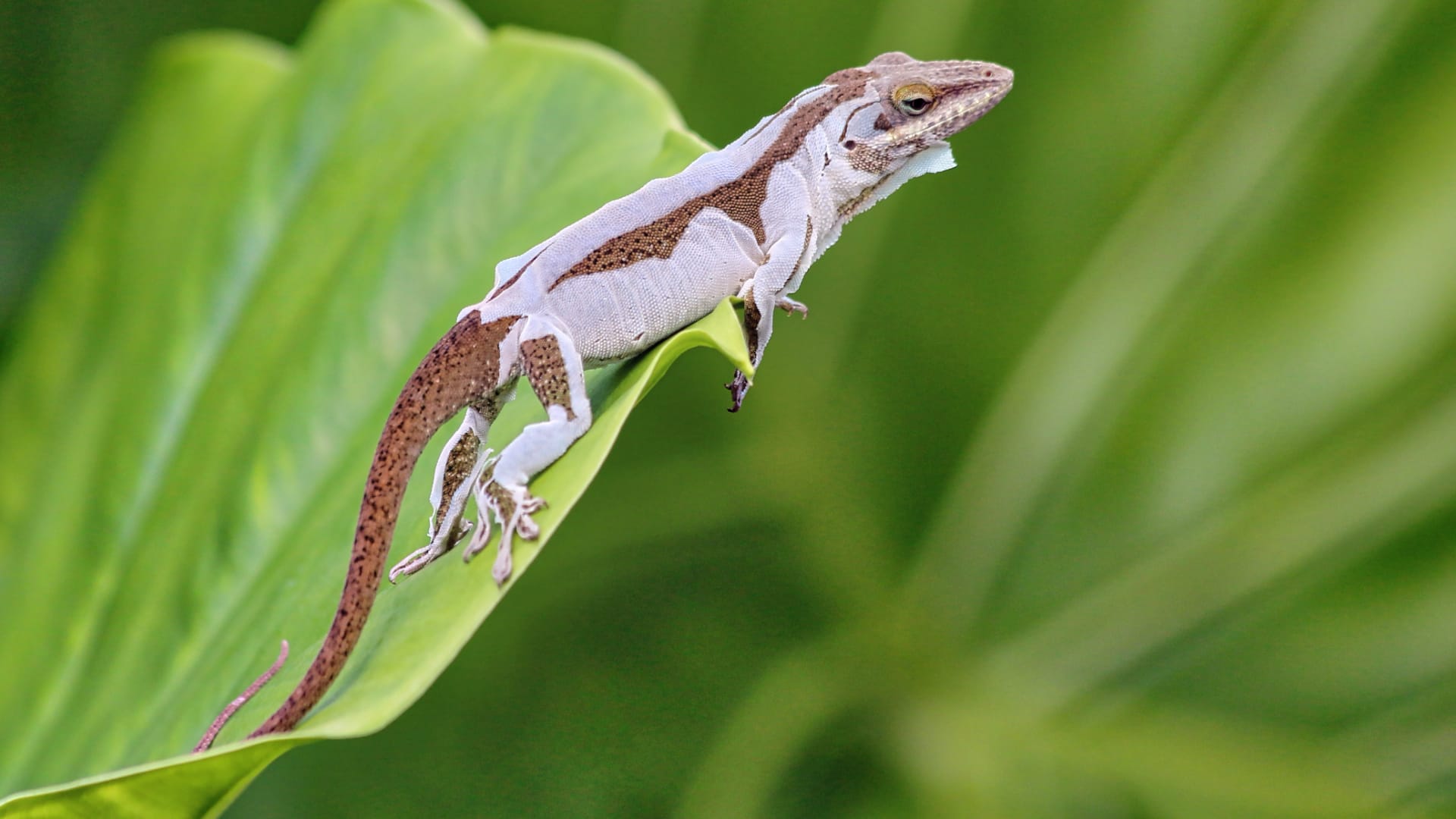
This image shows a small lizard perched on a green leaf. The lizard has brown and white coloring on its body and a long tail. You can see its tiny clawed feet gripping the leaf, and its eye is watching the world around it. This type of lizard is found in warm places and blends in with plants to stay safe.
🔬 Scientific Phenomena
Anchoring Phenomenon: Why does this lizard have two different skin colors—brown on one side and white on the other?
This is an example of camouflage and adaptation. Lizards like this one have special skin coloring that helps them hide from predators and stay safe in their environment. The brown side matches tree bark and leaves, while the lighter side may match sky or lighter plant parts. As reptiles grow, their skin doesn't stretch like ours does—instead, they shed their old skin and grow new skin underneath. This process is called molting. The different colors visible on this lizard's body may show areas where old skin is coming off and new skin is showing underneath, helping scientists see that the lizard is growing and changing.
📚 Core Science Concepts
- Adaptation and Camouflage: Animals have body features that help them survive in their habitats. This lizard's coloring helps it hide from larger animals that might eat it.
- Growth and Change in Living Things: All animals grow bigger over time. Reptiles shed their skin as they grow because their skin cannot stretch like human skin can.
- Skin as Protection: A lizard's skin protects its body from the environment and helps it stay the right temperature. Skin is the largest organ on any animal's body.
- Reptile Characteristics: Reptiles are cold-blooded animals with scaly skin, claws, and tails. They lay eggs and must find warm or cool places to control their body temperature.
Pedagogical Tip:
When teaching about animal adaptations, anchor lessons to students' own bodies first. Ask: "How does YOUR skin help keep you safe and healthy?" This concrete connection helps Third Graders transfer learning from themselves to animals, making the concept more memorable and meaningful.
UDL Suggestions:
Provide multiple representations of lizard anatomy: labeled photographs, real lizard videos, tactile models, and digital illustrations. Some students will understand camouflage better through hands-on activities (hiding patterned paper animals in patterned backgrounds) rather than discussion alone. Consider pairing visual learners with kinesthetic activities to reach all learners in your classroom.
🎓 NGSS Connections
Performance Expectation:
3-LS1-1: Develop models to describe that organisms have unique and diverse life cycles but all have in common birth, growth, reproduction, and death.
Disciplinary Core Ideas:
- Growth and Development of Organisms
- Variation of Traits
- Adaptation
Crosscutting Concepts:
- (The pattern of the lizard's coloring relates to its environment)
- (The lizard's skin structure helps it survive)
💬 Discussion Questions
- How does the lizard's coloring help it stay safe? (Bloom's: Understand | DOK: 1)
- Why do you think a lizard needs to shed its skin as it grows, but you don't have to shed your skin? (Bloom's: Analyze | DOK: 2)
- If this lizard lived on a bright green plant all the time, how might its coloring be different over many generations? (Bloom's: Evaluate | DOK: 3)
- What other animals do you know that change how they look as they grow, and how is that similar to or different from how the lizard changes? (Bloom's: Analyze | DOK: 2)
📖 Vocabulary
- Camouflage: Coloring or patterns on an animal's body that help it blend in with its surroundings so predators cannot see it easily.
- Adaptation: A special body part or behavior that helps an animal survive in its environment.
- Reptile: A cold-blooded animal with scaly skin, claws, and a backbone that lays eggs.
- Molt (or Shed): When an animal loses its old skin, feathers, or outer covering so new growth can happen underneath.
- Predator: An animal that hunts and eats other animals for food.
- Habitat: The place where an animal lives, such as a forest, desert, or rainforest.
🌡️ Extension Activities
Activity 1: Camouflage Hide-and-Seek
Create paper lizards with different color patterns (solid brown, striped, spotted, solid green). Hide them in various classroom environments: on a green poster board, on a brown paper bag, on a patterned rug, and on a plain white wall. Have students search for them and discuss which ones were easiest and hardest to find. Ask: "Why were some lizards easier to find?" Connect this to how real lizards survive in nature.
Activity 2: Skin Shedding Simulation
Provide students with a stretchy sock or stocking material. Have them put their hand in it and try to stretch it as their hand grows. Then show them how it tears or wears out. Explain that reptile skin works the same way—it doesn't stretch, so the animal must shed it and grow new skin. You can use cellophane or plastic wrap as an alternative tactile material.
Activity 3: Life Cycle Diagram
Have students create a visual life cycle wheel for a lizard showing birth (hatching from egg), growth (getting bigger), adult stage, and reproduction (laying eggs). Students can draw or trace each stage around a circle, adding colors to show how camouflage might change as the lizard grows.
🔍 Zoom In / Zoom Out Concepts
Zoom In: The Cellular Level
Under a microscope, if we could look very closely at the lizard's skin, we would see tiny structures called cells. A lizard's skin cells are packed together tightly like a brick wall. These cells have a special protein called keratin that makes the skin tough and scaly. When a lizard molts, the old layer of skin cells separates from the new layer growing underneath. The brown and white colors we see come from tiny pigment cells within the skin that contain different colored chemicals. As the lizard sheds its old skin, we can sometimes see where new pigment cells are making fresh colors underneath!
Zoom Out: The Ecosystem Connection
This little lizard is part of a larger community called an ecosystem. The green leaf it's sitting on provides food for insects, which the lizard hunts and eats. The lizard itself becomes food for larger predators like birds and snakes. The tree that grows the leaf needs sunlight and water from the soil. The lizard helps the ecosystem by controlling insect populations and becoming food for other animals. If the plants in this ecosystem disappeared, the lizard would have nowhere to hide and no insects to eat. If the lizards disappeared, the birds and snakes that eat them would need to find other food. Every living thing—from the tiniest soil bacteria to the largest tree—is connected in this web of life.
🤔 Potential Student Misconceptions
Misconception 1: "Lizards take off their skin like clothes."
Clarification: Lizards don't remove their skin the way we take off a jacket. Instead, the old outer layer of skin naturally peels away in patches or strips over time as new skin grows underneath. It's not something the lizard decides to do—it just happens automatically as part of growing. Sometimes lizards eat the shed skin to get nutrients back into their bodies!
Misconception 2: "All lizards are green or brown to match plants."
Clarification: While camouflage is important, not all lizards use coloring to hide. Some lizards are brightly colored with reds, yellows, and blues to warn predators: "I'm poisonous, don't eat me!" Other lizards live in deserts or rocks and have different colors to match those environments. Camouflage is one adaptation, but lizards use many different strategies to stay safe.
Misconception 3: "The lizard's two-colored body means it's sick or broken."
Clarification: When we see a lizard with very different coloring on different parts of its body (like this one), it's usually because the lizard is in the middle of shedding its skin. The lighter areas show new skin coming in, and the darker areas show old skin still attached. This is completely normal and healthy! It's a sign the lizard is growing and developing properly.
🔗 Cross-Curricular Ideas
Math Connection: Measuring Growth
Have students measure and graph the growth of a lizard (using pictures or videos showing the same individual over time, or data from a local zoo or nature center). Students can create bar graphs or line graphs showing how lizard length increases each year. They can also estimate: "If a baby lizard is 2 inches long and grows 1 inch per year, how long will it be in 5 years?" This connects measurement, data representation, and multiplication concepts.
ELA Connection: Write a Lizard's Day
Students write a short narrative story from the lizard's perspective: "A Day in My Life as a Lizard." They can describe what the lizard sees, hears, and does throughout the day, incorporating vocabulary like camouflage, molting, predator, and adaptation. Encourage descriptive language about the green habitat and the lizard's feelings (though anthropomorphized) as it hunts for food and avoids danger. This builds narrative writing skills while reinforcing science concepts.
Art Connection: Camouflage Painting and Collage
Students create their own "camouflage lizard" by first painting or collaging a background (forest, desert, or rocky environment with specific colors and textures), then creating a lizard body and coloring it to blend into that specific background. Display the finished artwork and challenge classmates to find the hidden lizards. This combines color theory, fine motor skills, and artistic creativity with the science concept of adaptation.
Social Studies Connection: Habitats Around the World
Research where different types of lizards live around the globe (deserts in Africa, rainforests in South America, grasslands in Australia, etc.). Create a world map and mark different lizard habitats with illustrations or photos. Discuss how the climate, plants, and other animals in each habitat influence what the lizards look like and how they behave. This builds geography skills and global awareness while deepening understanding of how habitats shape adaptations.
🚀 STEM Career Connection
- Herpetologist — Studies reptiles and amphibians — snakes, lizards, frogs and turtles.
- Try it: Explain why a lizard might have different colors on its body. (Practice: Constructing Explanations and Designing Solutions)
- Tools: snake hooks, pitfall traps, temperature probes, a field notebook
- Where they work: deserts and wetlands, zoos, natural history museums, universities
- Meet one: Earyn McGee — What happens to desert lizards when the streams they live near dry up.
- Median pay: /year — "Zoologists and wildlife biologists"
- Conservation Biologist — Works out which plants and animals are in trouble, and what would help them recover.
- Try it: Design a safe habitat for a lizard that includes hiding places. (Practice: Constructing Explanations and Designing Solutions)
- Tools: population surveys, GPS trackers, habitat maps, trail cameras
- Where they work: nature reserves, conservation charities, government agencies, universities
- Meet one: Tierra Curry — Which plants and animals are closest to disappearing, and what it takes to save them.
- Median pay: /year — "Zoologists and wildlife biologists"
Wage figures are median annual wages for the U.S. occupation named after each one, from the U.S. Bureau of Labor Statistics, Occupational Employment and Wage Statistics (OEWS), national, May 2025. Several careers share one occupation, so their figures match.
---
Teacher Notes: This lesson builds foundational understanding of animal adaptations and life processes. By connecting the visible characteristics in the photo to survival strategies, Third Graders develop ecological thinking. Emphasize that animals change and adapt over both their individual lifetimes (molting, growing) and over many generations (evolution of coloring patterns). This scaffolds toward more complex adaptation concepts in upper grades.