📸 Photo Description
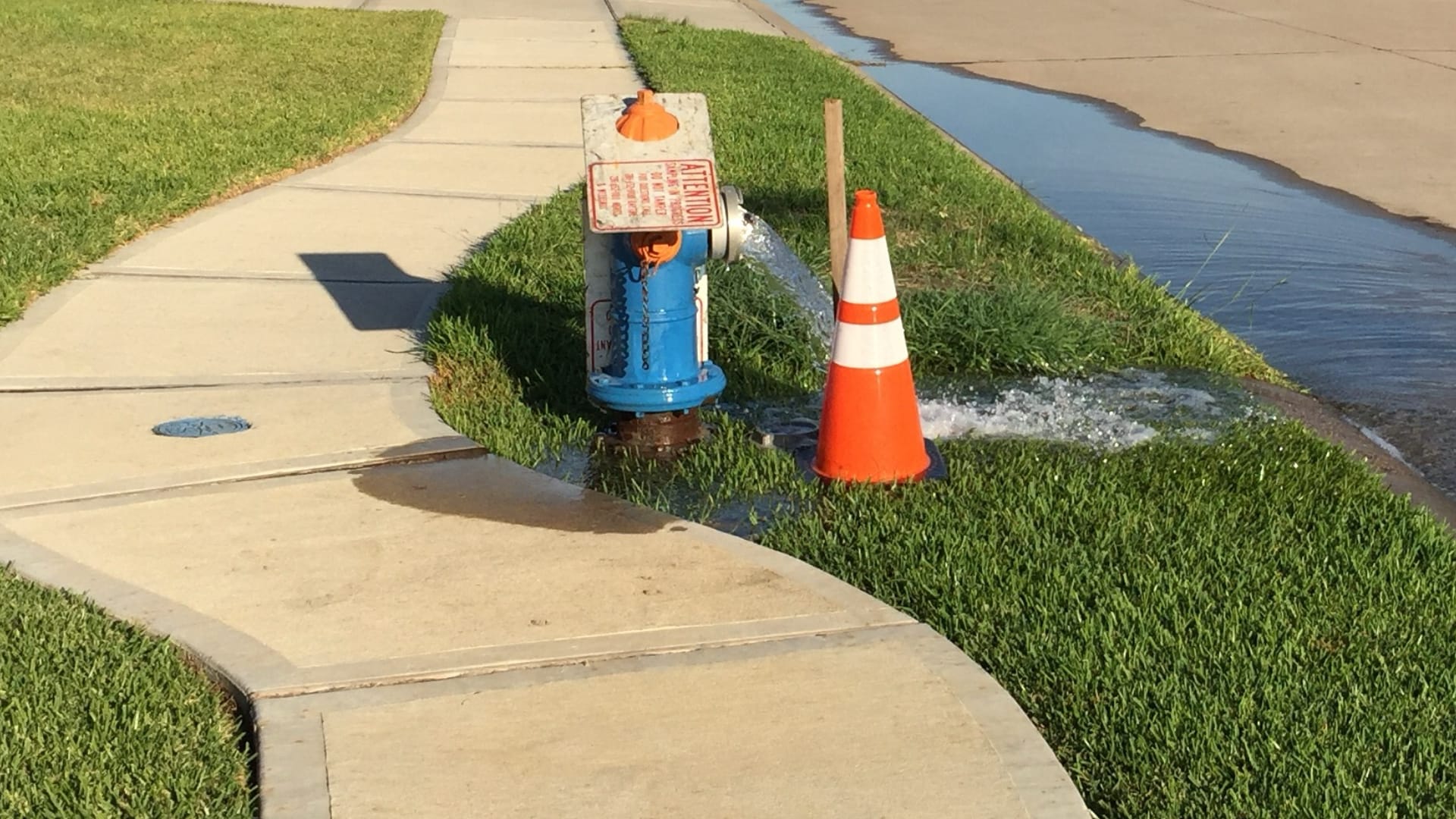
This image shows a blue water valve or meter located near a sidewalk and grassy area, with an orange and white traffic cone beside it next to a small body of water. The valve has a warning sign on top and appears to be part of a water management or drainage system in a residential area.
🔬 Scientific Phenomena
Anchoring Phenomenon: Water management and flow in community infrastructure.
The cone and valve placement demonstrate how engineers control and direct the movement of water through pipes and systems. Water naturally flows downward due to gravity, but humans design valves, meters, and pipes to control where and how fast water moves. In this case, the system likely manages stormwater runoff (water from rain and irrigation) that flows from the sidewalk and grass toward the retention pond or drainage system visible in the image. The valve allows operators to open, close, or regulate water flow, while the cone warns people about the work site.
📚 Core Science Concepts
- Gravity and Water Flow: Water moves downward and seeks the lowest point. Gravity pulls water from higher areas (sidewalk, grass) toward lower areas (the pond), and pipes and valves help guide this natural movement.
- States of Water: The image shows water in its liquid state in the pond. Water can exist as a solid (ice), liquid (water), or gas (water vapor). The water in this system is liquid but may evaporate into gas or freeze into ice depending on temperature.
- Engineering and Human Systems: People design valves, pipes, and drainage systems to control water movement in communities. These tools help prevent flooding, protect property, and manage water resources.
- Observable Properties of Water: Water is transparent (you can see through it), it reflects light, and it takes the shape of its container (the pond or pipes).
Pedagogical Tip:
Use this image as a "mystery" prompt: "Why do you think someone put this valve and cone here?" This activates prior knowledge and creates curiosity before teaching formal concepts. Third graders benefit from concrete, visible systems before abstract explanations.
UDL Suggestions:
Multiple Means of Engagement: Some students may connect better to this image through tactile exploration. Consider providing students with a simple valve model or allowing them to manipulate a toy water system. Additionally, connect the image to students' own experiences: "Have you seen water drains near your home or school?" This personalizes the learning and increases relevance for diverse learners.
🎓 NGSS Connections
Performance Expectation:
3-PS2-1: Plan and conduct an investigation to provide evidence that balanced and unbalanced forces on an object change its shape, motion, or direction.
Disciplinary Core Ideas:
- - Forces and Motion: The location of an object can change, and that change in position is called motion. (Water moves through pipes due to gravitational force.)
- - Engineering Design: People design solutions to solve problems caused by natural events and processes. (Valves and drainage systems solve water management problems.)
Crosscutting Concepts:
- - Water systems have parts (valves, pipes, reservoirs) that work together.
- - Gravity causes water to flow; valves cause water flow to stop or slow.
💬 Discussion Questions
- Why do you think engineers built a pipe and valve system in this neighborhood? (Bloom's: Understand | DOK: 2)
- What would happen to the water without this drainage system during a heavy rainstorm? (Bloom's: Analyze | DOK: 3)
- How is a water valve similar to a faucet in your kitchen or bathroom? (Bloom's: Compare | DOK: 2)
- What do you think the orange cone is warning people about, and why is safety important around water systems? (Bloom's: Evaluate | DOK: 3)
📖 Vocabulary
- Valve: A device that opens, closes, or controls the flow of water through a pipe (like a switch for water).
- Drainage System: Pipes and structures designed to collect and move water away from areas where people live.
- Gravity: The force that pulls objects and water downward toward Earth.
- Liquid: A state of matter that has a definite volume but no definite shape—it takes the shape of its container (like water).
- Meter: A device that measures or counts something, such as how much water flows through a pipe.
🌡️ Extension Activities
- DIY Water Flow Experiment: Provide students with clear plastic tubes, funnels, and water. Have them design their own simple drainage system using blocks and cups to show how water flows downhill. Ask them to predict and test different angles and obstacles. This directly models the real system in the photo.
- Community Water Walk: Take students on a short, supervised walk around the school or neighborhood to identify other water management features (storm drains, gutters, downspouts, retention ponds). Create a class map marking these locations and discussing what each does.
- Gravity and Flow Investigation: Fill clear containers with water and provide various materials (straws, funnels, small tubes). Have students explore how gravity affects water movement and how tools can redirect its flow. Connect observations back to the valve system in the photo.
🔍 Zoom In / Zoom Out Concepts
Zoom In: Molecular Level – Water Molecules in Motion
Even though water looks smooth when it flows through the pipe, it's actually made of billions of tiny particles called molecules moving and bumping into each other. When gravity pulls on water, it's pulling on all these molecules at once, making them move together downward. Inside the valve, there are even tinier spaces where water molecules squeeze through when the valve opens. If we could see at this super-tiny level with a special microscope, we'd watch individual water molecules racing through the pipe!
Zoom Out: Watershed System – Water's Journey Through the Community
This single valve is just one small piece of a much larger system called a watershed. Rain falls on rooftops, sidewalks, and grass across the entire neighborhood and nearby areas. All that water flows downhill through gutters, drains, pipes, and valves like the one in this photo. It eventually collects in retention ponds (like the one visible here), then moves to larger rivers, streams, or treatment facilities. This water system connects the whole community together—water from your neighbor's yard might flow through this same valve! Understanding this "zoom out" perspective helps students see that their local actions (like not littering near drains) affect water quality downstream.
🤔 Potential Student Misconceptions
Misconception 1: "Water just disappears when it goes down a drain."
Clarification: Water doesn't vanish—it goes somewhere! Through pipes and valves like this one, water is directed to other places: treatment facilities, rivers, ponds, or back into the ground. Help students trace the water's journey by following the pipe or asking, "Where do you think the water goes after it leaves this valve?" Use the visible pond in the photo as proof that water collects and stays somewhere.
Misconception 2: "Valves work like magic—you turn them and water just stops."
Clarification: Valves aren't magic; they're simple machines! Inside a valve is a small gate, ball, or plug that either blocks the pipe opening or lets water through. When you turn the handle, you're moving this gate to open or close the path. You can demonstrate this with a simple toy valve or by using a straw and your finger to show how blocking a hole stops water flow.
Misconception 3: "Only rain creates water that needs to be drained; we don't need drainage systems on sunny days."
Clarification: Water systems work year-round! People water lawns, wash cars, and use water indoors even on sunny days. All that water has to go somewhere—it drains through pipes. Additionally, groundwater (water underground) and water from melting snow also need drainage. The drainage system is always "on duty," not just during rainstorms.
🔗 Cross-Curricular Ideas
Math: Measuring Water Flow
Create a simple math activity where students estimate and measure how long it takes water to fill a container. Connect this to the valve: "If this valve controls water flow, how might we measure whether it's letting water flow fast or slow?" Students can time water draining from a bucket with the "valve" (a faucet) open versus closed, then compare measurements and create a simple bar graph showing the differences. This integrates measurement, time, and data representation.
ELA: Narrative Writing – "A Drop of Water's Adventure"
Have students write a short story from the perspective of a water droplet that falls as rain, flows through the neighborhood, passes through this valve, and ends up in the pond. The narrative should include where the water goes and what it "sees" along the way. This builds writing skills while reinforcing the water's journey through the system. Students can illustrate their stories and create a class book titled "Tales from the Drainage System."
Social Studies: Community Infrastructure & Engineering
Expand the concept to discuss how communities plan and maintain water systems. Ask: "Who do you think maintains this valve? Why is teamwork important for water systems?" Discuss local water departments, city planners, and civil engineers. Have students create a simple "Thank You" poster or letter to thank the people who keep water systems working in their community. This connects science to civic responsibility and career awareness.
Art: Design a Water System
Provide students with art materials (paper, markers, clay, recyclables) and ask them to design their own drainage system for a pretend neighborhood. Students draw or build where valves should go, where pipes lead, and where water should collect. This creative engineering task helps students apply their understanding of water flow while developing spatial reasoning and design thinking. Display finished designs and have students explain their choices to classmates.
🚀 STEM Career Connection
- Civil Engineer — Designs the things a town runs on — roads, bridges, water pipes and drains.
- Try it: Design and build a simple system using tubes and containers to move water from a high point to a low point, and explain how your design controls the water's flow. (Practice: Constructing explanations and designing solutions)
- Tools: surveying equipment, CAD software, soil tests, load calculations
- Where they work: construction sites, city engineering departments, design firms, transport agencies
- Meet one: Roma Agrawal — How to hold a skyscraper up — she designed the foundations and the spire of the Shard.
- Median pay: /year — "Civil engineers"
- Environmental Engineer — Designs the systems that clean water, cut pollution and deal with waste.
- Try it: Imagine a spill of glitter (representing pollution) into a small model stream; design and test a simple filter using household materials to remove the glitter from the water. (Practice: Constructing explanations and designing solutions)
- Tools: water treatment models, air samplers, filtration rigs, CAD software
- Where they work: treatment plants, engineering firms, environmental agencies, universities
- Meet one: Yewande Akinola — How to get clean water to places that do not have it, and how to design buildings that waste less of it.
- Median pay: /year — "Environmental engineers"
Wage figures are median annual wages for the U.S. occupation named after each one, from the U.S. Bureau of Labor Statistics, Occupational Employment and Wage Statistics (OEWS), national, May 2025. Several careers share one occupation, so their figures match.
---
Teacher Notes: This image is an excellent real-world anchor to introduce water systems, gravity, and engineering design. Third graders are naturally curious about their physical world and community infrastructure. By connecting abstract concepts (gravity, states of matter) to a concrete, visible system, you help students develop systems thinking—a key NGSS practice. Encourage students to notice water management systems in their own lives and share observations.