📸 Photo Description
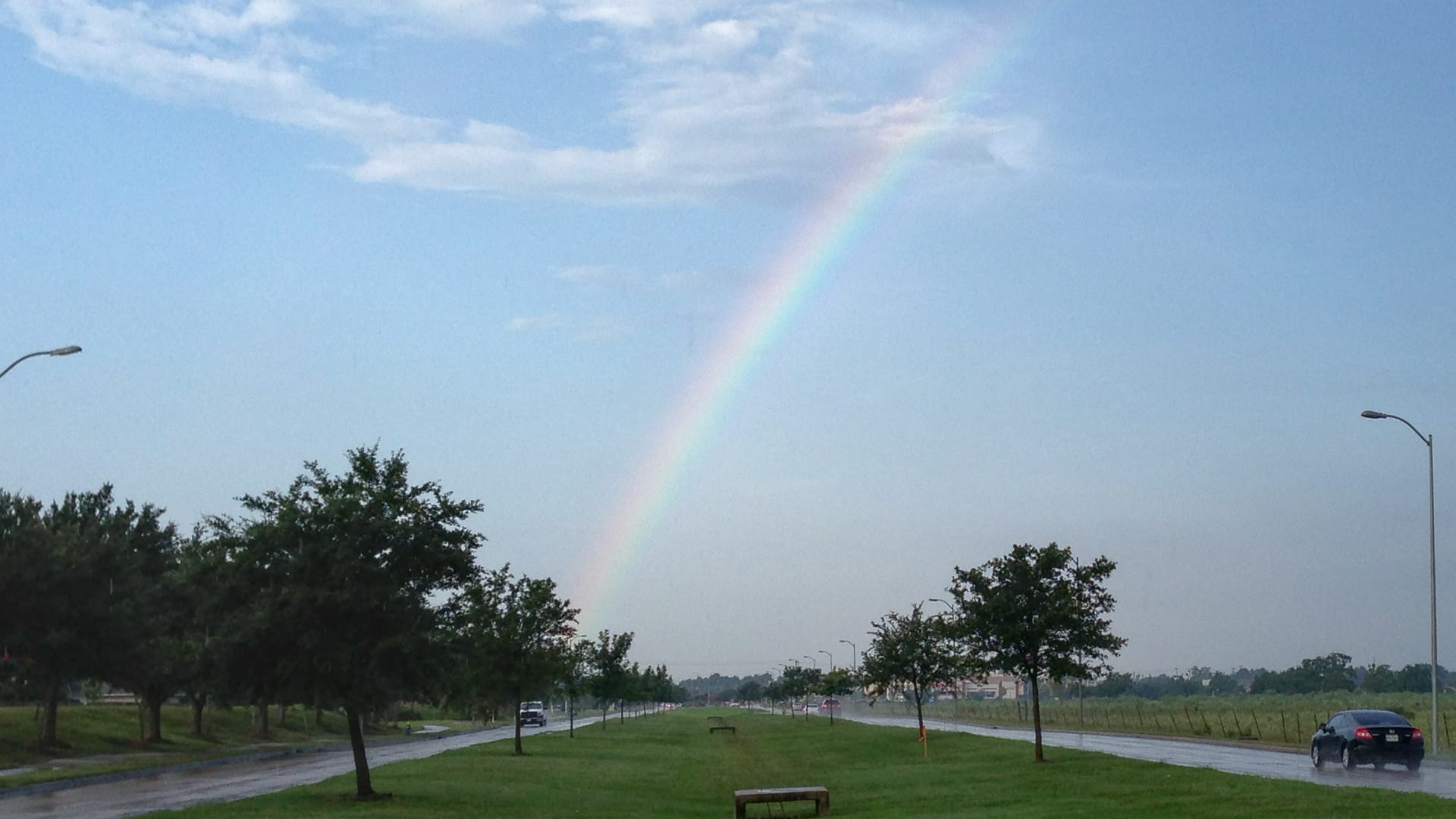
This image shows a beautiful rainbow stretching across a rainy sky above a divided highway with green grass, trees, and street lights on both sides. After rain, sunlight and water droplets in the air work together to create this colorful arc. You can see how the rainbow appears when the sun shines from behind the observer through millions of tiny water drops.
🔬 Scientific Phenomena
Anchoring Phenomenon: Light refraction and dispersion creating a rainbow.
Why it happens: Rainbows occur when three conditions align: sunlight, water droplets in the air, and the observer positioned correctly. Sunlight enters each water droplet, bends (refracts) as it enters, reflects off the back of the droplet like a mirror, and bends again as it exits. Different colors of light bend at slightly different angles, which separates white sunlight into its component colors: red, orange, yellow, green, blue, indigo, and violet. The observer always sees the rainbow at approximately a 42-degree angle from the antisolar point (the point directly opposite the sun).
📚 Core Science Concepts
- Light travels in straight lines but can bend: When light passes through water droplets, it changes direction. This bending of light is called refraction. Students can observe this by looking at a pencil in a glass of water—it appears bent because light bends as it moves from water to air.
- White light is made of many colors: Sunlight appears white, but it actually contains all the colors of the rainbow mixed together. When light bends and separates in water droplets, we see these colors individually.
- Rainbows require specific conditions: Three things must happen together for a rainbow to appear: the sun must shine, there must be water droplets in the air (from rain, mist, or a sprinkler), and the observer must be positioned between the sun and the water droplets.
- Colors always appear in the same order: The colors of a rainbow always appear in the same sequence because each color bends at a slightly different angle. Red bends the least and appears on the outside; violet bends the most and appears on the inside.
Pedagogical Tip:
Build prior knowledge by asking students to recall times they've seen rainbows before discussing this image. Third graders learn best through personal connection and observation. Consider showing the rainbow photo first without explanation, asking "What do you wonder about?" before introducing scientific vocabulary. This activates curiosity and engagement.
UDL Suggestions:
Multiple Means of Representation: Provide a simplified diagram showing how light bends through a water droplet alongside the photograph. Use different colored arrows to show light paths. Multiple Means of Action & Expression: Allow students to demonstrate understanding by drawing their own rainbows, creating a rainbow with a prism or water spray, or explaining the phenomenon using manipulatives (colored beads, mirrors, water droplets). Multiple Means of Engagement: Connect rainbows to cultural significance, mythology, or student artwork to increase relevance and motivation.
🎓 NGSS Connections
Relevant Performance Expectation:
- 3-PS2-1: Plan and conduct an investigation to provide evidence that pushes, pulls, and some other forces can change the speed or direction of an object's motion. (Note: While light behavior connects to force concepts, the primary standard is below.)
- K-PS3-1 and 4-PS4-2: Make observations to determine the effect of sunlight on Earth's surface (K-PS3-1); develop a model to describe that light reflecting from objects and entering the eye allows objects to be seen (4-PS4-2).
Disciplinary Core Ideas:
- : Light can travel in straight lines and can bend (refract) when it passes through different materials.
- : Objects can be seen when light is available to illuminate them.
Crosscutting Concepts:
- : The colors of a rainbow always appear in the same order due to the predictable pattern of light refraction.
- : Specific conditions (sun, water droplets, observer position) cause rainbows to form.
💬 Discussion Questions
- Why do you think a rainbow only appears when it's raining and sunny at the same time? (Bloom's: Analyze | DOK: 2)
- If you tried to walk toward a rainbow, do you think you could catch it or touch it? Why or why not? (Bloom's: Evaluate | DOK: 3)
- What would happen to the rainbow if there were no water droplets in the air? (Bloom's: Understand | DOK: 2)
- Can you think of other times you might see a rainbow besides during rain? (Bloom's: Create | DOK: 3)
📖 Vocabulary
- Rainbow: A colorful arc in the sky made when sunlight shines through water droplets after rain.
- Refraction: The bending of light as it passes through water or other materials.
- Light: Energy that helps us see; it travels very fast in straight lines from the sun or light bulbs.
- Water droplet: A tiny drop of water in the air or on a surface.
- Sunlight: The light that comes from the sun, which is actually made of all the colors mixed together.
- Prism: A clear object (like a triangular glass) that can bend light and separate it into rainbow colors.
🌡️ Extension Activities
- Create a Rainbow with a Prism or Water Spray: On a sunny day, take students outside with a clear prism or create a rainbow using a spray bottle. Have them observe the colors and order them from outside to inside. Ask: "How is this rainbow like the one in the photo? How is it different?" This hands-on experience makes the concept concrete and memorable.
- Rainbow Color Ordering Game: Provide students with colored strips of paper (red, orange, yellow, green, blue, indigo, violet) and have them arrange the colors in the correct rainbow order. Mix them up and repeat. Then show pictures of rainbows and have students identify if the colors are in the correct order. This reinforces the pattern concept.
- Design a Rainbow Experiment: Challenge students to predict where a rainbow would appear if they stood in different positions relative to the sun and water droplets. Have them test their predictions during a field trip or on a day when a sprinkler is available. Record observations with drawings and words: "Did the rainbow appear where we predicted?"
🔍 Zoom In / Zoom Out Concepts
Zoom In: The Microscopic Dance of Light and Water
Imagine zooming in so close that you could see inside a single raindrop—much smaller than an ant! Inside that tiny droplet, light is doing something amazing. When light enters the water droplet, it's like a car driving into a thick fog; it has to slow down and change direction. This happens because water is denser (thicker and heavier) than air. As the light bounces around inside the droplet like a ball in a mirror maze, each color of light bends at a slightly different angle. Red light bends just a little, while violet light bends much more. This tiny difference in bending is what separates white sunlight into all the colors we see in a rainbow. Billions and billions of water droplets are doing this at the same time, and together they create the colorful arc we observe in the sky.
Zoom Out: Rainbows and Earth's Water Cycle
Now zoom out and think about where those water droplets come from! They're part of Earth's water cycle—a continuous journey that water takes around our planet. Water evaporates from oceans, lakes, and rivers, turning into invisible water vapor in the air. When that vapor rises high and cools down, it condenses into clouds made of millions of tiny water droplets. When clouds become heavy with water, rain falls back to Earth. In this photo, we're seeing a rainbow during that rainy moment. But the story doesn't end there! That rainwater flows into rivers and streams, soaks into the ground to help plants grow, and eventually returns to oceans and lakes, where the cycle begins again. Rainbows are a beautiful reminder that Earth's water is constantly moving, changing, and connecting all living things.
🤔 Potential Student Misconceptions
Misconception 1: "Rainbows are objects I can catch or walk to."
Third graders often think rainbows are solid things floating in the sky that can be reached or touched. They may try to walk toward a rainbow and become frustrated when it seems to move away.
Scientific Clarification: A rainbow isn't a physical object—it's an optical illusion created by light bending through water droplets from your specific viewpoint. Each person sees a different rainbow depending on where they stand! If you move, the rainbow appears to move with you because the angle between you, the sun, and the water droplets changes. It's like looking at your reflection in a mirror; the reflection moves when you move, but there's nothing actually there to catch.
Misconception 2: "The rainbow has a pot of gold or treasure at the end."
This folklore-based misconception is common in third grade. Students believe the rainbow has an actual end point they could reach.
Scientific Clarification: Because a rainbow is created from your specific position, it doesn't have a beginning or end that you can reach. The rainbow's arc is always centered on the point directly opposite the sun (from your viewpoint), at an angle of about 42 degrees. No matter where you go, you always see the rainbow at this same angle from the sun, so the "end" is always the same distance away—unreachable!
Misconception 3: "All rainbows look the same to everyone watching."
Students may think that everyone sees the exact same rainbow in the same location.
Scientific Clarification: Each person sees their own unique rainbow! Two people standing next to each other will see slightly different rainbows because the light is bending through different water droplets to reach their eyes. The rainbow we see depends on our position relative to the sun and the water droplets. This is why rainbows seem to "follow" us as we move—we're always creating our own personal rainbow based on our perspective.
🔗 Cross-Curricular Ideas
Math Connection: Rainbow Angles and Geometry
Students can learn that rainbows always form at a specific angle (about 42 degrees from the antisolar point). Create a simple protractor activity where students measure angles using a paper plate divided into sections. Have them predict the angle of the rainbow in photos and measure it with a homemade angle tool. This connects light refraction to geometric measurement and introduces the concept that science follows mathematical patterns.
ELA Connection: Rainbow Poetry and Descriptive Writing
Students can write descriptive poems or short stories about rainbows using sensory language. Provide sentence frames like: "The rainbow looked like... It appeared when... I felt... because..." Have students read A Rainbow of My Own by Don Freeman and then write their own stories about an imaginary adventure with a rainbow. This strengthens vocabulary (including science terms like refraction and water droplet) while exploring creative expression.
Art Connection: Color Mixing and Light Exploration
Connect the rainbow's color spectrum to art class by experimenting with color mixing. Students can use watercolors or food coloring in water to observe how colors blend and separate. Create a rainbow art project by layering tissue paper in the correct rainbow order, or make a rainbow spin wheel that appears white when spun quickly (demonstrating that colors combine to make white light—the reverse of a prism's effect).
Social Studies Connection: Cultural Significance of Rainbows
Explore how different cultures view rainbows through stories, myths, and traditions. Many Native American tribes, Celtic cultures, and other societies have rainbow stories and symbolism. Have students share rainbow stories from their own families or cultures. Create a classroom "Rainbow Around the World" bulletin board. This builds cultural awareness while connecting science to human experience and history.
🚀 STEM Career Connection
- Materials Scientist — Invents and tests new materials — stronger, lighter, or able to do something the old ones could not.
- Try it: Test different clear materials (like plastic wrap, a plastic bag, or a plastic cup) to see which ones refract light the most when you shine a flashlight through them. (Practice: Constructing Explanations and Designing Solutions)
- Tools: electron microscopes, stress testers, furnaces, X-ray diffractometers
- Where they work: research laboratories, manufacturing companies, national labs, universities
- Meet one: Ainissa Ramirez — How to make metal stick to glass and ceramics — she invented a solder that does it.
- Median pay: /year — "Materials scientists"
- Environmental Scientist — Measures how healthy the air, water and land are, and finds out what is harming them.
- Try it: Observe the sky after a rain shower and record the direction of the sun and any rainbows you see. (Practice: Constructing Explanations and Designing Solutions)
- Tools: water test kits, air sensors, sample jars, data loggers
- Where they work: rivers and lakes, city environmental offices, testing labs, consulting firms
- Meet one: Tierra Curry — Which plants and animals are closest to disappearing, and what it takes to save them.
- Median pay: /year — "Environmental scientists and specialists, including health"
Wage figures are median annual wages for the U.S. occupation named after each one, from the U.S. Bureau of Labor Statistics, Occupational Employment and Wage Statistics (OEWS), national, May 2025. Several careers share one occupation, so their figures match.