📸 Photo Description
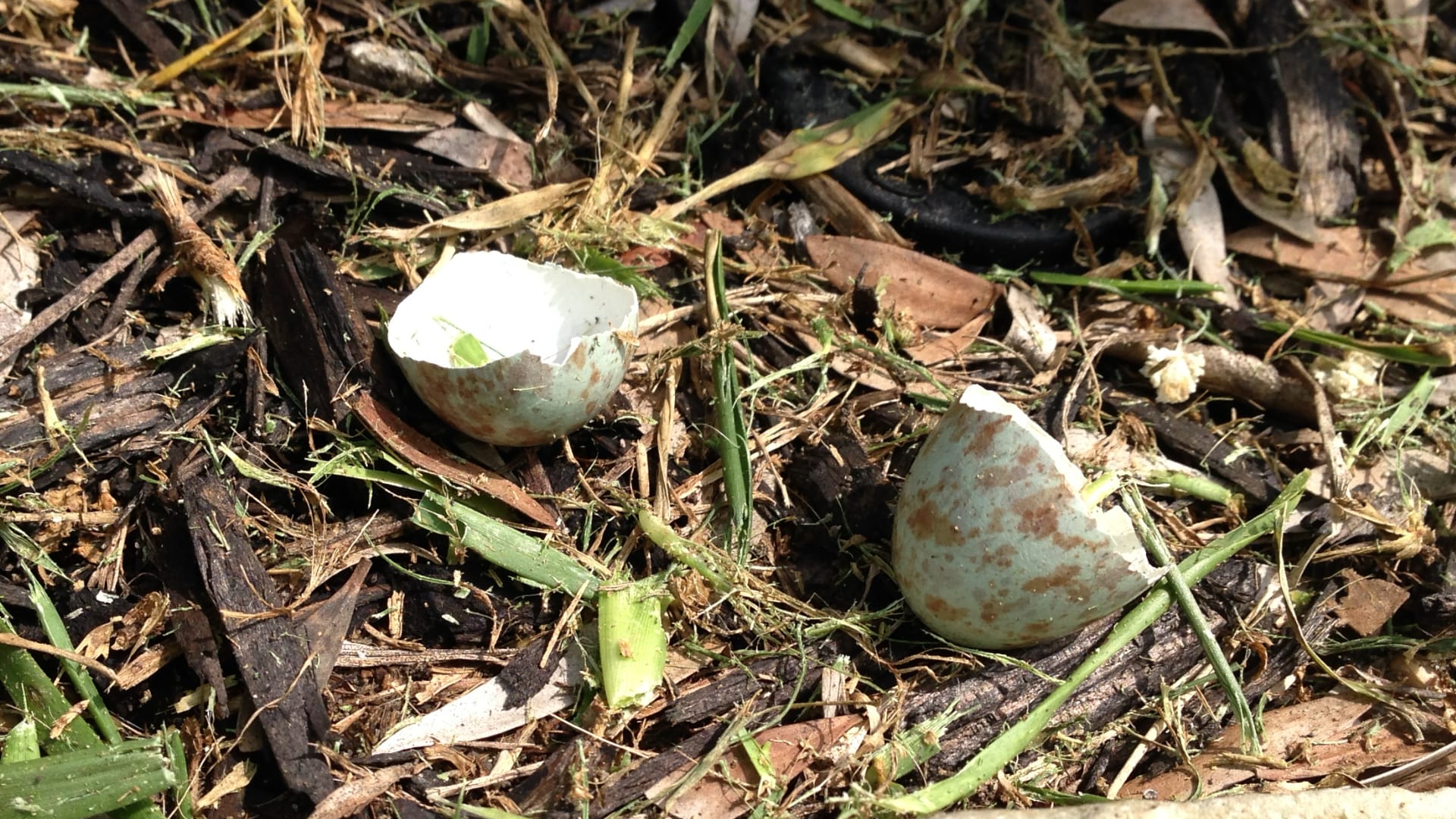
This image shows two broken eggshells resting on mulch and soil with green plant stems nearby. One shell is partially open showing a small green shoot or leaf inside, while the other shell sits beside it. The eggshells are white and speckled with brown, and they're surrounded by decomposing wood chips and grass, which creates a natural habitat for growing things.
🔬 Scientific Phenomena
Anchoring Phenomenon: An egg transitioning from a protective shell into a growing organism.
This image captures the moment when a baby animal (likely a bird or reptile) hatches and begins its next life stage. The eggshell's job is to protect and nourish the developing organism inside. Once the baby is ready, it breaks out of the shell and begins growing independently. The presence of the green sprout suggests that even after the egg's purpose is complete, the shell returns to the soil where it decomposes and provides nutrients for plants—demonstrating how matter and energy cycle through ecosystems.
📚 Core Science Concepts
- Life Cycles: All living things go through different stages of life (egg, baby, adult). Hatching is one important stage where an organism leaves its egg and begins a new phase of growth and independence.
- Growth and Development: After hatching, organisms continue to grow larger and develop new abilities. The green shoot visible in one shell shows how quickly growth can happen after hatching.
- Decomposition and Nutrient Cycling: When the eggshell is no longer needed, it breaks down in soil and returns nutrients to the earth. These nutrients help plants and other organisms grow, showing how nothing in nature is truly wasted.
- Habitats and Survival: Eggs are laid in safe places (habitats) where temperature, moisture, and protection help the baby survive until it's ready to hatch. The mulch and soil in this image provide the right conditions for eggs and new growth.
Pedagogical Tip:
Third graders benefit from concrete, observable examples of abstract concepts like life cycles. Rather than showing only diagrams, use real eggshells students can handle and observe. Let them gently crack open raw eggs (in a controlled setting) to see inside, or collect natural eggshells from outdoor areas. This multi-sensory approach builds stronger understanding and memory of sequencing stages.
UDL Suggestions:
Multiple Means of Representation: Provide both visual images AND tactile experiences with eggshells. Use visual timelines showing life cycle stages with pictures. For students with visual impairments, describe the texture of eggshells (hard, brittle, smooth on inside) and have them explore shells by touch.
Multiple Means of Action & Expression: Allow students to show understanding through drawing life cycle sequences, building 3D models with eggshells, dictating observations, or arranging picture cards in order—not just writing or verbal responses.
Multiple Means of Engagement: Connect eggshells to student interests: ask "What animals hatch from eggs that you've seen?" (birds, butterflies, dinosaurs in movies) to activate prior knowledge and boost engagement.
🎓 NGSS Connections
Performance Expectation:
3-LS1-1: Develop models to describe that organisms have unique and diverse life cycles but all animals have birth, growth, reproduction, and death in common.
Disciplinary Core Ideas:
- Growth and Development of Organisms
- Interdependent Relationships in Ecosystems (nutrient cycling through decomposition)
Crosscutting Concepts:
- (recognizing repeating patterns in life cycles)
- (stages of growth happen over time)
💬 Discussion Questions
- What do you think was inside this eggshell before it hatched? (Bloom's: Remember | DOK: 1)
- Why do you think the eggshell breaks open at this stage instead of staying closed forever? (Bloom's: Analyze | DOK: 2)
- How is the eggshell helping new life even after the baby animal has hatched and left? (Bloom's: Evaluate | DOK: 3)
- What other animals lay eggs, and how might their babies' habitats be different from this bird's habitat? (Bloom's: Create | DOK: 3)
📖 Vocabulary
- Hatch: When a baby animal breaks out of its egg and is born.
- Life Cycle: The different stages a living thing goes through from birth to death (egg, baby, adult, parent).
- Decompose: When something breaks down and rots into smaller pieces that become part of the soil.
- Habitat: A safe place where animals live that has food, water, and shelter they need to survive.
- Nutrients: Special materials in soil that help plants grow strong and healthy.
- Shell: A hard outer covering that protects something delicate inside, like an egg.
🌡️ Extension Activities
Activity 1: Life Cycle Sequencing with Eggshells
Provide students with picture cards showing different stages of a bird's life cycle (egg, hatching, chick, adult bird). Have students arrange the cards in order, then glue them to paper and draw what happens at each stage. Use real eggshells as a tactile anchor point. This reinforces sequencing skills and life cycle understanding.
Activity 2: Decomposition Observation Station
Place eggshells, leaves, and twigs in a clear container with moist soil. Over 2-3 weeks, students observe and sketch how the shells break down. They can use magnifying glasses to see changes up close. This directly shows nutrient cycling and the passage of time in ecosystems.
Activity 3: Design a Safe Egg Habitat
Give pairs of students a raw egg and craft materials (cotton, fabric, straw, bubble wrap). Challenge them to design a "habitat" or nest that would protect the egg from breaking if dropped from a low height. Students test their designs, then discuss what eggshells protect babies from in nature (temperature changes, predators, drying out).
🔍 Zoom In / Zoom Out Concepts
Zoom In: Cellular Level – Inside the Eggshell
Beneath what we see with our eyes, the eggshell is made of tiny, tightly packed crystals of calcium (the same material in our bones and teeth). Inside the shell, before hatching, a baby bird's cells are dividing and multiplying billions of times, growing wings, eyes, and a beating heart. The shell's hard exterior is actually porous—so tiny it has millions of invisible holes that let oxygen in and carbon dioxide out, allowing the baby to breathe while still protected inside. When the baby is ready, special muscles contract to help it break through this crystal barrier.
Zoom Out: Ecosystem Level – From Nest to Soil to Forest
One eggshell in a forest doesn't stay isolated. When it decomposes, it releases calcium and other nutrients into the soil. These nutrients are absorbed by plant roots, helping trees and wildflowers grow. Those plants feed insects and birds, which become food for larger animals. The nutrients cycle continuously—what was once protecting a baby bird becomes part of the forest soil, feeds new plants, and supports the entire woodland ecosystem. This eggshell is connected to the health of hundreds of organisms in its habitat.
🤔 Potential Student Misconceptions
Misconception 1: "The baby animal dies when it breaks out of the shell."
Clarification: Breaking out of the shell is actually a sign the baby is healthy and READY to live on its own. The shell's job is finished—it kept the baby safe while growing inside, but now the baby is big and strong enough to breathe air, eat food, and move around. Hatching is not the end; it's the beginning of a new, more independent stage of life.
Misconception 2: "All eggshells look the same and come from the same kind of animal."
Clarification: Eggshells come in many different colors, sizes, and thicknesses depending on what animal laid them. Chicken eggs are brown or white and medium-sized. Bird eggs in nature can be speckled, blue, or tiny. Turtle and reptile eggs have leathery shells instead of hard shells. The color and pattern often help camouflage eggs so predators don't find them. By looking at an eggshell, scientists can sometimes guess what animal it came from!
Misconception 3: "Once the eggshell breaks, it's just trash and useless."
Clarification: Eggshells are valuable! They decompose and return calcium and nutrients to the soil, helping plants grow. Some animals, like birds, even eat crushed eggshells to get extra calcium for their own egg production. In nature, nothing is wasted—everything has a purpose and gets recycled.
🔗 Cross-Curricular Ideas
ELA Connection: Life Cycle Narrative Writing
Have students write or dictate a short story from the perspective of a baby bird: "My Life in the Egg." What does the baby see, feel, and experience inside the shell? What happens on the day of hatching? Students can illustrate their stories and share them aloud. This builds narrative skills while reinforcing life cycle vocabulary and sequencing.
Math Connection: Measuring Growth Over Time
Collect eggshell fragments of different sizes and have students measure them with non-standard units (paperclips, blocks) or rulers. Create a bar graph comparing shell sizes. Then, challenge students with a problem: "If a baby bird grows 2 centimeters each week after hatching, how big will it be after 4 weeks?" This integrates measurement, graphing, and multiplication concepts.
Art Connection: Nature Collage with Eggshells
Provide students with crushed eggshells (rinsed and dried), paint, and paper. Students create a springtime or nature-themed collage by gluing shells to paper and painting around them. This tactile art project helps students connect the physical eggshell to the life cycle concept while celebrating decomposition and renewal of materials in nature.
Social Studies Connection: Nesting Traditions Across Cultures
Discuss how different cultures around the world celebrate eggs and hatching (Easter egg hunts, decorated eggs in Ukraine, egg festivals). Have students research or share family traditions related to eggs. Create a class book of traditions from various cultures, reinforcing that people everywhere recognize the importance of eggs and new life.
🚀 STEM Career Connection
- Biologist — Studies living things of every kind and what keeps them alive.
- Try it: Draw a diagram showing the stages of a butterfly's life cycle, from egg to adult. (Practice: Developing and Using Models)
- Tools: microscopes, sample jars, measuring tools, a field notebook
- Where they work: laboratories, field sites, museums, universities
- Meet one: Sandra Díaz — What a plant's leaves, wood and shape tell you about how it lives — and how those traits add up across a whole ecosystem.
- Median pay: /year — "Biological scientists, all other"
- Horticulturist — Grows and cares for plants on purpose — choosing what will thrive in a particular place.
- Try it: Draw a model of how a seed sprouts from a shell and grows into a plant. (Practice: Developing and Using Models)
- Tools: pruning shears, soil test kits, grafting knives, greenhouses
- Where they work: botanical gardens, plant nurseries, city parks, farms and orchards
- Meet one: Carlos Magdalena — How to bring the world's rarest plants back from the edge, including the smallest water lily on Earth after it vanished from the wild.
- Median pay: /year — "Soil and plant scientists"
Wage figures are median annual wages for the U.S. occupation named after each one, from the U.S. Bureau of Labor Statistics, Occupational Employment and Wage Statistics (OEWS), national, May 2025. Several careers share one occupation, so their figures match.
---
Teacher Note: This anchoring phenomenon is excellent for spring observations. If possible, have students observe real bird nests in your school garden or nearby area, or invite a local nature expert to discuss egg protection and hatching timelines.