📸 Photo Description
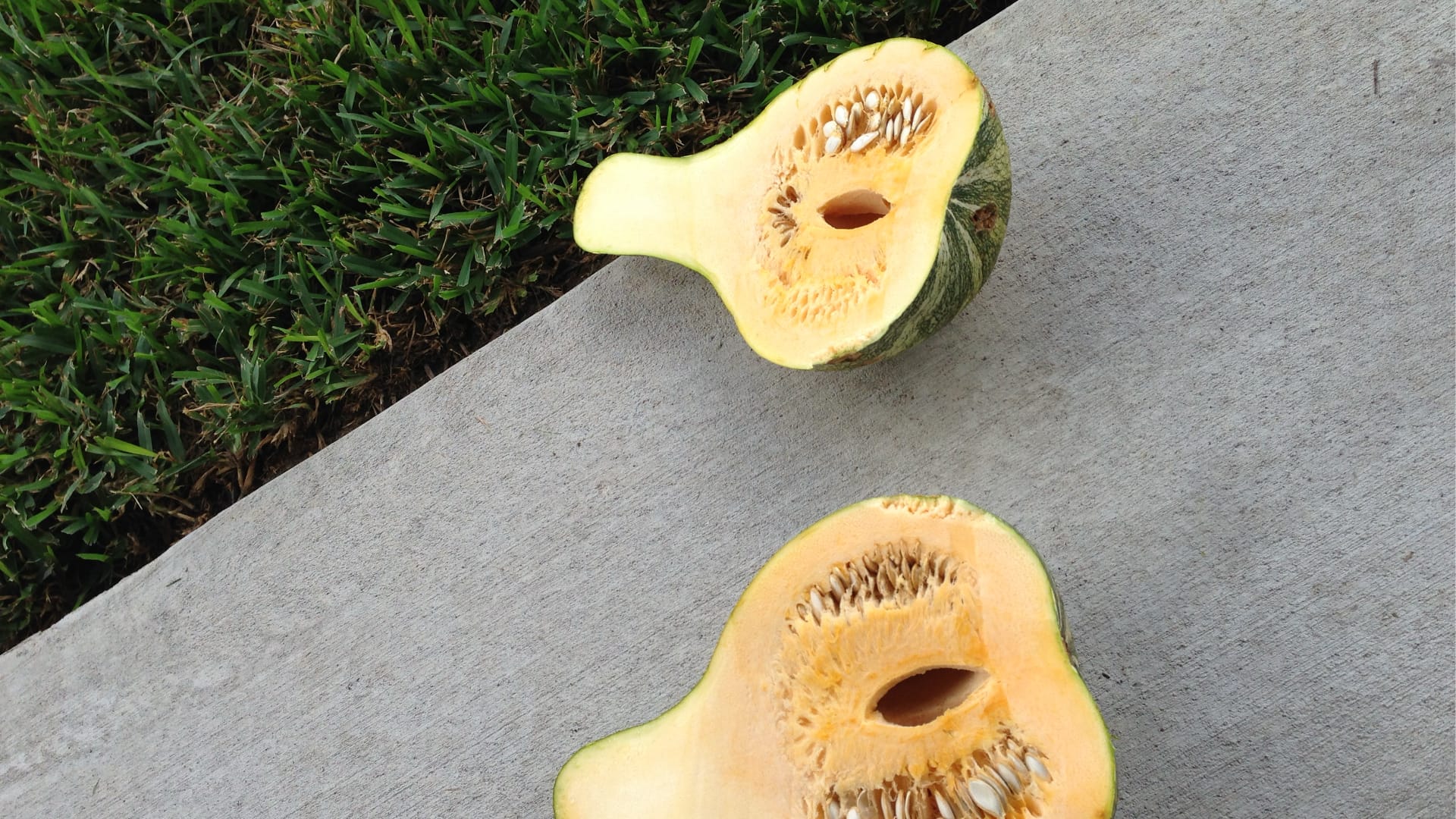
This image shows two halves of a winter squash or butternut squash cut open to reveal the inside. You can see the pale yellow flesh and the central cavity filled with many tan-colored seeds attached to stringy fibers. The seeds are the part of the plant that can grow into new squash plants.
🔬 Scientific Phenomena
Anchoring Phenomenon: Why do plants make seeds inside fruits?
Plants produce seeds as a way to make new plants. Seeds are like "baby plants" that are protected inside a fruit. The fruit's thick, hard skin keeps the seeds safe until they are ready to grow. The stringy fibers around the seeds help hold them in place and provide nutrients. When the fruit is ripe and falls to the ground, or when an animal eats it, the seeds can spread to new places where they will have room and resources to grow into new plants.
📚 Core Science Concepts
- Seeds as Plant Babies: Seeds contain a tiny plant (called an embryo) plus stored food that helps the plant grow. Each seed has the potential to become a new plant.
- Fruits Protect Seeds: Fruits are the part of the plant that holds and protects seeds. The thick flesh and skin of the squash keep seeds safe from damage, animals, and harsh weather.
- Plant Reproduction: Plants make seeds to create new plants. This is how plants reproduce and spread to new areas. Unlike animals, plants cannot move, so seeds allow plants to grow in new locations.
- Structures Inside Fruits: The fibers and flesh inside a fruit serve important jobs—they protect seeds, store nutrients, and help spread seeds when the fruit breaks down.
Pedagogical Tip:
Use real squashes or pumpkins (especially during fall) to make this lesson concrete and memorable. Let students cut them open themselves (with appropriate supervision and safety tools) to observe seeds directly. This tactile, real-world experience is far more powerful than looking at pictures alone. Store seeds in a paper envelope and have students plant some to observe germination over several weeks.
UDL Suggestions:
Multiple Means of Representation: Provide images, real specimens, and diagrams labeling seed parts. Some students may benefit from a magnifying glass to observe seed details up close. Multiple Means of Action & Expression: Allow students to draw, write, or verbally explain what they observe about seeds and fruits. Multiple Means of Engagement: Connect to student interests by asking, "What fruits do you eat that have seeds? Have you ever planted a seed?" This activates prior knowledge and increases relevance.
🎓 NGSS Connections
Performance Expectation:
3-LS1-1: Develop models to describe that organisms have unique and diverse life cycles but all animals and plants have birth, growth, reproduction, and death in common.
Disciplinary Core Ideas:
- : Growth and Reproduction of Organisms
- : Variation of Traits
Crosscutting Concepts:
-
-
💬 Discussion Questions
- What job do you think the thick, hard skin of this squash has? (Bloom's: Understand | DOK: 1)
- Why might it be helpful for seeds to be inside a fruit instead of just laying on the ground? (Bloom's: Analyze | DOK: 2)
- How are seeds like babies? How are they different from animal babies? (Bloom's: Evaluate | DOK: 3)
- If you planted one of these seeds, what do you predict would happen, and why? (Bloom's: Analyze | DOK: 2)
📖 Vocabulary
- Seed: A small package that contains a baby plant and food to help it grow into a new plant.
- Fruit: The part of a plant that holds and protects seeds.
- Reproduce: To make new living things; plants make seeds to reproduce.
- Embryo: The tiny baby plant inside a seed that will grow into a new plant.
- Germination: When a seed wakes up and starts to grow into a plant.
- Fiber: Thin, string-like structures that provide support and hold things together in the fruit.
🌡️ Extension Activities
- Seed Saving & Planting: Have students rinse and dry seeds from the squash, then plant them in small cups with soil. Place them on a sunny windowsill and water regularly. Students observe and record changes over 2-3 weeks, noting when the first sprout appears. This directly connects to the life cycle and growth concept.
- Seed Comparison Hunt: Provide students with different types of seeds (beans, sunflower seeds, apple seeds, watermelon seeds) in a "seed collection." Have them compare sizes, colors, shapes, and textures using a chart or Venn diagram. Discuss why different plants might make different-sized seeds.
- Fruit & Seed Exploration: Bring in various fruits (apple, orange, banana, tomato, pepper, bean pod) and have students cut them open to find seeds. Create a class chart showing which fruits have seeds on the inside, on the outside, or scattered throughout. Discuss whether students noticed a pattern.
🔍 Zoom In / Zoom Out Concepts
Zoom In (Microscopic Level):
If we could shrink down and look inside a single seed with a super powerful microscope, we would see the tiny embryo—the baby plant! The embryo has the tiniest leaves, roots, and a little stem all folded up inside. Around the embryo is stored food (called the cotyledon or endosperm) that acts like a lunch box for the baby plant. When the seed gets water and warmth, the cells inside the embryo start to divide and grow, waking up the baby plant so it can push its way out of the seed coat.
Zoom Out (Ecosystem Level):
Squash seeds don't just grow in your garden alone—they're part of a much bigger system! When squash plants produce fruits and seeds, they're feeding animals like squirrels, birds, and insects. Some animals eat the fruit and then move around, dropping seeds in new places (seed dispersal). Those seeds might grow into new squash plants far from the original plant. These new plants then feed more animals and produce their own seeds. The whole cycle connects plants, animals, soil, water, and sunlight in nature—all working together as an ecosystem.
🤔 Potential Student Misconceptions
Misconception 1: "Seeds are already tiny plants, just smaller versions."
Clarification: Seeds contain a baby plant (embryo) that is folded up very tightly and protected inside the seed coat. The embryo is much tinier than a full plant, and it won't look like a plant until it germinates and the root and shoot push out. The stored food inside the seed helps the baby plant grow bigger and unfold into its true plant shape.
Misconception 2: "All fruits have seeds on the inside like this squash does."
Clarification: Some fruits have seeds on the inside (like squash and apples), but others have seeds on the outside (like strawberries) or all mixed throughout (like kiwi). Some plants that we think of as vegetables actually have seeds too—like tomatoes and peppers! The important thing is that all fruits have the job of protecting and spreading seeds, even if the seeds are in different places.
Misconception 3: "Seeds need dirt to grow, so they can only grow in the ground."
Clarification: Seeds actually need three main things to grow: water, warmth, and air. They don't need dirt to sprout; they need dirt later for nutrients and to anchor the roots. You can grow seeds in wet paper towels, cotton, or sand to prove this! However, once the seedling develops, good soil helps provide the nutrients the growing plant needs to become strong and healthy.
🔗 Cross-Curricular Ideas
Math Connection: Seed Counting & Data Collection
Have students count the seeds in their squash halves and record the numbers. Create a class bar graph showing "How many seeds did each student's squash have?" Discuss questions like: "Which squash had the most seeds? The least? What was the total number of seeds in our class?" Students can also estimate before counting and compare their predictions to actual counts, practicing estimation skills.
ELA Connection: Seed Journey Story
Ask students to write or dictate a creative story from the perspective of a seed. "My name is Sally Seed, and I grew inside a squash. One day, the squash fell off the plant, and here's what happened next..." Students can illustrate their stories and share them aloud. This combines narrative writing, vocabulary practice, and imagination while reinforcing the concept of seed dispersal and plant life cycles.
Social Studies Connection: Community Gardens & Food
Connect squash seeds to real-world food systems. Ask: "Where does the food in your kitchen come from? Does anyone in your family grow vegetables?" Discuss local farmers markets, school gardens, or community gardens where students might see squash plants growing. You could invite a local gardener to visit the class or take a field trip to a pumpkin patch in fall. This connects science learning to students' communities and teaches where food originates.
Art Connection: Seed Mosaic & Nature Collage
After removing seeds from a squash, have students rinse and dry them completely. Students can create nature art by gluing seeds onto paper or cardboard to make patterns, mosaics, or pictures. They could also combine squash seeds with other natural materials (beans, leaves, twigs, dried flowers) to create textured collages. This reinforces the observation of seed diversity and allows creative expression while celebrating the natural beauty of seeds.
🚀 STEM Career Connection
- Botanist — Studies plants — how they grow, how they reproduce, and how they survive where they live.
- Try it: Construct a model of a plant's reproductive cycle, focusing on how seeds are formed within fruits and their dispersal. (Practice: Developing and Using Models)
- Tools: a hand lens, a plant press, a soil probe, field guides
- Where they work: botanical gardens, herbariums, forests and fields, universities
- Meet one: Robin Wall Kimmerer — Mosses — which she calls the coral reefs of the forest — and what Indigenous knowledge teaches about bringing plants back.
- Median pay: /year — "Soil and plant scientists"
- Horticulturist — Grows and cares for plants on purpose — choosing what will thrive in a particular place.
- Try it: Design a model that demonstrates the journey of a seed from inside a fruit to becoming a new plant. (Practice: Developing and Using Models)
- Tools: pruning shears, soil test kits, grafting knives, greenhouses
- Where they work: botanical gardens, plant nurseries, city parks, farms and orchards
- Meet one: Carlos Magdalena — How to bring the world's rarest plants back from the edge, including the smallest water lily on Earth after it vanished from the wild.
- Median pay: /year — "Soil and plant scientists"
Wage figures are median annual wages for the U.S. occupation named after each one, from the U.S. Bureau of Labor Statistics, Occupational Employment and Wage Statistics (OEWS), national, May 2025. Several careers share one occupation, so their figures match.