Plant Thorns and Spines as Survival Tools
---
📸 Photo Description
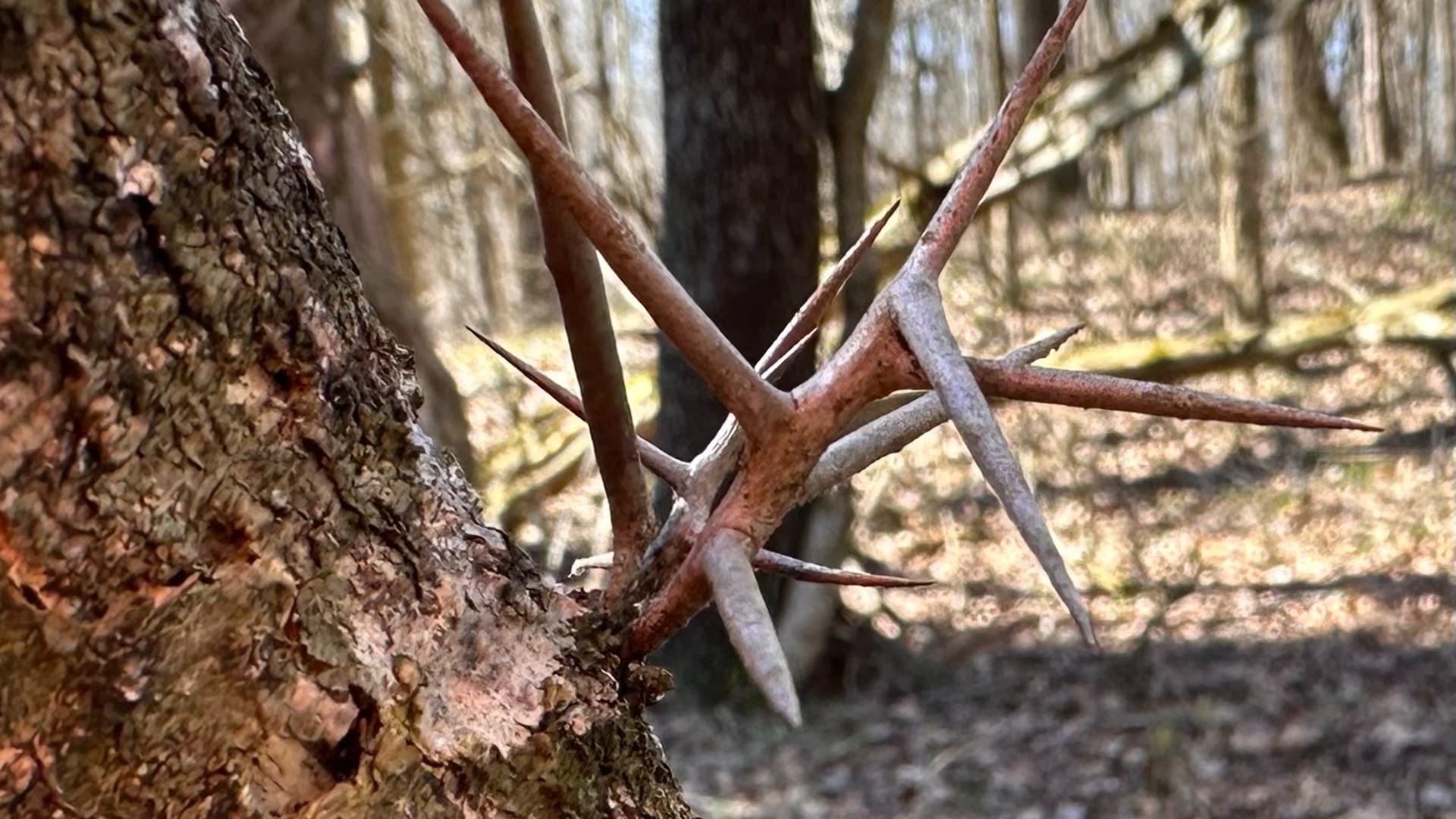
This image shows a thorn-covered plant branch growing on a tree trunk in a forest. The thorns are long, sharp, pointed structures that stick out from the branch in different directions. The tree's bark is rough and textured, and you can see other trees in the background of the forest.
---
🔬 Scientific Phenomena
Anchoring Phenomenon: Why do some plants have thorns?
Plants develop thorns and spines as a defensive adaptation—a special feature that helps them survive. Thorns protect plants from animals that might eat their leaves, stems, or fruit. When an animal tries to nibble on a thorny plant, the sharp points hurt the animal, so the animal learns to leave that plant alone. Over many generations, plants with thorns survived better than plants without them, especially in environments where herbivores (plant-eating animals) were common. This is an example of natural selection in action—plants with helpful traits are more likely to survive and pass those traits to their offspring.
---
📚 Core Science Concepts
- Adaptations: Special body parts or behaviors that help living things survive in their environment. Thorns are an adaptation that protects plants from being eaten.
- Structure and Function: The sharp, pointed shape of thorns is perfectly designed for defense. The structure (pointy shape) matches its function (keeping animals away).
- Survival and Protection: Plants cannot run away from danger like animals can, so they need other ways to protect themselves. Thorns are one strategy plants use.
- Variation in Plants: Not all plants have thorns—some have smooth bark, waxy coatings, or bitter tastes instead. Different plants have different adaptations based on where they live.
Pedagogical Tip:
When teaching adaptations to third graders, use the phrase "helps the plant survive" repeatedly. Connect adaptations to problems: "The problem: animals want to eat the plant. The solution: thorns!" This problem-solution framework helps young learners understand WHY adaptations exist, not just WHAT they are.
UDL Suggestions:
To support diverse learners: (1) Provide tactile learning by allowing students to safely observe real thorny branches or touch pictures/models; (2) Use visual supports with labeled diagrams showing the thorn and its function; (3) Offer a video showing animals avoiding thorny plants to make the concept concrete; (4) Allow students to draw or physically act out how thorns protect plants.
---
🎓 NGSS Connections
Performance Expectation:
3-LS4-3: Construct an argument that some animals help plants reproduce and disperse seeds; some relationships may be helpful (pollination), harmful (eating), or neutral (neither beneficial nor harmful) to the plant or animal and explain how some behaviors and physical characteristics of animals help them obtain food and reproduce.
Disciplinary Core Ideas:
- (Adaptation of organisms for environmental demands)
- (Structure and function of organisms)
Crosscutting Concepts:
- (The shape of thorns allows them to protect plants)
- (Animals eating plants → plants develop thorns as a defense)
---
💬 Discussion Questions
- What problem do you think thorns solve for a plant? (Bloom's: Understand | DOK: 1)
- Why might an animal decide not to eat a plant with thorns after touching one? (Bloom's: Analyze | DOK: 2)
- If a plant didn't have thorns and lived in a place with many hungry animals, what might happen to that plant over time? (Bloom's: Evaluate | DOK: 3)
- Can you think of other ways plants protect themselves besides having thorns? (Bloom's: Create | DOK: 3)
---
📖 Vocabulary
- Adaptation: A special body part or behavior that helps a living thing survive in its home.
- Thorn: A sharp, pointed spike that grows on a plant and protects it from being eaten.
- Defense: Protection against danger or attack; something that keeps you safe.
- Survive: To stay alive and healthy in your environment.
- Herbivore: An animal that eats only plants.
- Environment: The place where a living thing lives, including all the things around it like weather, soil, and other animals.
---
🌡️ Extension Activities
Activity 1: Thorn Models
Students create their own "protective plant" using a paper cup or toilet paper tube as the plant stem. They attach toothpicks, popsicle sticks, or craft pipe cleaners as "thorns." Then they test their model by having a partner (the "herbivore") try to pick leaves off without touching the thorns. Discuss which designs worked best.
Activity 2: Adaptation Scavenger Hunt
Take students on a safe nature walk around the school grounds or local park to find different plant adaptations. They might find thorny plants, smooth plants, fuzzy plants, or plants with waxy leaves. Have students photograph or sketch what they find and sort them by adaptation type.
Activity 3: Storybook Creation
Students work in small groups to create a illustrated book or comic strip titled "The Plant and the Hungry Animal." The story shows how a plant's thorns protect it from being eaten. This connects science to literacy and helps students explain adaptations in their own words.
🔍 Zoom In / Zoom Out Concepts
Zoom In: The Cellular Level
If we could zoom way down inside a thorn using a super-powerful microscope, we would see tiny cells packed tightly together. Plant cells have hard walls made of a material called cellulose that make them strong and stiff. The cells in thorns are arranged in a special way that makes them pointy and hard instead of soft and bendy. The plant uses energy from sunlight to build these tough cells, just like how your body uses food energy to build strong bones and muscles. Scientists who study plants at this tiny level are called plant biologists, and they use microscopes to understand how thorns form.
Zoom Out: The Ecosystem Web
A single thorny plant in a forest is part of a much bigger picture. That plant is connected to many other living things: the animals that try to eat it (and get pricked!), the insects that pollinate its flowers, the soil that feeds its roots, and the trees around it that share the same forest home. When thorns successfully protect a plant from being eaten, that plant grows big and strong, produces more seeds, and helps other animals by providing shelter and food (like berries or seeds). The thorns affect the whole forest ecosystem because they change which animals eat which plants, which affects the whole food web. Everything in nature is connected!
🤔 Potential Student Misconceptions
Misconception 1: "Thorns are pointy because the plant is angry or mean."
Clarification: Plants don't have feelings like anger. Thorns grew on plants over many, many years because plants with sharp thorns survived better when hungry animals tried to eat them. The plant didn't choose to make thorns on purpose—it happened through natural selection. Thorns are a tool for survival, not a sign of a "mean" plant.
Misconception 2: "All thorns are exactly the same size and shape on every plant."
Clarification: Different plants have different kinds of thorns! Some thorns are long and needle-like, some are short and bumpy, and some are curved like hooks. Each type of thorn is adapted to the specific environment where that plant lives and the specific animals that live nearby. A plant in a dry desert has different thorns than a plant in a wet rainforest.
Misconception 3: "Thorns are the only way plants protect themselves from being eaten."
Clarification: Plants have many different defense strategies! Some plants have leaves that taste bitter or poisonous, some have waxy coatings that animals don't like, and some hide by being very small or camouflaged. Just like people have different ways to stay safe, plants have different ways to survive. Thorns are just one adaptation among many.
🔗 Cross-Curricular Ideas
Language Arts Connection:
Have students write from the perspective of a thorny plant or a hungry animal. Students could write a letter from a deer to a thornbush explaining why they won't eat it anymore, or a monologue from the plant describing its day. This connects narrative writing skills to scientific understanding and helps students "get inside" the concept of adaptation.
Mathematics Connection:
Students can measure and count thorns on real branches or in photos. They could create a bar graph comparing the number of thorns on different plant samples, or measure the length of thorns using non-standard units (like paper clips) and standard units (centimeters). This integrates measurement and data representation with life science.
Social Studies Connection:
Explore how Indigenous peoples and early humans learned which plants were safe to eat and which had dangerous thorns. Discuss how people in different parts of the world adapted their own behaviors based on local plants. This connects to cultural knowledge, geography, and how humans interact with their natural environment.
Art Connection:
Students create large-scale drawings, paintings, or sculptures of thorny plants, experimenting with different textures, colors, and materials. They could use textured items like sandpaper, yarn, or clay to represent thorns. This helps students observe plant details closely while expressing their understanding creatively.
🚀 STEM Career Connection
- Botanist — Studies plants — how they grow, how they reproduce, and how they survive where they live.
- Try it: Construct an explanation for why a plant might develop thorns, using evidence from a picture of a thorny plant and a description of its environment. (Practice: Constructing Explanations and Designing Solutions)
- Tools: a hand lens, a plant press, a soil probe, field guides
- Where they work: botanical gardens, herbariums, forests and fields, universities
- Meet one: Robin Wall Kimmerer — Mosses — which she calls the coral reefs of the forest — and what Indigenous knowledge teaches about bringing plants back.
- Median pay: /year — "Soil and plant scientists"
- Conservation Biologist — Works out which plants and animals are in trouble, and what would help them recover.
- Try it: Design a solution to help a plant that is being eaten by animals by adding a protective feature, like thorns, to your drawing of the plant. (Practice: Constructing Explanations and Designing Solutions)
- Tools: population surveys, GPS trackers, habitat maps, trail cameras
- Where they work: nature reserves, conservation charities, government agencies, universities
- Meet one: Tierra Curry — Which plants and animals are closest to disappearing, and what it takes to save them.
- Median pay: /year — "Zoologists and wildlife biologists"
Wage figures are median annual wages for the U.S. occupation named after each one, from the U.S. Bureau of Labor Statistics, Occupational Employment and Wage Statistics (OEWS), national, May 2025. Several careers share one occupation, so their figures match.
---
Created for Third Grade NGSS-aligned instruction | Life Science Domain