📸 Photo Description
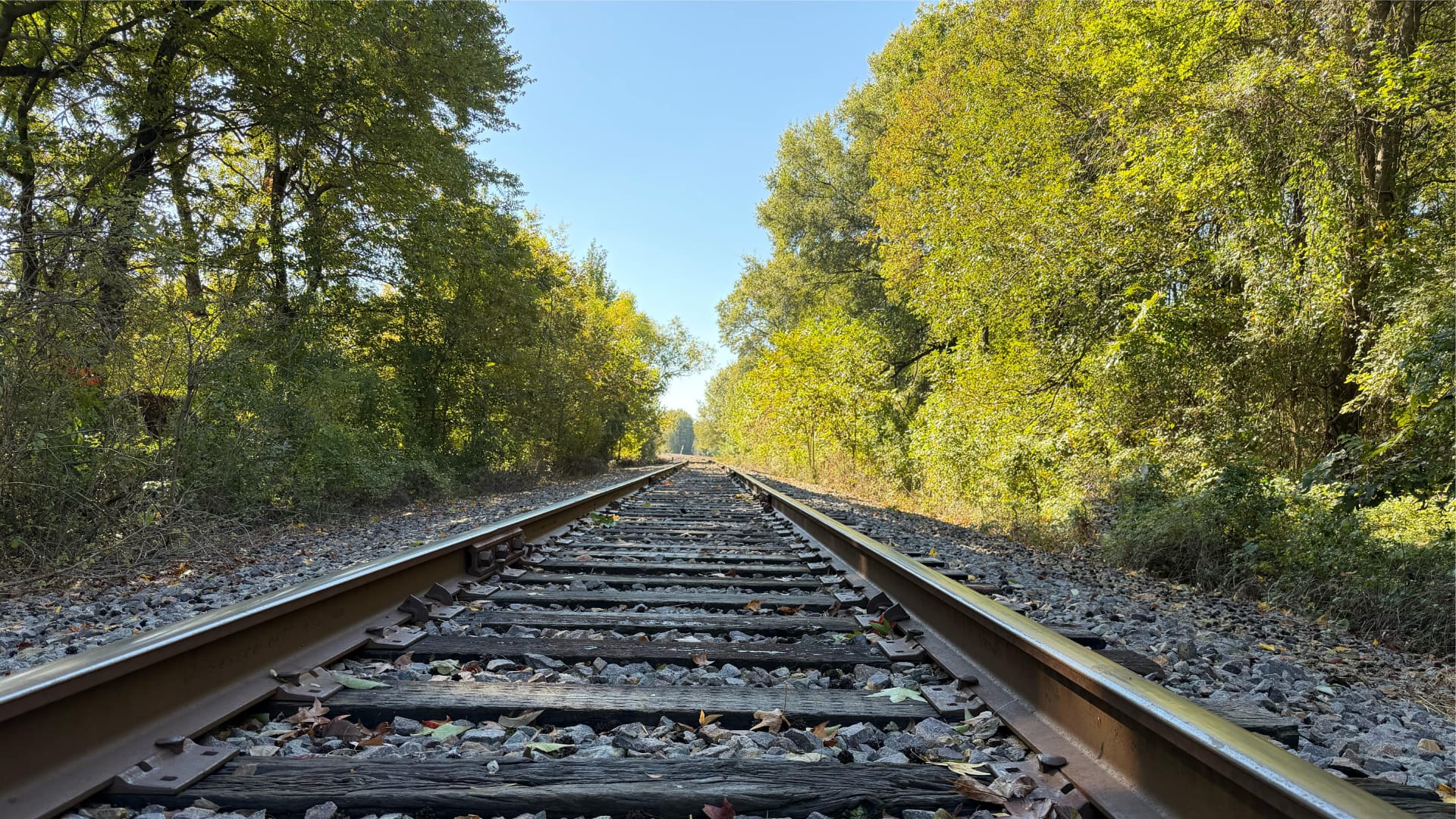
This image shows railroad tracks stretching into the distance, surrounded by trees and green leaves. The metal rails are parallel to each other and rest on dark wooden beams called ties, which sit on gravel. The trees create a natural tunnel overhead, and the tracks appear to disappear into the distance, creating a feeling of depth.
🔬 Scientific Phenomena
Anchoring Phenomenon: Why do railroad tracks have two parallel rails instead of one, and how do they stay in place?
Scientific Explanation: Railroad tracks are designed with two parallel rails because they provide balance and stability for heavy trains. The metal rails are made of steel, which is strong and doesn't bend easily under weight. The wooden ties underneath distribute the train's weight across a larger area of ground, preventing the train from sinking into the earth. The gravel (called ballast) acts like a cushion that holds the ties in place and allows water to drain away. This system works together to safely support trains that can weigh hundreds of tons.
📚 Core Science Concepts
- Forces and Motion: Trains move along the tracks because wheels push against the rails. The parallel rails guide the train so it moves in a straight line and doesn't tip over.
- Stability and Balance: Two rails create a wider base of support than one rail would. This makes the train more stable, similar to how you balance better on two feet than on one foot.
- Materials and Their Properties: Steel rails are used because steel is very strong, doesn't rust easily, and can support heavy loads. Wood ties are used because they grip the ground and don't slide around.
- Load Distribution: The weight of the train is spread across many ties and a large area of ground, rather than being concentrated in one spot. This is why the gravel is important—it spreads the weight even more.
Pedagogical Tip:
Students at this age are concrete thinkers, so avoid abstract explanations. Instead, use direct comparisons: "The two rails work like your two legs—they help you balance." Let students physically experience concepts by walking along a line (one rail) versus between two lines (two rails) to understand stability.
UDL Suggestions:
Representation: Provide images of railroad tracks from different angles (aerial view, side view, close-up) so visual learners can understand the 3D structure. Create a simple labeled diagram showing rails, ties, and ballast with pictures.
Engagement: Connect to student interests by asking if they've seen trains or toy train sets. Some students may have family experiences with trains; invite them to share observations.
Action/Expression: Allow students to demonstrate understanding through building (model tracks with craft materials), drawing, or role-playing a train and the rails that guide it.
🎓 NGSS Connections
Performance Expectation:
3-PS2-1: Plan and conduct an investigation to provide evidence that balanced and unbalanced forces on an object change its shape and/or the speed or direction of its motion.
Disciplinary Core Ideas:
- Forces and Motion
- Types of Interactions
Crosscutting Concepts:
-
-
💬 Discussion Questions
- Why do you think the railroad tracks are made of two rails running side by side instead of just one single rail? (Bloom's: Analyze | DOK: 2)
- What would happen to a train if the wooden ties weren't there to hold up the metal rails? (Bloom's: Evaluate | DOK: 3)
- How do you think the gravel under the ties helps keep the tracks in place? (Bloom's: Explain | DOK: 2)
- If you had to design a track system to hold something even heavier than a train, what changes might you make? (Bloom's: Create | DOK: 3)
📖 Vocabulary
- Rails: Long metal bars that form the path a train travels on.
- Ties (or sleepers): Wooden beams laid across the rails that help hold them in place and spread the train's weight.
- Ballast: Small stones or gravel placed under and around the ties to keep them from moving and to drain water.
- Parallel: Two lines or rails that run next to each other and never cross or meet.
- Stability: The quality of being steady and balanced, not tipping over easily.
- Steel: A very strong metal made from iron that is used to make train rails.
🌡️ Extension Activities
- Build a Model Track System: Provide students with craft sticks, straws, or plastic rulers to represent rails, and popsicle sticks for ties. Have them arrange materials to create a stable track structure. Then place toy cars or blocks on top to test whether the design can hold weight without tipping. This hands-on experience demonstrates why two parallel rails are better than one.
- Balance and Stability Investigation: Create a simple experiment where students place a ruler (representing a train) across two pencils (representing rails) versus one pencil. Have them gently push or add weight to see which setup is more stable. They can record observations with drawings and discuss why the two-rail system works better.
- Design a Playground Path: Challenge students to design a safe pathway through the classroom or playground using "rails" made from tape. They must consider how to keep people moving in the right direction without falling, similar to how railroad tracks guide trains. Have them explain their design choices to classmates.
🔍 Zoom In / Zoom Out Concepts
Zoom In: The Atomic Level of Steel Rails
When we zoom in very close to a steel rail—so close that we'd need a special microscope to see it—we'd find tiny particles called atoms all packed tightly together. Steel is made of iron atoms linked together in a special pattern that makes it very strong and hard to break. When a heavy train rolls across the rail, the atoms don't move apart or break—they stay linked together because steel's atomic structure is so strong. This is why steel doesn't bend or snap like a twig would. The atoms are like LEGO blocks all connected in a perfect way to hold heavy weight!
Zoom Out: The Railroad System and Communities
When we zoom out and look at the bigger picture, railroad tracks like these are part of a huge transportation network that connects towns and cities across entire countries and even continents. These tracks help people travel, move goods like food and toys from factories to stores, and connect communities together. The forest around these tracks is also part of a larger ecosystem—animals use the space alongside the tracks for homes and traveling routes, and the trees help clean the air. Railroad systems connect people, places, and nature in one big system. One set of tracks might be part of a journey that goes hundreds of miles!
🤔 Potential Student Misconceptions
Misconception 1: "The train stays on the tracks because it's glued down."
Clarification: The train doesn't stick to the tracks like glue. Instead, the train's wheels fit onto the rails like a skateboard wheel rolling along a curved surface. The two parallel rails guide the wheels so they can only roll in one direction—forward along the track. The weight of the train pushes down on the rails, and the rails push back up to support it (like the ground pushes back when you jump). The train stays on the tracks because of the shape of the wheels and rails, not because of glue or magnets.
Misconception 2: "The wooden ties are just there to hold the rails apart."
Clarification: While ties do hold the two rails the correct distance apart, their most important job is to spread out the train's weight. Imagine standing on one foot versus two feet—with one foot, you sink deeper into sand. The ties are like footprints that spread the train's heavy weight across a much larger area of ground. Without the ties, the rails would sink into the earth because the train is so heavy!
Misconception 3: "All the gravel stones do the same job."
Clarification: The gravel (ballast) has two important jobs working together. First, it holds the wooden ties in place so they don't slide or shift. Second, it acts like a sponge—water flows through the spaces between the rocks instead of pooling under the tracks and making them soft and mushy. Without good drainage, heavy rains would turn the ground under the tracks into mud, and the tracks would sink and become dangerous.
🔗 Cross-Curricular Ideas
Math Connection: Parallel Lines and Measurement
Students can measure the distance between two railroad rails using a ruler or meter stick, then practice drawing parallel lines of the same distance apart on paper. Have them compare: "Are my lines the same distance apart all the way down the page, like railroad rails?" This connects geometry concepts (parallel lines) to the real-world function of railroad design. Students could also count and estimate how many railroad ties would fit in a certain distance.
ELA Connection: Narrative and Descriptive Writing
Ask students to write from the perspective of a railroad tie or a steel rail. "I am a wooden tie on the railroad track. Every day, a heavy train rolls over me. Here's what I feel, hear, and do..." This creative writing exercise helps students understand the function of track components while practicing descriptive language and point of view. Students can also read and discuss train-themed picture books like The Little Engine That Could and write their own simple train adventure stories.
Social Studies Connection: Transportation History and Community
Discuss how railroads changed communities—they brought people, jobs, and goods to towns. Show students a map of railroad routes in your state or region and discuss which towns are connected. Have students interview family members or community members about trains they've seen or ridden. This connects to understanding how transportation shapes where and how people live and work, and builds appreciation for infrastructure in their community.
Art Connection: Perspective Drawing and Vanishing Points
Use this photo to teach students about perspective—how objects look smaller as they get farther away (notice how the tracks seem to disappear into a point in the distance). Have students create their own perspective drawings: railroad tracks, hallways, roads, or pathways that seem to stretch far into the distance. This artistic technique is called a "vanishing point." Students can color their drawings and display them, discussing how artists use perspective to make drawings look three-dimensional.
🚀 STEM Career Connection
- Civil Engineer — Designs the things a town runs on — roads, bridges, water pipes and drains.
- Try it: Design and build a model of a railroad track using craft sticks and clay, ensuring the two rails are parallel and stable. (Practice: Constructing Explanations and Designing Solutions)
- Tools: surveying equipment, CAD software, soil tests, load calculations
- Where they work: construction sites, city engineering departments, design firms, transport agencies
- Meet one: Roma Agrawal — How to hold a skyscraper up — she designed the foundations and the spire of the Shard.
- Median pay: /year — "Civil engineers"
- Materials Engineer — Chooses and shapes the right material for a job, and tests it until it fails.
- Try it: Test different combinations of materials, like wood and gravel, to see which best supports a heavy object without shifting. (Practice: Constructing Explanations and Designing Solutions)
- Tools: tensile testers, furnaces, microscopes, hardness testers
- Where they work: manufacturing plants, product design firms, testing labs, universities
- Meet one: Ainissa Ramirez — How to make metal stick to glass and ceramics — she invented a solder that does it.
- Median pay: /year — "Materials engineers"
Wage figures are median annual wages for the U.S. occupation named after each one, from the U.S. Bureau of Labor Statistics, Occupational Employment and Wage Statistics (OEWS), national, May 2025. Several careers share one occupation, so their figures match.