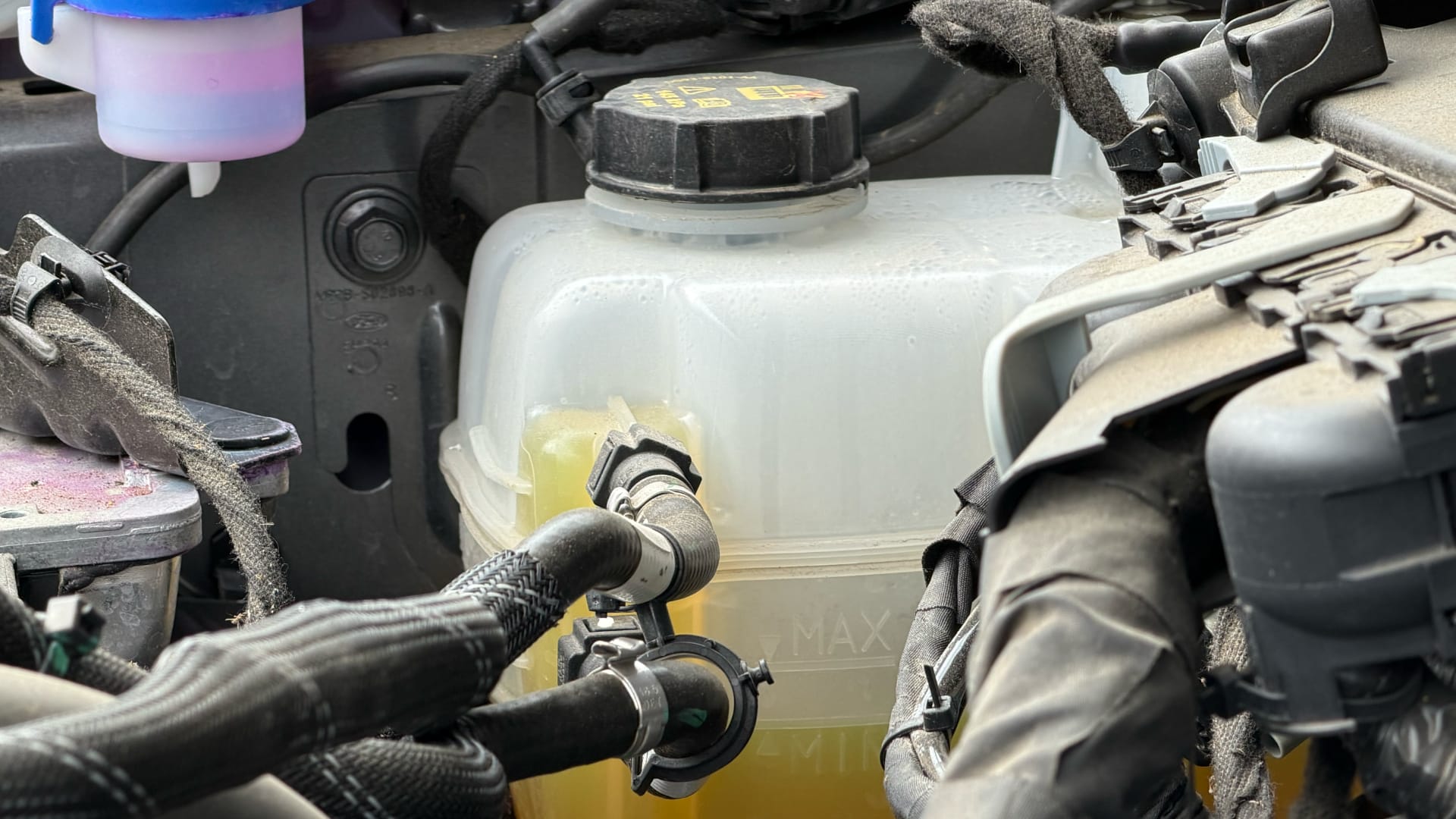
📸 Photo Description
This image shows the engine compartment of a car with a white plastic container filled with yellow liquid—coolant fluid that keeps the engine from getting too hot. You can see hoses connected to the container and various engine parts around it. The coolant is a liquid that flows through the engine to absorb heat and prevent it from overheating.
🔬 Scientific Phenomena
Anchoring Phenomenon: Heat transfer and the role of liquids in managing temperature in machines.
Why This Happens: Engines produce enormous amounts of heat when they burn fuel. If an engine gets too hot, it can break. Engineers designed a cooling system where liquid coolant circulates through the engine. The liquid absorbs heat from the hot engine parts and carries that heat away to a radiator where it cools down. This cycle repeats continuously while the car runs. Liquids are excellent at absorbing and moving heat because their molecules can move freely and distribute thermal energy efficiently.
📚 Core Science Concepts
- States of Matter: The coolant in this image is a liquid—one of three states of matter (solid, liquid, gas). Liquids have a definite volume but take the shape of their container, which makes them perfect for flowing through engine tubes.
- Heat Transfer: Heat moves from the hot engine to the cooler liquid, and then the liquid carries that heat away. This process is called convection and is one of the main ways heat travels in machines and nature.
- Properties of Liquids: Liquids can flow, pour, and change shape while keeping the same volume. This property allows the coolant to travel through narrow hoses and fill spaces around engine parts.
- Purpose and Design: Humans design systems (like this cooling system) that use the properties of matter to solve problems—in this case, preventing engines from overheating and breaking.
Pedagogical Tip:
Third graders are concrete thinkers who learn best through direct observation and hands-on experience. Rather than only explaining how the coolant works, create a simple demonstration using colored water in clear tubing to show how liquids flow. Let students trace the path the coolant takes and feel warm water flowing through tubes. This builds understanding through sensory experience before introducing the abstract concept of heat transfer.
UDL Suggestions:
Representation: Provide a labeled diagram of the cooling system so visual learners can see the component relationships. Use color-coding (blue for cool liquid, red for hot) to show temperature differences. Action & Expression: Allow students to demonstrate understanding through drawing, building a model with paper tubes, or physically tracing the coolant path with their finger. Engagement: Connect to student experience by asking, "Have you ever felt a car radiator? Felt the fan blow hot air?" to make the concept personally relevant.
🎓 NGSS Connections
Performance Expectation:
2-PS1-1: Plan and conduct an investigation to describe and classify different kinds of materials by their observable properties.
Note: The most directly aligned PE for this image is:
5-PS1-3: Make observations and measurements to identify materials based on their properties.
Disciplinary Core Ideas:
- - Structure and Properties of Matter
- - Forces and Motion (thermal energy application)
Crosscutting Concepts:
- - The regular cycle of heat absorption and release
- - Heat moves through the system
- - The cooling system is a complete system with interdependent parts
💬 Discussion Questions
- Why do you think the coolant in a car engine needs to be a liquid instead of a solid or a gas? (Bloom's: Analyze | DOK: 2)
- What do you think would happen to the engine if the cooling system stopped working and the liquid couldn't flow anymore? (Bloom's: Predict | DOK: 3)
- How is the coolant in a car similar to the blood in your body? (Bloom's: Compare | DOK: 2)
- Can you think of other machines or things in nature that use liquids to move heat from one place to another? (Bloom's: Apply | DOK: 3)
📖 Vocabulary
- Coolant: A liquid that absorbs heat and carries it away from hot engines to keep them from getting too hot.
- Liquid: A state of matter that has a definite volume but takes the shape of its container and can flow.
- Heat: The energy that makes things warm and causes them to change temperature.
- Engine: A machine that burns fuel to create power that makes cars move.
- Temperature: How hot or cold something is; we measure it with a thermometer.
- Convection: The movement of heat through a liquid or gas as warmer parts move and cooler parts sink.
🌡️ Extension Activities
- Liquid Flow Demonstration: Set up clear tubing with blue-colored water and a warm water source. Have students predict where the warm water will flow, then release it and observe. Ask: "Why does the warm water move?" This shows convection without needing an actual engine.
- Design a Cooling System: Provide students with paper tubes, a container, and colored water. Challenge them to design a system that moves water from a "hot" area (a cup of warm water) to a "cool" area. Students must plan the route the liquid will take and test their design.
- Compare States of Matter in Engines: Show pictures or videos of different cooling methods (water cooling, air cooling, oil cooling). Have students sort images by state of matter and discuss which states work best for moving heat and why liquids are most common.
🔍 Zoom In / Zoom Out Concepts
Zoom In: Molecular Level
If we could shrink down and look inside the coolant liquid with a super-powerful microscope, we would see tiny particles called molecules bouncing around and moving very fast. When the coolant gets near the hot engine, these molecules move even faster and bump into each other more. This bumping and moving IS what we call heat! As the molecules move faster, they carry that energy away through the hoses to cooler areas. When the coolant reaches the radiator and cools down, the molecules slow down and move less. This is why liquids are so good at moving heat—their molecules are free to move around and spread thermal energy everywhere they go.
Zoom Out: The Complete Vehicle System
The cooling system doesn't work alone in a car. It's part of a much bigger system that includes the engine (which creates heat), the radiator (which releases heat into the air), the fan (which helps cool the radiator), and even the thermostat (which controls when coolant flows). All these parts work together to keep the whole car running smoothly. If we zoom out even further, we can see that cars are part of our transportation system, which connects to roads, cities, and how people travel. Engineers had to design all these connected parts to work as a team, just like organs in your body work together to keep you healthy!
🤔 Potential Student Misconceptions
Misconception 1: "The coolant makes the engine cold."
Clarification: The coolant doesn't actually freeze or make the engine cold. Instead, it absorbs heat from the hot engine and carries it away to the radiator, where the heat escapes into the air. The coolant helps keep the engine at the right temperature—not too hot and not too cold. Think of it like a delivery truck that picks up hot things and carries them somewhere else to cool down.
Misconception 2: "The coolant is water from the tap."
Clarification: While coolant looks similar to water, it's actually a special mixture made in factories. Regular tap water would freeze in winter and boil in summer, which wouldn't work well in engines. Scientists and engineers created coolant that stays liquid in very hot and very cold temperatures. It also has special chemicals that protect the metal parts of the engine from rust.
Misconception 3: "Once the coolant cools the engine, it's done and doesn't need to move anymore."
Clarification: The coolant keeps circulating around and around while the car is running—it never stops! The engine continuously makes heat, so the coolant must continuously carry that heat away. It's like a never-ending cycle: the coolant gets hot near the engine, travels to the radiator to cool down, and then travels back to the engine to pick up more heat. This cycle repeats hundreds of times while you're driving.
🔗 Cross-Curricular Ideas
Mathematics: Measuring and Graphing Temperature
Have students measure the temperature of warm water in a cup using a thermometer, then track how the temperature changes over time as it cools (similar to how coolant cools in a radiator). Students can record temperatures every 2 minutes for 20 minutes and create a line graph showing the cooling pattern. This builds data collection and graphing skills while reinforcing heat transfer concepts.
English Language Arts: Informative Writing
Students write a simple "How-To" guide titled "How to Keep an Engine Cool" or create a comic strip showing the journey of a coolant molecule from the engine to the radiator and back. This helps students organize their understanding in sequential steps and practice descriptive vocabulary while explaining a process.
Social Studies: Community Helpers and Jobs
Connect to the community by inviting a local mechanic or automotive technician to visit the classroom (virtually or in person) to discuss their job and show students real car parts. Students can create "Thank You" posters for workers who maintain and repair vehicles that help people in their community travel safely. This builds appreciation for skilled trades and local professionals.
Art/Engineering Design: Build a Model Cooling System
Students use craft materials (clear plastic tubing, containers, blue-colored water, and tape) to design and build their own miniature cooling system. They can decorate their model and present how it works to classmates. This hands-on engineering challenge lets students apply their understanding of how liquids flow through connected parts to solve a real problem.
🚀 STEM Career Connection
- Mechanical Engineer — Designs things that move — engines, turbines, joints and gears — and works out the forces on them.
- Try it: Design and build a simple model engine part that can move using a rubber band or a simple lever system. (Practice: Constructing Explanations and Designing Solutions)
- Tools: CAD software, 3D printers, force sensors, wind tunnels
- Where they work: engineering firms, factories, design studios, research labs
- Meet one: Shini Somara — How air and water flow around things, worked out on a computer before anything is built.
- Median pay: /year — "Mechanical engineers"
- Materials Scientist — Invents and tests new materials — stronger, lighter, or able to do something the old ones could not.
- Try it: Explain why a metal spoon feels colder than a wooden spoon when you touch them, even if they are the same temperature. (Practice: Constructing Explanations and Designing Solutions)
- Tools: electron microscopes, stress testers, furnaces, X-ray diffractometers
- Where they work: research laboratories, manufacturing companies, national labs, universities
- Meet one: Ainissa Ramirez — How to make metal stick to glass and ceramics — she invented a solder that does it.
- Median pay: /year — "Materials scientists"
Wage figures are median annual wages for the U.S. occupation named after each one, from the U.S. Bureau of Labor Statistics, Occupational Employment and Wage Statistics (OEWS), national, May 2025. Several careers share one occupation, so their figures match.
---
Teacher Note: This lesson builds foundational understanding of states of matter and heat transfer through a real-world context. Third graders will benefit from repeated exposure to the concept that liquids' ability to flow makes them useful for specific purposes. Connect this to other classroom experiences (water cycles, cooking, washing hands) to reinforce that these concepts appear everywhere in daily life.