📸 Photo Description
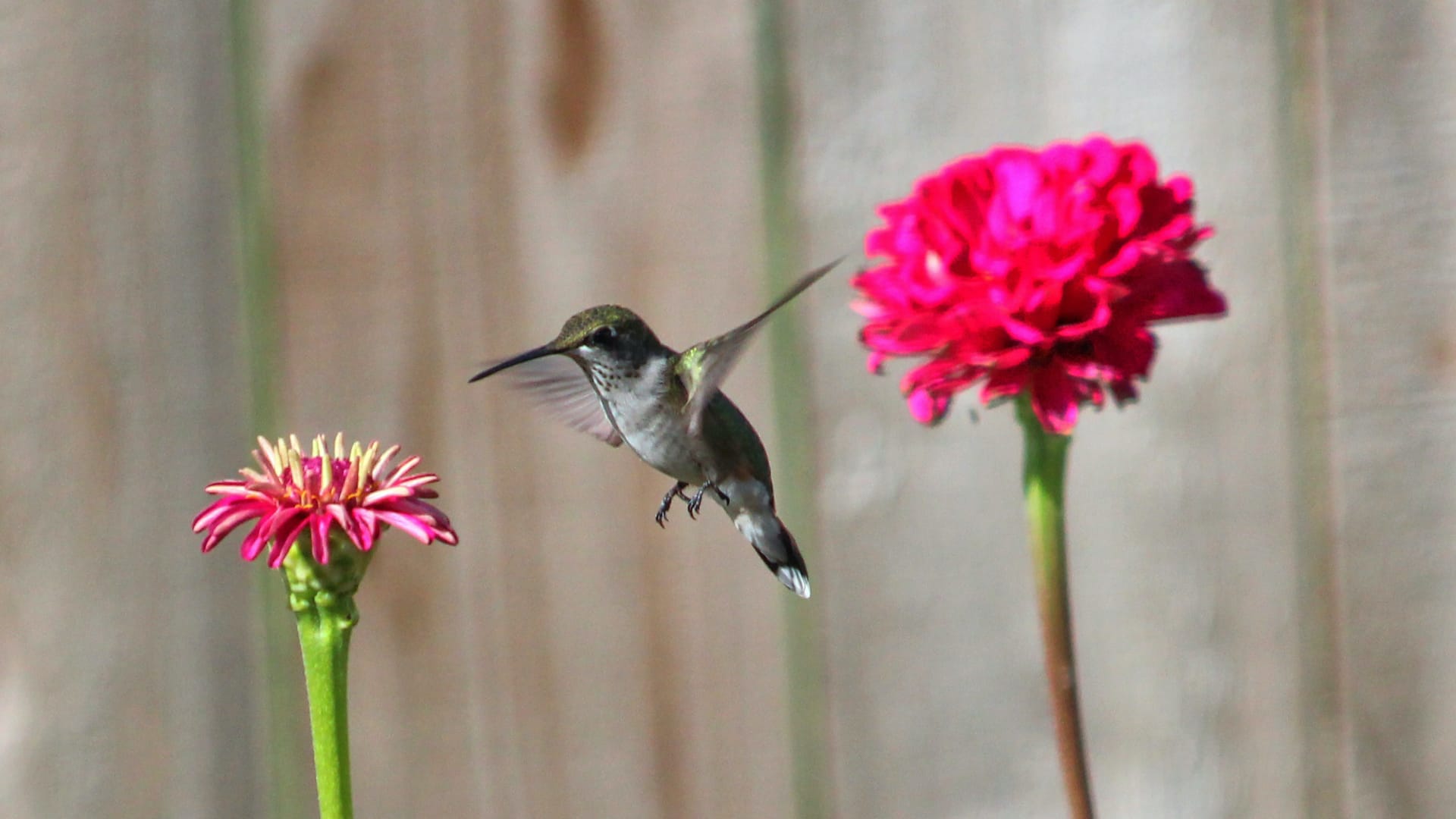
This image shows a tiny hummingbird hovering in mid-air near bright pink flowers. The hummingbird has a long, thin beak, shimmering green feathers, and its wings are moving so fast they're blurry. You can see two flowers on green stems—one smaller and one larger and fuller—that the hummingbird is visiting to drink nectar.
🔬 Scientific Phenomena
Anchoring Phenomenon: How does a hummingbird stay floating in the air while it drinks from flowers?
Why This Happens: Hummingbirds have special adaptations that allow them to hover. Their wings beat 50+ times per second (much faster than other birds), creating an upward force that keeps them suspended in the air. This rapid wing movement allows the hummingbird to stay still while feeding on nectar, a sugary liquid inside flowers. The hummingbird's long, thin beak is perfectly shaped to reach deep into flowers to drink the nectar, which gives the bird energy for its incredibly fast movements.
📚 Core Science Concepts
- Adaptation and Survival: Hummingbirds have special body parts (long beaks, fast wings, small size) that help them survive by getting food from flowers.
- Energy and Food: Hummingbirds drink nectar from flowers because it contains sugar that gives them the energy they need to fly and stay warm.
- Relationships Between Living Things: Hummingbirds and flowers help each other—the hummingbird gets food, and the flower gets pollinated (moved pollen between flowers) when the bird visits.
- Movement and Force: The rapid beating of hummingbird wings creates an upward force that allows the bird to hover in one place, unlike most other birds that must move forward to stay in the air.
Pedagogical Tip:
Third graders learn best through concrete observation and hands-on experiences. Consider showing a slow-motion video of hummingbird wings before this lesson so students can actually see the wing motion, since it's invisible to the naked eye at normal speed. This bridges the gap between abstract concept and observable reality.
UDL Suggestions:
To support diverse learners, provide multiple means of representation: show the image, play a slow-motion video, and use a hand-drawn diagram of a hummingbird with labels. For action and expression, allow students to choose between drawing, writing, or acting out how a hummingbird moves. For engagement, connect to student interests by asking which flowers grow in their neighborhood and what animals they've seen visiting those flowers.
🎓 NGSS Connections
Performance Expectation: 3-LS1-1. Develop models to describe that organisms have unique and diverse life cycles but all have in common birth, growth, reproduction, and death.
Disciplinary Core Ideas:
- Growth and Reproduction of Organisms
- Adaptation
Crosscutting Concepts:
- (hummingbird beak and wings are shaped for their specific function)
- (hummingbirds visit flowers in patterns; flowers bloom in patterns)
- (nectar contains energy that moves through the hummingbird)
💬 Discussion Questions
- What special body parts does the hummingbird have that help it drink from flowers? (Bloom's: Understand | DOK: 1)
- Why do you think the hummingbird's wings need to beat so fast? (Bloom's: Analyze | DOK: 2)
- How do you think the hummingbird and the flower help each other? (Bloom's: Analyze | DOK: 2)
- If a hummingbird couldn't hover in the air, how would that change the way it gets food? (Bloom's: Evaluate | DOK: 3)
📖 Vocabulary
- Nectar: A sweet liquid made inside flowers that hummingbirds and other animals drink for energy.
- Adaptation: A special body part or behavior that helps an animal survive and get what it needs.
- Hover: To stay in one place in the air without moving forward or backward.
- Pollination: The movement of pollen from one flower to another, which helps make new flowers and seeds.
- Beak: The hard, pointed mouth part of birds used for eating and drinking.
🌡️ Extension Activities
- Wing Beat Measurement: Have students hold a pencil vertically and see how many times they can tap the table with the eraser in one second. Then explain that a hummingbird's wings beat about 50 times in that same one second! Students can draw pictures showing the difference and label them "My wings" and "Hummingbird wings."
- Flower Nectar Simulation: Mix sugar and water to make a simple "nectar" solution. Let students use a straw (like a hummingbird's beak) to drink the mixture, then discuss how this gives them energy, just like it does for hummingbirds. Connect this to why the hummingbird needs to eat so frequently.
- Hummingbird Habitat Design: Provide students with colored paper, markers, and scissors to design and create flowers that a hummingbird might visit. Students can display their flowers and explain why the hummingbird would choose them (color, shape, size).
🔍 Zoom In / Zoom Out Concepts
Zoom In: The Cellular Level
Deep inside a hummingbird's muscles, there are tiny structures called mitochondria (the power plants of cells). When the hummingbird drinks nectar, the sugar enters its body and goes into these mitochondria. The mitochondria break down the sugar and turn it into energy that powers the hummingbird's super-fast wing muscles. Without these tiny power plants working inside billions of cells, the hummingbird wouldn't be able to flap its wings so quickly or fly at all!
Zoom Out: The Ecosystem Connection
A hummingbird visiting flowers is just one small part of a much larger system. Hummingbirds live in ecosystems with plants, insects, other animals, soil, water, and sunlight—all connected. The flowers need bees and hummingbirds for pollination so they can make seeds. Those seeds grow into new plants that feed many animals. The hummingbird, in turn, is food for hawks and snakes. When you zoom out, you see that if hummingbirds disappeared, flowers wouldn't get pollinated, and the whole ecosystem would change.
🤔 Potential Student Misconceptions
Misconception 1: "Hummingbirds are insects because they're so tiny."
Clarification: Hummingbirds are actually birds, not insects! They have feathers, wings, beaks, and backbones just like other birds. The reason they're so small is because they need to be lightweight to hover in the air. Insects have six legs and no feathers—hummingbirds have two legs and beautiful feathers.
Misconception 2: "Hummingbirds eat only nectar from flowers."
Clarification: While nectar is a hummingbird's main food because it gives them quick energy, they also eat tiny insects and spiders! These insects give the hummingbird important nutrients called proteins that help it grow strong and healthy. They're like the hummingbird's version of vegetables—important even though they're not the bird's favorite food.
Misconception 3: "The hummingbird's long beak is used for sucking up nectar like a straw."
Clarification: Actually, hummingbirds use their long beaks to reach deep into flowers, but then they use their super-long, tube-shaped tongues to lap up the nectar—kind of like how a cat drinks milk! The beak is more like a key that unlocks the flower, and the tongue is what actually gets the nectar.
🔗 Cross-Curricular Ideas
Mathematics Connection: Measuring Wing Beats
Have students create a simple bar graph comparing wing beats of different birds. Collect data: hummingbirds beat their wings about 50 times per second, chickens about 2 times per second, and eagles about 1 time per second. Students can draw bars or use manipulatives to represent each bird's wing speed, then answer questions like "How many more times does a hummingbird flap than a chicken?"
English Language Arts Connection: Descriptive Writing
Ask students to write a short poem or descriptive paragraph from the hummingbird's perspective: "A Day in My Life as a Hummingbird." Encourage them to use sensory words (bright pink flowers, sweet nectar, fast-moving wings, tiny feet) and focus on how the bird sees, feels, and experiences the world. Share poems aloud and create a classroom book of hummingbird poetry.
Social Studies Connection: Hummingbirds Around the World
Hummingbirds live in different parts of the Americas, from Canada to South America! Show students a map and mark where different hummingbird species live. Discuss how climate, weather, and available flowers are different in each region. Students can choose one region and create a poster showing what a hummingbird's habitat looks like there (mountains, rainforests, deserts, etc.).
Art Connection: Nature Observation & Sketching
Have students observe real flowers (or pictures of flowers) and sketch them with colored pencils or markers. Focus on capturing the colors, shapes, and details that would attract a hummingbird. Then students can add a drawn or painted hummingbird to their flower artwork. Display these in a classroom "Hummingbird Garden" bulletin board.
🚀 STEM Career Connection
- Ornithologist — Studies birds — how they fly, what they eat, where they nest, and where they travel.
- Try it: Explain how a hummingbird's wings must move to stay in one place. (Practice: Constructing explanations and designing solutions)
- Tools: binoculars, spotting scopes, leg bands, sound recorders
- Where they work: wildlife refuges, bird observatories, parks, universities
- Meet one: Corina Newsome — How seaside sparrows in salt marshes lose nests to rising water — nests built higher escape the flooding but become easier for predators to find.
- Median pay: /year — "Zoologists and wildlife biologists"
- Conservation Biologist — Works out which plants and animals are in trouble, and what would help them recover.
- Try it: Design a safe place for hummingbirds to get nectar in a garden. (Practice: Constructing explanations and designing solutions)
- Tools: population surveys, GPS trackers, habitat maps, trail cameras
- Where they work: nature reserves, conservation charities, government agencies, universities
- Meet one: Tierra Curry — Which plants and animals are closest to disappearing, and what it takes to save them.
- Median pay: /year — "Zoologists and wildlife biologists"
Wage figures are median annual wages for the U.S. occupation named after each one, from the U.S. Bureau of Labor Statistics, Occupational Employment and Wage Statistics (OEWS), national, May 2025. Several careers share one occupation, so their figures match.