📸 Photo Description
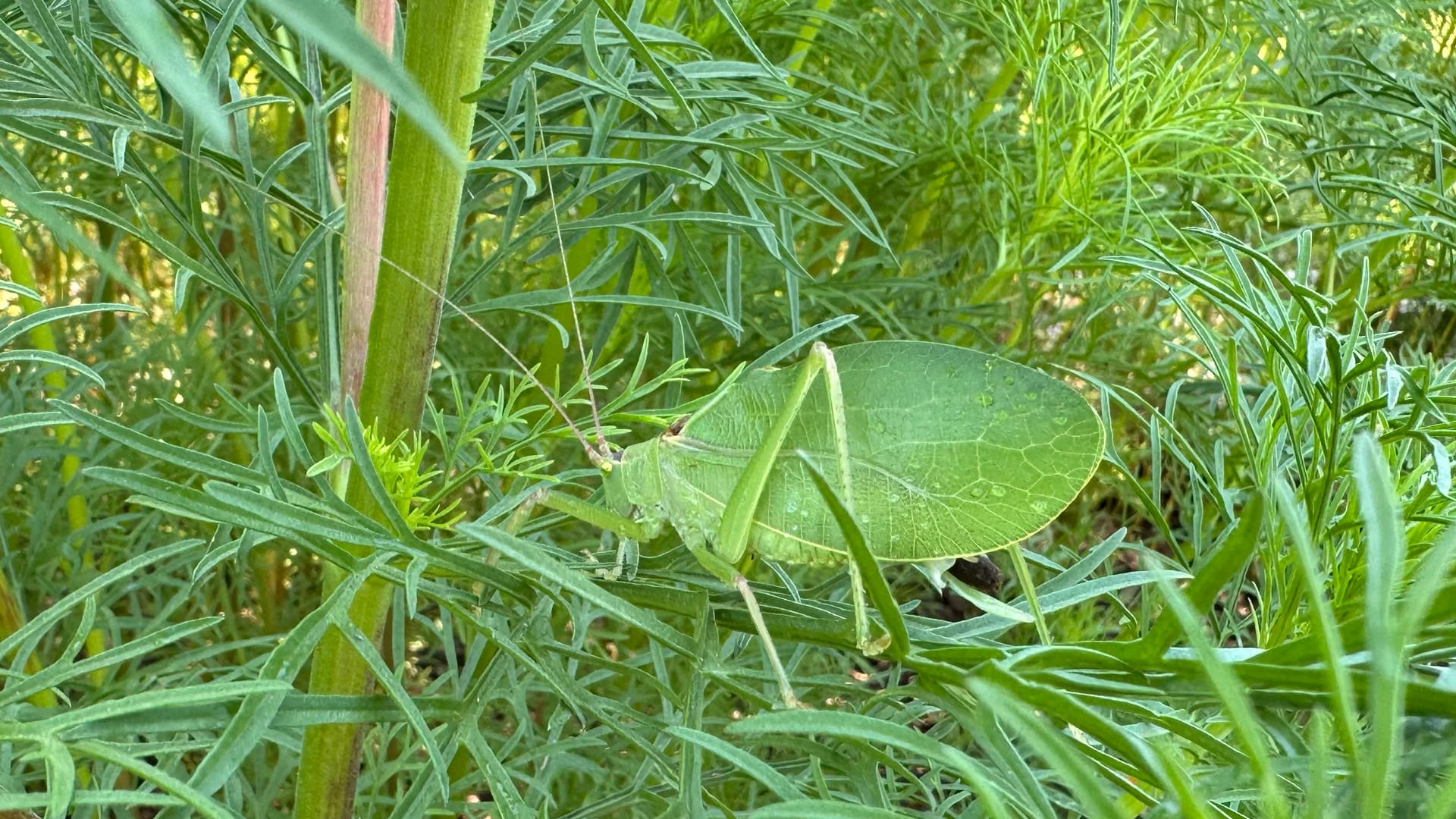
This image shows a katydid, an insect that looks like a green leaf, resting on grass and plant stems. You can see how the katydid's body, wings, and legs are all colored green, just like the plants around it. This makes it very hard to spot the katydid among the grass and leaves because it blends in so well.
🔬 Scientific Phenomena
Anchoring Phenomenon: Animal Camouflage—Why does the katydid look like the plants it lives on?
The katydid's green color and leaf-shaped wings are examples of camouflage, a trait that helps animals hide from predators. Over many generations, katydids with green coloring survived better than those with other colors because they weren't eaten as easily. Animals that match their environment are harder for predators to see, so they live longer and have babies. This process is called natural selection. The katydid's shape, color, and texture all match grass and leaves so well that other animals have a harder time finding it.
📚 Core Science Concepts
- Camouflage as an Adaptation: An adaptation is a body part or behavior that helps an animal survive. The katydid's green color is an adaptation that helps it hide from predators like birds and reptiles.
- Traits and Inheritance: Organisms have traits (characteristics) that are passed down from parents to offspring. The katydid's green color is a trait that comes from its parents and can be passed to its babies.
- Variation in Populations: Not all katydids look exactly the same—some may be lighter or darker green, or have slightly different shapes. This variation helps some katydids survive better in different environments.
- Habitat and Environment Fit: Animals' bodies and behaviors match the places where they live. The katydid lives on plants, and its appearance matches plants perfectly.
Pedagogical Tip:
When teaching camouflage, use actual live insects or high-quality photos in a progressive sequence: first show the insect alone, then show it in its habitat. This builds cognitive demand and allows students to experience the "aha moment" when they finally spot the creature. This concrete discovery is more powerful than simply telling students the insect is camouflaged.
UDL Suggestions:
To support diverse learners, provide multiple means of representation: (1) Use real images AND illustrations labeled with color and shape; (2) Offer a simplified diagram showing how camouflage works with arrows; (3) Include a video clip showing a katydid moving in grass so kinesthetic learners can see the blending effect in motion. For students with visual processing challenges, provide a tactile exploration option using green fabric and leaf cutouts to physically match shapes and textures.
🎓 NGSS Connections
Performance Expectation: 3-LS4-2: Use evidence to construct an explanation for how the variations in characteristics among individuals of the same species may provide advantages in surviving, finding mates, and reproducing.
Disciplinary Core Ideas:
- - Natural Selection: Some kinds of plants and animals have features that help them thrive in different kinds of places.
- - Adaptation: For any particular environment, some organisms can survive well, some survive less well, and some cannot survive at all.
Crosscutting Concepts:
- - Similarities and differences in patterns of traits shared between parent and offspring often provide clues about the rules of inheritance of those traits.
- - In nature, objects and organisms change and interact, and these changes have causes and observable effects.
💬 Discussion Questions
- If the grass in this katydid's home turned brown in the fall, why might a green katydid have trouble surviving there? (Bloom's: Analyze | DOK: 2)
- Why do you think the katydid's body shape looks like a leaf, not just its color? (Bloom's: Evaluate | DOK: 3)
- How would a bright red katydid survive differently than a green katydid in the same grassy area? (Bloom's: Analyze | DOK: 2)
- If some katydids in a population are darker green and some are lighter green, what might happen over time if their habitat gets darker? (Bloom's: Synthesize | DOK: 3)
📖 Vocabulary
- Camouflage: A color, pattern, or shape that helps an animal hide from other animals that might want to eat it.
- Adaptation: A body part or behavior that helps an animal survive and do well in its home.
- Predator: An animal that hunts and eats other animals.
- Habitat: The place where an animal lives and finds food, water, and shelter.
- Trait: A characteristic or feature of an animal or plant, like color or size.
- Variation: Differences in how individual animals or plants look or act, even when they are the same kind.
🌡️ Extension Activities
- Camouflage Hunt Activity: Create a "habitat" using a bulletin board or poster covered with images of grass, leaves, and branches. Hide 10 paper cutouts of various insects (some green, some red, some spotted) around the board. Have students find and count them, then discuss which ones were hardest to find and why. Connect this to the katydid: "Green insects hide better on green plants!"
- Design Your Own Camouflaged Animal: Provide students with a printed picture of a specific habitat (forest floor, sandy desert, snowy field, ocean coral). Students draw and color an imaginary animal that would blend into that habitat, then explain why their animal's colors and patterns help it hide. Display these with the question: "Can you spot the hidden animal?"
- Katydid Life Cycle and Adaptation Sorting: Create cards showing different life stages of a katydid (egg, nymph, adult) and different environments (green grass, brown leaves, flowers). Have students match which life stage might be best adapted to each environment and explain their thinking using the word "camouflage."
🔍 Zoom In / Zoom Out Concepts
Zoom In: Cellular Level—Pigments and Color
At the microscopic level, the katydid's green color comes from special chemicals called pigments inside the cells of its skin and wings. One important pigment is chlorophyll, which is the same green color found in plant leaves. The katydid's body produces this green pigment naturally, just like plants do. When light hits these pigments, our eyes see green. Scientists can look at katydid cells under a microscope and see tiny structures that hold these green pigments. This is why the katydid looks so much like the plants around it—it has the same green color at the cellular level!
Zoom Out: Ecosystem Level—Food Chains and Predator-Prey Relationships
When we zoom out and look at the bigger picture, the katydid is part of a whole ecosystem where many animals depend on each other. The katydid eats plants (it's a primary consumer), and predators like birds, spiders, and reptiles hunt the katydid (making the katydid prey). The katydid's camouflage affects the entire food chain: if predators can't see katydids easily, fewer katydids get eaten, so the katydid population grows. This means more food for the predators, but it also means more plant damage from katydids eating leaves. Camouflage isn't just about one animal hiding—it's part of how entire ecosystems stay balanced and healthy.
🤔 Potential Student Misconceptions
Misconception 1: "The katydid turned green to match the grass on purpose."
Clarification: Katydids don't choose their color or decide to hide. The green color is something they are born with, inherited from their parents. It happened because over many, many years, green katydids survived longer than other colors (because predators couldn't see them as well), so more green katydids had babies. This natural process took a very long time—not something the katydid does during its lifetime.
Misconception 2: "All camouflage is the same—it's just about matching color."
Clarification: Camouflage involves more than just color. The katydid's leaf-shaped wings, its bumpy texture, and the way its body is thin and flat all help it look like a plant part. Sometimes camouflage is a pattern (like stripes), a texture (bumpy or rough), a shape, or even a behavior (staying still). Color is just one tool in the camouflage toolbox.
Misconception 3: "If we paint a katydid a different color, it will be safer or less safe."
Clarification: Painting or dyeing a katydid won't change how it survives because camouflage is a natural trait that animals are born with. The katydid's green color works because it's produced by the katydid's own body. An artificial paint wouldn't work the same way and could actually harm the insect. A katydid's survival depends on the color it naturally inherited from its parents.
🔗 Cross-Curricular Ideas
Mathematics: Pattern and Measurement
Have students create a "Katydid Camouflage Graph." Display photos of katydids in grass and ask students to estimate or measure (using a ruler) how many seconds it takes them to spot the katydid. Record class data on a bar graph showing variation in "finding time." Discuss: Why did some students take longer? Connect this to the concept of variation in a population—some katydids hide better than others, just like some took longer to find!
English Language Arts: Descriptive Writing and Narrative
Students write from the katydid's perspective: "A Day in My Life as a Hidden Katydid." Encourage vivid sensory language: "I am green like the leaves around me. I can feel the rough plant stem under my legs. I hear a bird calling above me, but it cannot see me..." This builds empathy for the animal while reinforcing descriptive vocabulary related to camouflage and habitat.
Art: Camouflage Collage and Color Mixing
Students create a mixed-media collage by cutting shapes from green magazines, fabric, and paper in various shades (light green, dark green, yellow-green, blue-green). They arrange these to create a "hidden katydid" artwork that blends into the background. This hands-on project helps students understand how variation in green shades makes camouflage work and explores the color palette of nature.
Social Studies: Animal Habitats Around the World
Expand the lesson by researching katydids and other camouflaged animals in different habitats worldwide (rainforests, deserts, temperate forests). Students create a simple map or poster showing where katydids live and how their camouflage suits their specific region. This connects adaptation to geography and helps students understand that different environments require different survival strategies.
🚀 STEM Career Connection
- Conservation Biologist — Works out which plants and animals are in trouble, and what would help them recover.
- Try it: Explain how a katydid's camouflage helps it survive and why that's important for its species. (Practice: Constructing Explanations and Designing Solutions)
- Tools: population surveys, GPS trackers, habitat maps, trail cameras
- Where they work: nature reserves, conservation charities, government agencies, universities
- Meet one: Tierra Curry — Which plants and animals are closest to disappearing, and what it takes to save them.
- Median pay: /year — "Zoologists and wildlife biologists"
- Wildlife Biologist — Studies wild animals — what they eat, where they go, and what they need to survive.
- Try it: Design a study to observe how well katydids are camouflaged in different plant environments. (Practice: Constructing Explanations and Designing Solutions)
- Tools: binoculars, radio collars, trail cameras, a field notebook
- Where they work: national parks, wildlife refuges, state wildlife agencies, universities
- Meet one: Rae Wynn-Grant — Where black bears and people run into each other, and how to keep both safe.
- Median pay: /year — "Zoologists and wildlife biologists"
Wage figures are median annual wages for the U.S. occupation named after each one, from the U.S. Bureau of Labor Statistics, Occupational Employment and Wage Statistics (OEWS), national, May 2025. Several careers share one occupation, so their figures match.
---
Teacher Tip: This lesson works beautifully as an entry point to Unit 4: Adaptation and Survival. Consider pairing it with a field study where students hunt for camouflaged insects in your schoolyard using the same "search strategy" they used in the classroom activity. This bridges the disconnect between classroom learning and real-world observation.