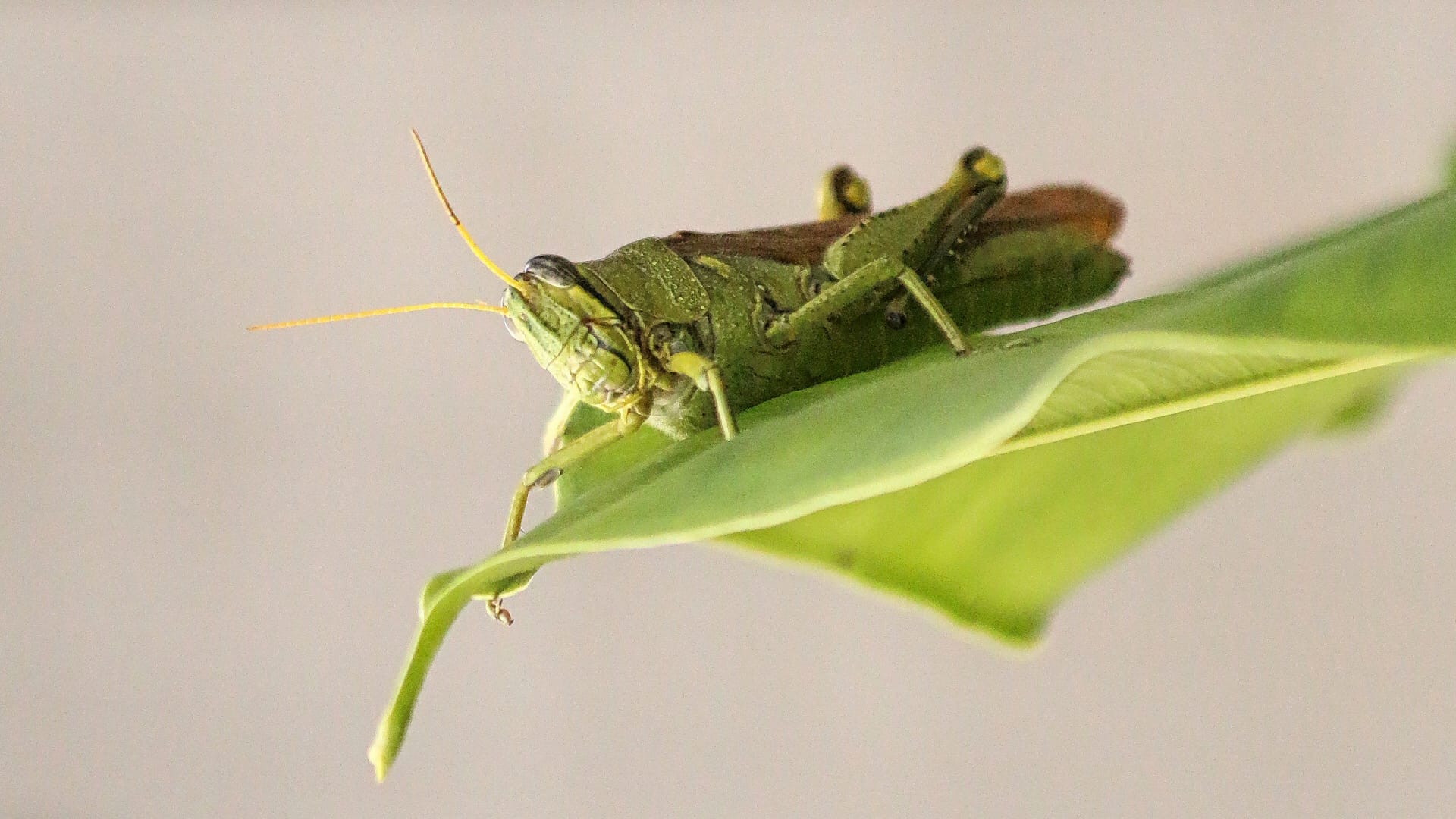
📸 Photo Description
This image shows a green grasshopper sitting on a plant leaf. The grasshopper has a long body with six legs, two long antennae (feelers) on its head, and powerful back legs that help it jump. You can see its bumpy, textured skin and the way it grips the leaf with its feet.
🔬 Scientific Phenomena
Anchoring Phenomenon: Why does a grasshopper have long back legs and antennae?
Grasshoppers have evolved specific body parts that help them survive in their environment. Their long, powerful hind legs allow them to jump away from predators quickly—sometimes 20 times their own body length! Their long antennae act as sensory organs, helping grasshoppers detect vibrations, smell, and sense their surroundings. Their green coloring helps them blend in with plants (camouflage), making it harder for predators to find them. These are adaptations—inherited traits that help living things survive and thrive in their habitats.
📚 Core Science Concepts
- Insect Body Parts: All insects have three main body sections (head, thorax, abdomen), six legs, and antennae. These parts help insects survive and move through their world.
- Adaptations: Grasshoppers' long legs, antennae, and green color are special features that help them survive. Different insects have different adaptations based on where they live.
- Life Cycles & Growth: Grasshoppers go through changes as they grow (called metamorphosis). They start as eggs, hatch into nymphs (baby grasshoppers), and eventually become adults.
- Habitats & Needs: Grasshoppers live where they can find plants to eat and places to hide. They need food, water, shelter, and safety to survive.
Pedagogical Tip:
Use the "observe, describe, wonder" routine with this image. Have students first observe without talking (30 seconds), then describe what they see using specific detail words, then ask what they wonder about. This builds scientific vocabulary and curiosity before diving into instruction.
UDL Suggestions:
Provide multiple ways for students to engage with insect content: (1) Visual—show real insects or high-quality photos; (2) Kinesthetic—have students act out how grasshoppers jump or use their antennae; (3) Tactile—if safe and age-appropriate, let students feel textures (sandpaper, pipe cleaners) that mimic insect body parts. Offer choice in how students demonstrate learning (drawing, writing, verbal explanation, or acting).
🎓 NGSS Connections
Performance Expectation:
3-LS1-1: Develop models to describe that organisms have unique and diverse life cycles but all have in common birth, growth, reproduction, and death.
Disciplinary Core Ideas:
- Growth and Reproduction of Organisms
- Inheritance of Traits
- Adaptation
Crosscutting Concepts:
- —Insects show patterns in body structures and behaviors
- —Body parts help grasshoppers do what they need to survive
💬 Discussion Questions
- What body parts do you see on the grasshopper, and how might each one help it survive? (Bloom's: Analyze | DOK: 2)
- Why do you think the grasshopper is green instead of red or blue? (Bloom's: Infer | DOK: 2)
- If a grasshopper didn't have long back legs, how might its life be different? (Bloom's: Evaluate | DOK: 3)
- How is a grasshopper's body similar to and different from an ant's body? (Bloom's: Compare | DOK: 2)
📖 Vocabulary
- Adaptation: A body part or behavior that helps an animal survive in its home. (Example: A grasshopper's long legs are an adaptation for jumping away from danger.)
- Antennae: Long, thin feelers on an insect's head that help it sense smells and vibrations. (The word for one antenna is antenna.)
- Thorax: The middle section of an insect's body where the legs and wings are attached.
- Camouflage: Colors or patterns on an animal's body that help it hide by blending in with its surroundings.
- Habitat: The natural home of a plant or animal where it finds food, water, and shelter.
- Metamorphosis: Big changes in an animal's body as it grows from a baby to an adult.
🌡️ Extension Activities
- Insect Detective Hunt: Take students outside to search for real insects (grasshoppers, crickets, beetles, ants). Have them observe and sketch one insect, labeling the head, thorax, abdomen, legs, and antennae. Back in class, compare drawings and discuss which adaptations help each insect survive. Safety note: Supervise closely and remind students to observe insects respectfully without harming them.
- Build a Grasshopper Model: Provide craft materials (pipe cleaners, paper, string, paint) and have students create a 3D grasshopper model. They should label at least three body parts and explain one adaptation in writing or verbally.
- Grasshopper Jump Challenge: Mark distances on the floor (1 foot, 2 feet, 3 feet, etc.). Have students practice jumping like a grasshopper and measure how far they can jump. Compare this to how far a real grasshopper jumps proportionally. Create a chart showing that grasshoppers can jump 20 times their body length—a superpower! Safety note: Use a padded gym area or carpet and ensure adequate space.
🔍 Zoom In / Zoom Out Concepts
Zoom In: Microscopic Level
If we could use a super-powerful microscope to look very closely at a grasshopper's skin, we would see tiny, tiny holes called pores. These pores let the grasshopper breathe! Unlike humans who have lungs inside their bodies, grasshoppers breathe through small tubes called spiracles that run along the sides of their body. Air moves through these tubes to help the grasshopper's cells get the oxygen they need to live and jump. The bumpy texture you see on the grasshopper's skin is actually made up of millions of tiny cells all packed together, each one doing an important job to keep the grasshopper alive.
Zoom Out: Ecosystem Level
A grasshopper is just one small part of a much bigger system called an ecosystem. In a meadow or garden ecosystem, grasshoppers eat plants (they are herbivores), and then birds, snakes, and other animals eat the grasshoppers. When grasshoppers die, they return nutrients to the soil, which helps new plants grow. The plants give grasshoppers food and shelter, the grasshoppers feed other animals, and everything is connected in a circle. If grasshoppers disappeared from an ecosystem, birds and other predators would lose an important food source, and the whole system would be out of balance. This shows us that every living thing—even a tiny grasshopper—matters!
🤔 Potential Student Misconceptions
Misconception 1: "Grasshoppers are insects, and insects are bugs. All bugs are insects."
Clarification: All insects ARE bugs in the general sense (small creatures), but not all bugs are insects! Some bugs (like spiders) have 8 legs and are called arachnids, not insects. True insects always have exactly 6 legs, 3 body parts, and antennae. A grasshopper is an insect because it has these features. Help students sort real pictures of creatures into "insects" and "not insects" based on leg and body part counts.
Misconception 2: "Grasshoppers make noise by rubbing their legs together, just like a cricket."
Clarification: While some grasshoppers DO make sounds by rubbing their legs together (called stridulation), many grasshoppers actually make noise by rubbing their hind legs against their wings, or they don't make loud sounds at all! Some grasshoppers communicate by jumping or changing color. Not all grasshoppers "sing"—it depends on the species. This is a great opportunity to explore diversity within a single insect type.
Misconception 3: "If I remove a grasshopper's antennae, it can still survive and live a normal life."
Clarification: A grasshopper can survive for a short time without antennae, but it would have a very hard time! The antennae are like a grasshopper's nose, eyes, and ears all combined. Without them, the grasshopper cannot smell food, detect danger, feel vibrations, or navigate its world. It would likely not survive long in nature. This helps students understand that adaptations are not extras—they are essential for survival.
🔗 Cross-Curricular Ideas
Mathematics: Measurement & Data
Create a "Grasshopper Jump Data" activity. Have students measure and record how far they can jump in centimeters or inches. Then teach them that real grasshoppers can jump up to 20 times their body length. If a grasshopper is 5 cm long, how far could it jump? (100 cm!) Create a class bar graph or table showing student jump distances compared to predicted grasshopper jump distances. This builds measurement skills and proportional reasoning.
English Language Arts: Descriptive Writing & Poetry
Read Grasshopper on the Road by Arnold Lobel together, then have students write their own short story or poem from a grasshopper's perspective. Encourage them to use sensory words: What does the grasshopper see? Hear? Feel? This could be a simple "Acrostic Poem" using the word GRASSHOPPER, or a "Five Senses" descriptive paragraph. Display student work with drawings of grasshoppers alongside the text.
Art: Camouflage & Blending
Provide students with green, yellow, and brown markers, colored paper, and craft materials. Have them design their own "camouflaged insect" by creating a creature that blends into a specific habitat (grass, tree bark, flower petals). Then play a "spot the insect" game where students try to find each other's hidden creatures on different background papers. Discuss why camouflage is an adaptation and have students label the colors and patterns they chose on their artwork.
Social Studies: Habitats & Community Roles
Create a "Grasshopper's Home" map activity. Have students draw or build a diorama of a grasshopper's habitat, including plants it eats, predators it avoids, shelter, and water sources. Discuss how grasshoppers depend on their community (plants and other animals) and how the community depends on grasshoppers. This connects to concepts of interdependence and how humans also live in communities where everyone has a role.
🚀 STEM Career Connection
- Entomologist — Studies insects — how they live, what they eat, and the jobs they do in an ecosystem.
- Try it: Design a simple experiment to test if grasshoppers prefer certain types of plants for food, based on their adaptations. (Practice: Constructing Explanations and Designing Solutions)
- Tools: insect nets, a hand lens, pinning boards, microscopes
- Where they work: museums, farms, insect labs, universities
- Meet one: Corrie Moreau — How ants evolved together with the bacteria that live inside them.
- Median pay: /year — "Zoologists and wildlife biologists"
- Conservation Biologist — Works out which plants and animals are in trouble, and what would help them recover.
- Try it: Explain how a grasshopper's camouflage helps it survive and suggest other animals that use camouflage. (Practice: Constructing Explanations and Designing Solutions)
- Tools: population surveys, GPS trackers, habitat maps, trail cameras
- Where they work: nature reserves, conservation charities, government agencies, universities
- Meet one: Tierra Curry — Which plants and animals are closest to disappearing, and what it takes to save them.
- Median pay: /year — "Zoologists and wildlife biologists"
Wage figures are median annual wages for the U.S. occupation named after each one, from the U.S. Bureau of Labor Statistics, Occupational Employment and Wage Statistics (OEWS), national, May 2025. Several careers share one occupation, so their figures match.
---
Teacher Tip: Start with the anchoring phenomenon (the image), allow student wonder and questions to guide your instruction, and circle back to the image at the end to see how much students' thinking has grown. This approach deepens engagement and scientific reasoning!