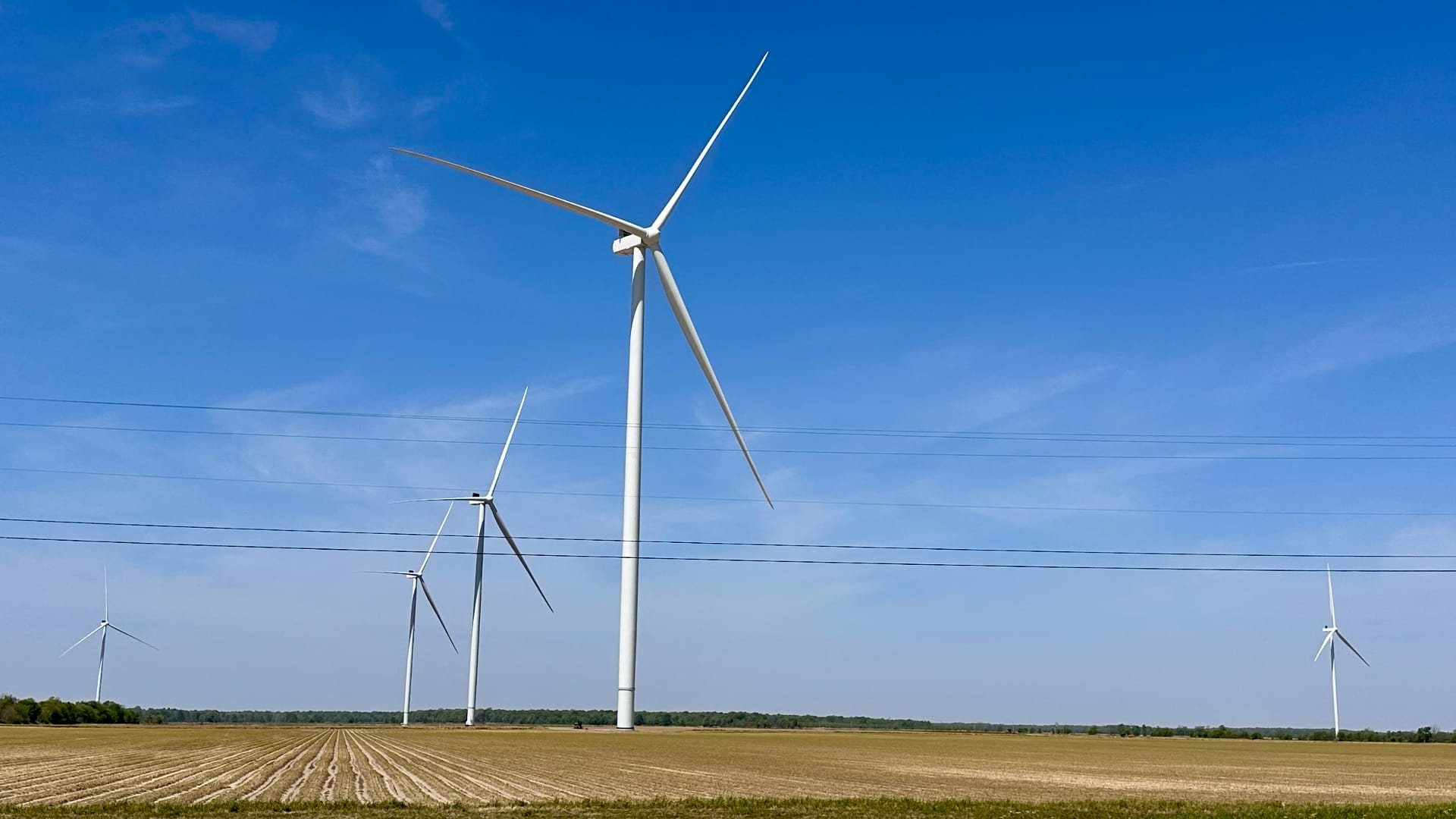
📸 Photo Description
Wind turbines are tall machines with big spinning blades that catch the wind blowing across open fields. The wind pushes the blades around and around, helping create energy that people use. The flat land around the turbines shows how wind moves across Earth's surface in spaces without trees or buildings blocking it.
🔬 Scientific Phenomena
Anchoring Phenomenon: Wind energy being captured and converted into usable power.
Why It's Happening (Scientific Explanation):
Wind is moving air caused by uneven heating of Earth's surface by the sun. When the sun heats different areas of land differently, the air moves to balance out these temperature differences. These wind turbines are positioned in open fields where wind moves consistently and freely. The blades catch this moving air and spin, demonstrating that wind is a force that can move and do work. This observable phenomenon illustrates how natural resources (wind) from Earth's systems can be used by humans. Wind is a renewable resource because Earth's atmosphere continuously circulates due to solar heating—a fundamental Earth system process.
📚 Core Science Concepts
- Wind as a Natural Force: Wind is moving air caused by the sun heating Earth unevenly. Wind can push, move, and do work (like spinning the turbine blades). This connects to Earth's weather systems and energy from the sun.
- Natural Resources and Human Use: Wind is a natural resource found in Earth's atmosphere that humans can use to generate energy. Understanding that wind is a renewable resource helps children recognize that some Earth materials and processes can be used again and again without running out.
- Weather and Observable Patterns: Wind is a key weather element. The presence of these turbines in open, flat areas shows that wind patterns vary by location—areas with consistent, strong winds are better for wind energy collection. Students can observe wind through its effects (moving grass, blowing leaves, spinning blades).
- Earth's Atmosphere and Systems: Wind turbines demonstrate the interconnection between Earth's atmospheric system (where wind occurs) and human communities. This illustrates that Earth is a system with many parts that interact.
Pedagogical Tip:
For Kindergarteners, focus on the observable, sensory experience of wind rather than the energy conversion mechanism. Help students feel wind on their skin, see its effects (leaves moving, turbine blades spinning), and understand it as "air that moves." Use the turbine as a concrete example of wind's power to move things—just like wind moves their hair or a kite. Avoid complex explanations about electricity or power generation.
UDL Suggestions:
Multiple Means of Engagement: Provide kinesthetic experiences by having students pretend to be wind turbine blades, spinning their arms as imaginary wind "pushes" them. Use video clips of turbines spinning in slow motion so all learners can see the motion clearly.
Multiple Means of Representation: Use pictures and simple diagrams showing wind as arrows moving toward the turbine blades. Create a "wind simulation" with a fan and pinwheel so students can see cause-and-effect relationships. Use consistent, simple language: "Wind pushes the blades. The blades spin around and around."
Multiple Means of Expression: Allow students to draw wind as arrows or wavy lines on paper, act out spinning blades, or point to where wind is pushing in photos. Accept varied representations of their understanding.
🔍 Zoom In / Zoom Out Concepts
Zoom In: Molecular/Microscopic View
At the tiniest level, wind is made of billions of air molecules (tiny invisible pieces of air) all moving together in the same direction. When these molecules bump into the turbine blades, they transfer energy that makes the blades spin. Students don't need to understand molecules, but the idea is: wind is made of something invisible (air) that has power to push things.
Zoom Out: Earth System Connection
Wind is part of Earth's weather system, which is powered by the sun's heat. The sun unevenly heats different parts of Earth (equator gets more heat than poles), causing air to move from hot areas to cold areas. This creates wind patterns around the entire planet. Wind turbines in specific locations tap into these large-scale atmospheric patterns that exist because of Earth's relationship to the sun. On an even larger scale, wind is part of Earth's climate system and the cycling of energy through our planet.
🤔 Potential Student Misconceptions
- Misconception: "The turbine blades are making the wind."
- Scientific Clarification: The wind is already there! The turbine blades are spinning because the wind is pushing them. The wind comes from the sun heating Earth's air. The turbines don't create wind; wind creates the spinning motion of the blades.
- Misconception: "Wind only happens on windy days I can feel it."
- Scientific Clarification: Wind is moving air that happens almost all the time, even when it's very light. Sometimes it's strong enough to feel on your skin or see leaves move (like around turbines in open fields). Sometimes it's too gentle to notice, but it's still there. Turbines need steady, consistent wind to work well.
- Misconception: "The turbine pushes air and that makes wind."
- Scientific Clarification: The turbine is moved by wind. Wind is created by the sun heating different parts of Earth, not by machines. Machines like turbines use wind that's already there; they don't make wind happen.
🎓 NGSS Connections
K-ESS2-1: Use and share observations of local weather conditions to describe patterns over time.
- Connection: Wind is a weather element. Observing turbines demonstrates wind's consistent presence in certain locations and how wind patterns vary by geography.
- (Weather and Climate)
-
K-ESS3-1: Use a model to represent the relationship between the needs of different plants and animals (including humans) and the places they live.
- Connection: Wind turbines show how humans modify and use their environment. Turbines are placed in specific locations (flat, open areas) where wind is abundant—showing how humans seek out resources where they naturally occur.
- (Environmental Impacts of Human Activity)
-
K-ESS3-3: Communicate solutions that will reduce the impact of humans on the land, water, air, and/or other living things in the local environment.
- Connection: Wind turbines are a solution humans have created to generate energy without polluting air or water (compared to fossil fuels). This demonstrates human innovation for sustainable use of natural resources.
- (Human Impacts on Earth Systems)
-
💬 Discussion Questions
- "What do you think is pushing the turbine blades around and around?"
(Bloom's: Understand | DOK: 1)
- "Why would people build these big turbines in a flat, open field instead of near trees?"
(Bloom's: Analyze | DOK: 2)
- "Can you see the wind? How do we know wind is real if we can't see it?"
(Bloom's: Analyze | DOK: 2)
- "What other things does wind push or move? Have you seen wind moving things outside?"
(Bloom's: Remember/Apply | DOK: 1)
📖 Vocabulary
- Wind: Moving air that we can feel and see moving things around us.
- Turbine: A machine with blades that spin around when wind (or water) pushes them.
- Blade: A flat, long piece that is part of the turbine and spins in the wind.
- Natural Resource: Something from nature that people can use, like wind, water, or trees.
- Energy: The power to make things move, change, or work.
- Weather: What the air outside is like (sunny, rainy, windy, hot, or cold).
🌡️ Extension Activities
- Wind Spinner Craft: Have students create simple paper pinwheel spinners (pre-made or student-assembled with teacher support). Take them outside to feel the wind pushing the pinwheel blades. Ask: "Is this like the big turbine blades? What's the same? What's different?" This makes the abstract concept of wind energy concrete and physically observable.
- Wind Observation Walk: Take students on a nature walk to observe signs of wind: leaves moving, grass bending, flags flying, dust or pollen in the air, spider webs moving. Have students point out and name what wind is moving. Back in class, create a class chart: "Signs of Wind We Saw Today." This reinforces that wind is everywhere and always doing work.
- Windy Day vs. Calm Day Compare: On different days (one windy, one calm), have students observe and discuss: "Is it windy today? How do you know? Can you see wind? Can you feel wind? What is the wind moving?" Create simple drawings comparing the two days, using arrows to show wind direction and force on the windy day.
🔗 Cross-Curricular Ideas
- Math + Art: Students create a simple graph or tally chart showing "Things Wind Can Move" (leaves, paper, grass, clouds, turbine blades, hair, etc.) collected from classroom or outdoor observations. Connect to data representation and categorization.
- ELA + Science: Read a picture book about wind (see resources below). Have students draw and dictate or write simple sentences: "Wind can ___" (push, move, spin, blow, etc.). Create a class wind story book: "Our Class Discovers Wind."
- Social Studies + Science: Discuss how people in different places experience wind differently. "People who live near turbines see wind power. What kind of weather do people in our community have? Where do you see wind in our town?" Connect to local geography and human communities using natural resources.
- Movement/PE + Science: Play "Wind and Blades" game: Students are turbine blades. Teacher (as wind) gives directional instructions: "Gently blow from the north—blades spin slowly!" "Strong wind from the west—spin fast!" This kinesthetic activity helps internalize wind direction and force while reinforcing observation skills.
🚀 STEM Career Connection
- Physicist — Works out the rules that matter and energy follow, from the very small to the whole universe.
- Try it: Experiment with blowing on different-sized objects to see which ones move the most easily. (Practice: Constructing Explanations and Designing Solutions)
- Tools: lasers, detectors, vacuum chambers, computer simulations
- Where they work: research laboratories, particle accelerators, observatories, universities
- Meet one: Chanda Prescod-Weinstein — Dark matter — the invisible material that makes up most of the universe.
- Median pay: /year — "Physicists"
- Mechanical Engineer — Designs things that move — engines, turbines, joints and gears — and works out the forces on them.
- Try it: Design and build a simple device that uses wind to move a small object. (Practice: Constructing Explanations and Designing Solutions)
- Tools: CAD software, 3D printers, force sensors, wind tunnels
- Where they work: engineering firms, factories, design studios, research labs
- Meet one: Shini Somara — How air and water flow around things, worked out on a computer before anything is built.
- Median pay: /year — "Mechanical engineers"
Wage figures are median annual wages for the U.S. occupation named after each one, from the U.S. Bureau of Labor Statistics, Occupational Employment and Wage Statistics (OEWS), national, May 2025. Several careers share one occupation, so their figures match.