📸 Photo Description
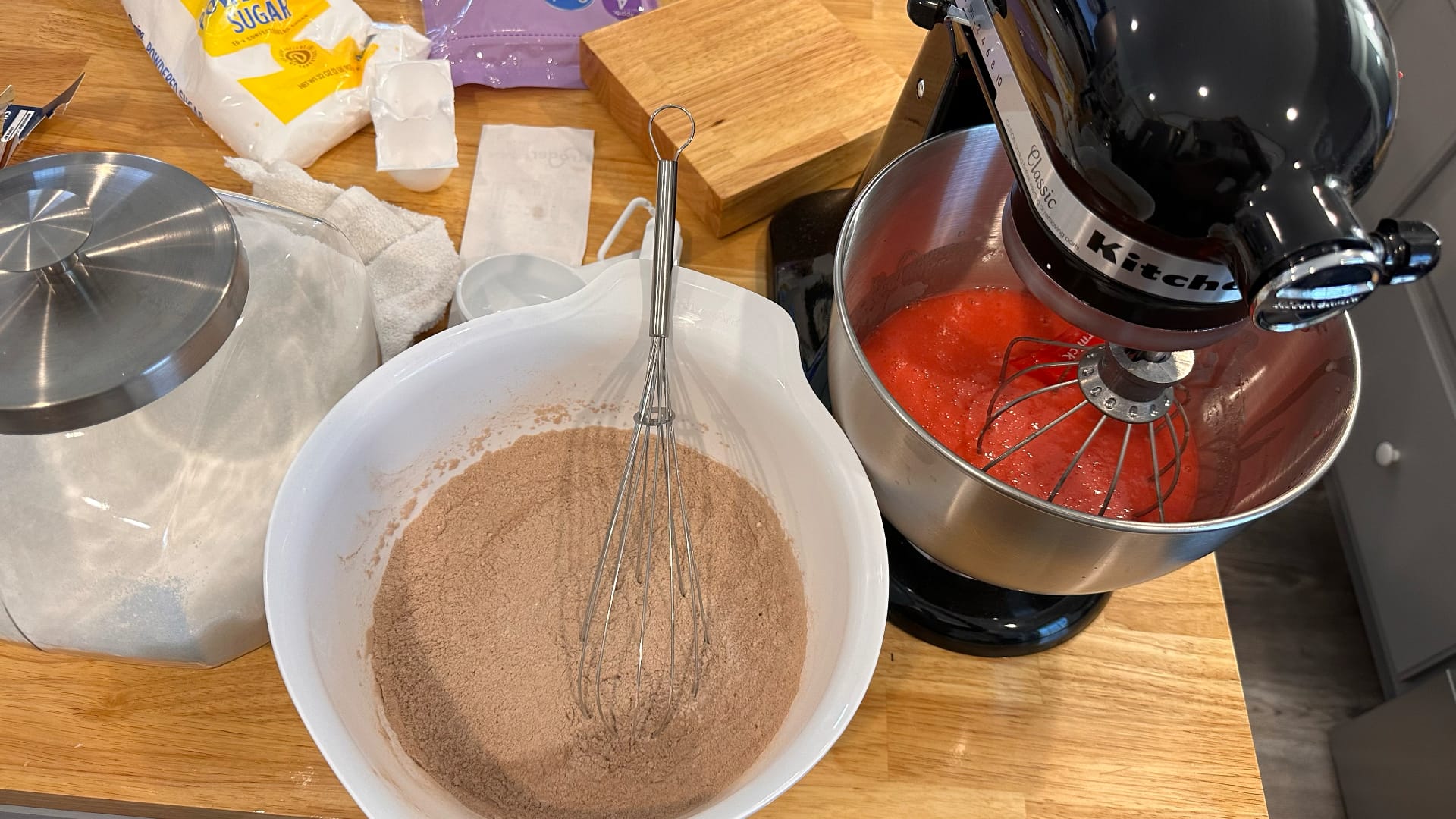
This image shows a cooking scene with dry ingredients in a white bowl (cinnamon and flour mixed together) and a stand mixer containing a red liquid, representing a mixture being created. Both examples show how different materials can be combined together while still keeping their own properties—you can still see the brown powder and the red liquid even when they're being mixed.
🔬 Scientific Phenomena
Anchoring Phenomenon: When you combine different materials together, you create a mixture.
Why This Happens: A mixture forms when two or more materials are stirred, blended, or combined together. The individual materials do not change into something completely new—they are just being combined. In this kitchen example, when flour and cinnamon are mixed in a bowl, they blend together, but you can still see both the light and brown colors. Similarly, when ingredients are added to a stand mixer, they combine to create batter or dough. Each material keeps its own characteristics; they're just sharing the same space now.
📚 Core Science Concepts
- What is a Mixture? A mixture happens when two or more different materials are put together. The materials mix but stay the same—they don't change into something brand new.
- Observable Properties in Mixtures: Even after mixing, you can often still identify the individual materials by their color, texture, or appearance. For example, you can still see brown cinnamon powder within the lighter flour.
- Reversible vs. Non-Reversible Changes: Some mixtures can be separated back into their original parts (reversible), while others cannot be easily separated once mixed (non-reversible). This connects to later understanding of physical vs. chemical changes.
- Everyday Mixtures: Mixtures are all around us—in the kitchen (cookie dough, cereal and milk, salad), in nature (sand and shells on a beach), and in homes (paint colors, salt water).
Pedagogical Tip:
When teaching mixtures to third graders, use the predictive, hands-on approach: Before students mix materials, have them predict what the mixture will look and feel like. Then let them observe and describe the actual results. This builds scientific thinking skills and helps students understand that observations are more reliable than assumptions.
UDL Suggestions:
Representation: Provide picture cards showing examples of mixtures alongside non-mixtures (like a peanut butter sandwich vs. mixed trail mix) so visual learners can categorize and compare. Action & Expression: Allow students to choose between drawing, building with manipulatives, or verbal description when explaining what a mixture is. Engagement: Let students select which materials they want to mix during investigations to increase autonomy and motivation.
🎓 NGSS Connections
Performance Expectation:
2-PS1-3: Make observations to construct an evidence-based account of how an object made of a small set of pieces can be disassembled and made into a new object.
Disciplinary Core Ideas:
- (Structure and Properties of Matter)
Crosscutting Concepts:
- (Students observe that mixing is a pattern of combining materials)
- (When materials are combined, a mixture results)
💬 Discussion Questions
- What do you notice about the flour and cinnamon in the bowl? Can you still see both materials, or did they disappear? (Bloom's: Remember/Understand | DOK: 1)
- If we mixed the flour and cinnamon together, then tried to separate them again, do you think we could easily pull them apart? Why or why not? (Bloom's: Analyze | DOK: 2)
- What other mixtures have you seen adults make in your kitchen at home? What materials did they combine? (Bloom's: Apply | DOK: 2)
- Compare mixing flour and cinnamon to mixing red food coloring into water. How are these mixtures alike and different? (Bloom's: Analyze/Evaluate | DOK: 3)
📖 Vocabulary
- Mixture: When two or more different materials are put together in the same place.
- Combine: To put things together; to mix materials so they share the same space.
- Ingredient: A material or item that is mixed with other materials to make something new (like flour in a cake recipe).
- Property: A characteristic of a material you can observe, like color, texture, size, or smell.
- Separate: To divide things that have been mixed; to pull materials apart.
- Reversible: Something that can be changed back to the way it was before.
🌡️ Extension Activities
- Mystery Mixture Investigation: Place three unlabeled materials in separate containers (examples: salt, sugar, sand, cinnamon, flour). Have students predict which ones are the same and which are different based on visual and tactile observations. Then, have them mix pairs together in clear cups to observe how the mixtures look different. Students sketch and label their observations in a science journal.
- Create-Your-Own Trail Mix: Students select 3–4 ingredients (cereal, raisins, nuts, pretzels, chocolate chips, coconut flakes) and combine them in a cup to create their own mixture. They predict what the mixture will look like, observe the results, and describe the properties using words like "crunchy," "colorful," "bumpy," etc. Note: Always check for nut allergies.*
- Separation Challenge: Create a simple mixture (sand + small pebbles, or pasta shapes + rice) and challenge students to separate the mixture using tools like strainers, sieves, or spoons. Discuss which tools work best and why, connecting to the idea that some mixtures are easier to separate than others.
🔍 Zoom In / Zoom Out Concepts
Zoom In: Microscopic Level
If we could shrink down teeny-tiny with a super powerful microscope, we would see that flour and cinnamon are made of millions and millions of small particles. When you mix them together, the cinnamon particles spread throughout the flour particles, but they don't stick together or change into something new. Each particle stays exactly what it is—a flour particle or a cinnamon particle. It's like having a huge crowd of people wearing red shirts (cinnamon) and blue shirts (flour) all standing together in the same room. You can still tell who's wearing red and who's wearing blue, even though they're all mixed up!
Zoom Out: Kitchen & Home Systems
When we look at the bigger picture, mixing ingredients is just the first step in cooking and baking. The kitchen is a place where people combine many different mixtures to create meals and treats for their families. Some mixtures (like flour and cinnamon) stay as mixtures. Other mixtures get heated in ovens or on stoves, which causes them to change into something completely new—like when cake batter gets baked into a solid cake. Understanding how to make mixtures helps us prepare food, stay healthy, and share meals with the people we care about.
🤔 Potential Student Misconceptions
Misconception 1: "When you mix things together, they disappear or become the same thing."
Clarification: When materials are mixed, they don't vanish! They're just blended together in the same space. The individual materials are still there—they just might be harder to see. For example, when you mix cinnamon and flour, the cinnamon particles are still brown and the flour is still white; they're just standing next to each other now instead of in separate bowls. We can still see both colors in the mixture.
Misconception 2: "All mixtures can be easily separated back into their original materials."
Clarification: Some mixtures are easy to separate (like separating pasta from rice with a strainer), but others are much harder or impossible to separate once mixed. When you stir red food coloring into water, the color spreads so thoroughly that you can't easily pull them back apart. It's important to observe different mixtures to understand which ones separate easily and which ones don't.
Misconception 3: "A mixture is only something made in the kitchen for cooking."
Clarification: Mixtures are everywhere! They're not just in cooking. Mixtures happen at the beach (sand and seashells), in nature (rocks and soil), in your classroom (pencils and erasers in a cup), and in many other places. Any time two or more materials are put together in the same space, a mixture can form.
🔗 Cross-Curricular Ideas
Math Connection: Measurement & Proportions
Have students measure dry ingredients using standard measuring cups (1 cup flour, ½ cup sugar, etc.). Create a simple recipe chart where students compare the amounts of different ingredients and practice adding/subtracting quantities. Students can predict how the mixture will change if they double or halve the recipe, building early fraction and measurement skills.
ELA Connection: Recipe Writing & Descriptive Language
Students create their own "mixture recipe" using descriptive adjectives and sequential language. They write simple instructions using words like "first," "next," and "finally" to describe how to make a trail mix or sensory mixture. Students share their recipes aloud, building vocabulary related to textures and properties (bumpy, smooth, colorful, crunchy).
Social Studies Connection: Food & Cultural Traditions
Discuss how different cultures around the world create special food mixtures and dishes. Students learn that salsa (tomatoes, onions, peppers mixed together) comes from Latin American cuisine, or that trail mix is popular for hiking and travel. Create a world map where students place pictures of mixtures from different countries, exploring how families around the globe combine foods in their own traditional ways.
Art Connection: Color Mixing & Visual Exploration
Students create a "texture board" by mixing and gluing different colored materials (paint, sand, glitter, tissue paper) onto paper to observe how colors and textures combine. They can also paint with water on colored construction paper to see how red and yellow mix to make orange, or experiment with mixing paints to discover secondary colors. This hands-on art experience reinforces the concept that materials can combine while maintaining some of their individual properties.
🚀 STEM Career Connection
- Materials Engineer — Chooses and shapes the right material for a job, and tests it until it fails.
- Try it: Mix small rocks and sand, then try to separate them by shaking the container and record if all the rocks come out. (Practice: Analyzing and Interpreting Data)
- Tools: tensile testers, furnaces, microscopes, hardness testers
- Where they work: manufacturing plants, product design firms, testing labs, universities
- Meet one: Ainissa Ramirez — How to make metal stick to glass and ceramics — she invented a solder that does it.
- Median pay: /year — "Materials engineers"
- Environmental Scientist — Measures how healthy the air, water and land are, and finds out what is harming them.
- Try it: Mix soil with a small amount of water and observe how the water changes color, recording your observations. (Practice: Analyzing and Interpreting Data)
- Tools: water test kits, air sensors, sample jars, data loggers
- Where they work: rivers and lakes, city environmental offices, testing labs, consulting firms
- Meet one: Tierra Curry — Which plants and animals are closest to disappearing, and what it takes to save them.
- Median pay: /year — "Environmental scientists and specialists, including health"
Wage figures are median annual wages for the U.S. occupation named after each one, from the U.S. Bureau of Labor Statistics, Occupational Employment and Wage Statistics (OEWS), national, May 2025. Several careers share one occupation, so their figures match.
---
Teacher Note: This lesson uses the kitchen/baking context as an authentic, relatable anchor point. Third graders have experience with food preparation, making this phenomenon highly engaging and concrete. Be sure to follow your school's food allergy protocols before conducting any taste-related activities.