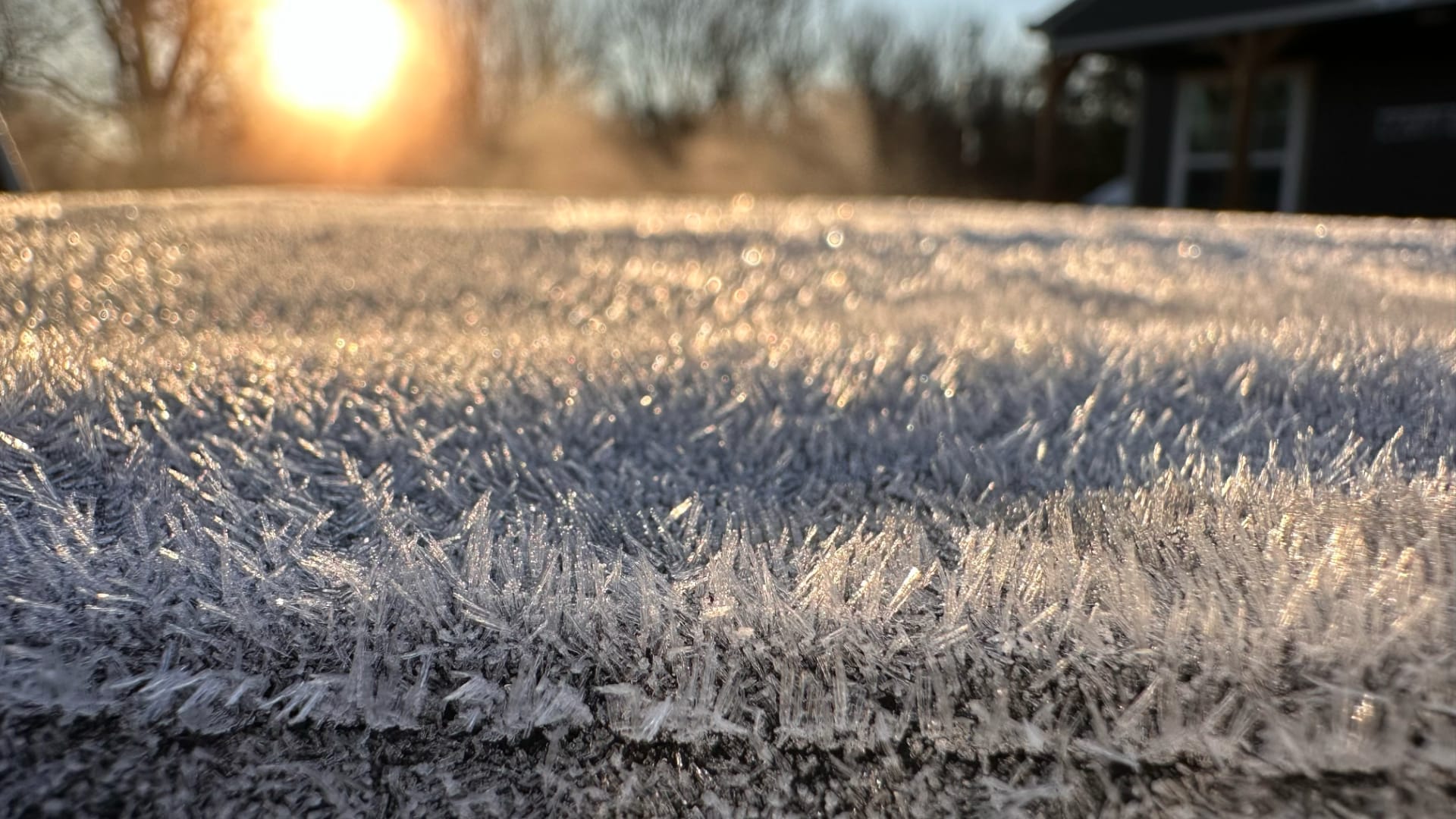
📸 Photo Description
This image shows frost—a thin, sparkly layer of ice crystals—covering a surface on a cold morning. The frost creates a bumpy, crystalline texture that catches the early sunrise light, making it sparkle and shine. In the background, you can see bare trees and a house, indicating this happened during winter or very early morning when temperatures dropped below freezing.
🔬 Scientific Phenomena
Anchoring Phenomenon: Frost formation through direct deposition
This image captures frost, which occurs when water vapor in the air turns directly into ice crystals without becoming liquid water first. This process is called deposition. When the air temperature drops below 32°F (0°C) on a clear night, water vapor near cold surfaces (like car roofs, grass, or windows) loses enough heat energy that it crystallizes into solid ice. The moisture doesn't fall as rain or snow—it freezes right where it touches the cold surface, creating those delicate, icy patterns visible in the photo.
📚 Core Science Concepts
- States of Matter & Phase Change: Water exists in three states—solid, liquid, and gas. Frost demonstrates how water vapor (gas) can change directly into ice (solid) when temperature drops.
- Temperature & Energy: Temperature is a measure of how fast tiny particles are moving. When it's very cold, water particles slow down so much they freeze into crystals.
- Weather & Seasonal Patterns: Frost typically forms during clear, cold nights when skies are cloudless and temperatures fall rapidly after sunset, especially in fall and winter.
- Observation & Properties: Frost shows observable physical properties—it's white, sparkly, crystalline, and bumpy—that help us identify and describe it.
Pedagogical Tip:
Third graders are concrete thinkers, so encourage them to touch frost in real life (gloved hands only!) or examine photos up close. Ask them to draw what they observe before introducing the science explanation. This builds observational skills and creates personal connection before abstract concepts.
UDL Suggestions:
Representation: Provide both visual images and tactile experiences. Create a frost observation station with magnifying glasses and labeled photos. Action & Expression: Allow students to show understanding through drawing, building models with salt and water, or physically arranging themselves to act out water molecules changing states. Engagement: Connect to student experiences: "Have you ever seen your breath turn into tiny ice crystals on a cold day?" or "Have you touched frost on a fence?"
🎓 NGSS Connections
Performance Expectation:
2-PS1-4: Construct an argument with evidence that some changes caused by heating or cooling can be reversed and some cannot.
Disciplinary Core Ideas:
- - Structure and Properties of Matter
- - States of Matter and Their Interactions
Crosscutting Concepts:
- - Frost forms predictably under certain temperature and moisture conditions
- - Cold temperatures cause water vapor to change into solid ice
💬 Discussion Questions
- What do you notice about the frost in this picture? Describe what it looks like. (Bloom's: Remember | DOK: 1)
- Why do you think frost forms on cold mornings but not on warm mornings? (Bloom's: Analyze | DOK: 2)
- If you could touch this frost, what do you predict it would feel like, and why? (Bloom's: Predict | DOK: 2)
- Where else in your neighborhood might you find frost on a cold morning, and why would those places get frosty? (Bloom's: Apply | DOK: 3)
📖 Vocabulary
- Frost: A thin, white, sparkly layer of ice crystals that forms on cold surfaces when water vapor freezes.
- Temperature: How hot or cold something is; measured in degrees.
- Water Vapor: Water in the form of an invisible gas floating in the air around us.
- Deposition: The process where water vapor turns directly into ice without becoming liquid first.
- Crystallize: When particles arrange themselves into organized, repeating patterns, forming solid crystals.
- Freeze: When a liquid changes into a solid because it gets very cold.
🌡️ Extension Activities
Activity 1: Frost Hunt & Documentation
Take students on a supervised outdoor "frost hunt" on a cold morning. Have them observe and sketch different surfaces where frost formed (grass, cars, leaves, windows). Ask: "Which surfaces got the frostiest? Why?" This builds observation skills and introduces the concept that different materials lose heat at different rates.
Activity 2: Create Frost in a Cup
Fill a clear cup with ice and salt (supervise closely). Place it on a paper towel outside or by a window. Within 5-10 minutes, frost will form on the outside. Students can observe the frost developing, touch the cup (briefly), and draw what happens. This is a safe, controlled way to demonstrate frost formation.
Activity 3: Temperature & Water Vapor Experiment
Have students breathe onto a cold mirror or window and observe the condensation (tiny water droplets). Compare this to frost formation. Discuss: "What's the same? What's different?" This bridges understanding from visible condensation to invisible frost formation.
🔍 Zoom In / Zoom Out Concepts
Zoom In: The Microscopic View
If we could shrink down and look at frost through a super-powerful microscope, we'd see something amazing! Each sparkly crystal is made of trillions of water molecules that arranged themselves in a perfect, geometric pattern—like a tiny, organized ice palace. These molecules are moving very, very slowly because it's so cold. At room temperature, water molecules bounce around randomly like excited kids on a playground. But when the temperature drops below freezing, the molecules slow down so much they lock together in organized rows and columns, creating the beautiful hexagonal (six-sided) crystal shapes we see in frost. No two frost crystals are exactly alike, just like snowflakes!
Zoom Out: The Water Cycle Connection
Frost is part of Earth's bigger water cycle—the never-ending journey water takes around our planet. Water evaporates from oceans, lakes, and rivers, becoming invisible water vapor that floats in the air. As this air rises and cools (especially at night), the water vapor condenses or deposits into frost, dew, clouds, or snow. This frost eventually melts when the sun warms the surface, and the water returns to the ground, soil, and eventually back to bodies of water. Frost is Earth's way of recycling water! Understanding frost helps us see that every raindrop, snowflake, and frosty morning is connected to the same global water system that covers most of our planet.
🤔 Potential Student Misconceptions
Misconception 1: "Frost is frozen dew" or "Frost is frozen rain"
Clarification: Frost and dew are formed differently! Dew happens when water vapor condenses into liquid water droplets—you can wipe it off. Frost forms when water vapor freezes directly into ice crystals without becoming liquid first (deposition). If dew freezes, it becomes frozen dew, which looks different from frost. Frost has those sparkly, pointy crystal shapes because the water went straight from gas to solid. Help students remember: Dew = wet droplets; Frost = icy crystals.
Misconception 2: "Frost falls from the sky like snow"
Clarification: Frost doesn't fall—it forms right on surfaces! When the ground, grass, or car gets very cold at night, the water vapor already in the air around those surfaces freezes onto them. It's like the cold surface is a magnet pulling the invisible water vapor out of the air and turning it into ice crystals. Snow falls from clouds and comes from the sky, but frost grows upward from cold surfaces below. You can see frost in the photo growing right on top of the grass and roof!
Misconception 3: "Frost only forms when it rains or is humid"
Clarification: Actually, frost can form even when the air seems dry! As long as there's some water vapor in the air (and there always is), frost can form on a clear, cold night. In fact, clear, cloudless nights are perfect for frost formation because clouds usually block the heat from escaping, keeping the ground warmer. On a clear night, heat radiates away from Earth, the ground cools rapidly, and—poof!—frost crystals form on any surface that gets cold enough.
🔗 Cross-Curricular Ideas
Math: Measuring & Estimating Frost Crystals
Have students use a ruler to measure the height of frost crystals in photos or from their own observations. Create a simple data chart showing "How tall was the frost on Monday? Tuesday? Wednesday?" Students can estimate and compare measurements, introduce basic graphing, and look for patterns in frost thickness on different days. Challenge them: "If each crystal is about 1 millimeter tall and we have 100 crystals in one square inch, how tall would all those crystals be if we stacked them?"
ELA: Descriptive Writing & Winter Poetry
Using sensory language, have students write descriptive paragraphs or acrostic poems about frost. Prompt: "Write five words that describe what frost looks, feels, and sparkles like." Read winter poetry aloud (like Robert Louis Stevenson's "Winter-Time" or poems from Owl Babies). Have students create their own frost-themed poems using metaphors: "Frost is like... because..." This builds vocabulary and connects science observation to creative writing.
Art: Frost Crystal Drawing & Salt Painting
Students can draw detailed frost crystals from close-up photos, focusing on the geometric, six-sided patterns found in nature. Create a collaborative art project where students paint with white glue and sprinkle salt or glitter to create a textured "frost landscape" on paper. Display these alongside real frost photographs. Discuss how artists use texture and light reflection to show how frost sparkles in the sunrise.
Social Studies: Weather Patterns & Community Preparedness
Connect frost to seasonal changes and how communities prepare for winter. Discuss: "Why do farmers and gardeners worry about frost? What do they do to protect plants?" Research local frost dates for your region (first frost in fall, last frost in spring) using almanacs or weather websites. Have students create a simple community frost-preparedness guide: "5 Ways Frost Affects Our Neighborhood" (salt trucks, frost warnings, plant care, etc.). This builds understanding of how weather impacts human communities and decision-making.
🚀 STEM Career Connection
- Environmental Scientist — Measures how healthy the air, water and land are, and finds out what is harming them.
- Try it: Measure and record the air temperature and humidity each morning for a week to see when frost is most likely to form. (Practice: Developing and Using Models)
- Tools: water test kits, air sensors, sample jars, data loggers
- Where they work: rivers and lakes, city environmental offices, testing labs, consulting firms
- Meet one: Tierra Curry — Which plants and animals are closest to disappearing, and what it takes to save them.
- Median pay: /year — "Environmental scientists and specialists, including health"
- Materials Engineer — Chooses and shapes the right material for a job, and tests it until it fails.
- Try it: Test different materials to see which ones form frost the quickest and hold it the longest. (Practice: Developing and Using Models)
- Tools: tensile testers, furnaces, microscopes, hardness testers
- Where they work: manufacturing plants, product design firms, testing labs, universities
- Meet one: Ainissa Ramirez — How to make metal stick to glass and ceramics — she invented a solder that does it.
- Median pay: /year — "Materials engineers"
Wage figures are median annual wages for the U.S. occupation named after each one, from the U.S. Bureau of Labor Statistics, Occupational Employment and Wage Statistics (OEWS), national, May 2025. Several careers share one occupation, so their figures match.
---
Teacher Note: This lesson works best when connected to students' direct observations. If frost isn't naturally occurring, the in-cup activity provides a safe, hands-on alternative that demonstrates the same scientific principles.