📸 Photo Description
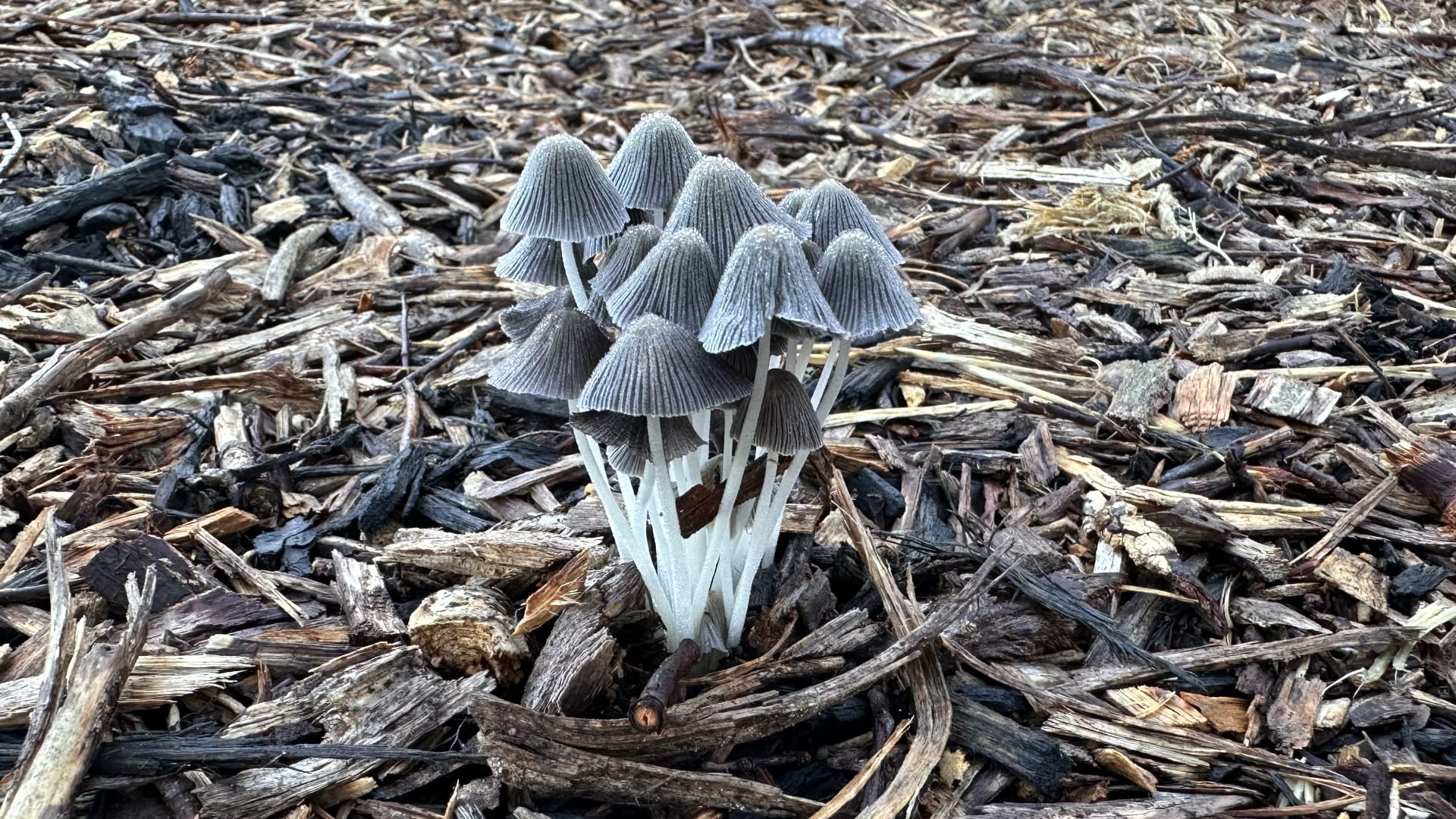
This image shows a cluster of small mushrooms with pale, cone-shaped caps growing from dark wood chips. The mushrooms have thin, delicate stems and caps with visible ridges or grooves running from the center outward. These tiny fungi are decomposers, meaning they break down dead wood and return nutrients to the soil.
🔬 Scientific Phenomena
Anchoring Phenomenon: Mushrooms appearing suddenly in mulch or wood chips
Why This Happens: Mushrooms are the "fruit" of a much larger organism called mycelium—an invisible network of threads living inside dead wood. When conditions are right (moisture, temperature, and time), the mycelium produces mushroom fruiting bodies to release spores (like seeds) into the air. These spores travel on wind and water to start new colonies elsewhere. The mushroom itself only lasts a few days, but the living mycelium beneath the soil continues its work breaking down dead plant material into nutrients that feed new plants.
📚 Core Science Concepts
- Decomposition and Nutrient Cycling: Mushrooms and fungi break down dead organisms and return nutrients to soil, completing nature's recycling system.
- Life Cycles: Like plants and animals, fungi have life cycles with different stages—mycelium growth, fruiting body formation, spore release, and germination.
- Habitats and Organisms: Fungi thrive in dark, moist environments with plenty of dead wood. They are a distinct type of organism (not plant, not animal) that plays a crucial role in ecosystems.
- Rapid Growth: Mushrooms can appear overnight because the living mycelium has been growing for weeks or months underground before suddenly producing visible fruiting bodies.
Pedagogical Tip:
Use the "mystery of sudden mushrooms" to hook student curiosity. Ask: "Where did this come from if it wasn't here yesterday?" This genuine wonder is a perfect entry point for discussing decomposition and the invisible life beneath our feet. Students retain concepts better when they solve mysteries they've personally wondered about.
UDL Suggestions:
Representation: Provide labeled diagrams showing the mycelium underground and the fruiting body above ground. Use videos or animations to show the invisible network of threads. Action & Expression: Let students observe mushrooms over several days and sketch changes, or create a life-cycle wheel showing mushroom stages. Engagement: Invite students to predict when/where they might find mushrooms by connecting to their own observations (after rain, in damp places, near trees).
🎓 NGSS Connections
Performance Expectation: 3-LS1-1. Develop models to describe that organisms have unique and diverse life cycles but all animals and plants have birth, growth, reproduction, and death in common.
Disciplinary Core Ideas:
- Growth and Reproduction of Organisms
- Biodiversity and Humans
Crosscutting Concepts:
- (Mushroom fruiting follows patterns based on environmental conditions)
- (Decomposition is gradual change over time)
- (Fungi are part of a nutrient cycle system)
💬 Discussion Questions
- Why do you think mushrooms appeared in this wood chip pile when they weren't there before? (Bloom's: Analyze | DOK: 2)
- What do you think the mushroom is doing under the ground where we can't see it? (Bloom's: Understand | DOK: 2)
- How are mushrooms different from plants, even though they both grow from the ground? (Bloom's: Compare | DOK: 3)
- If we picked all the mushrooms off, would they grow back in the same spot? Why or why not? (Bloom's: Evaluate | DOK: 3)
📖 Vocabulary
- Mushroom: The visible fruiting body of a fungus that releases spores into the air, like fruit on a plant.
- Fungus (plural: fungi): A type of living organism (like mushrooms and mold) that breaks down dead things instead of making its own food like plants do.
- Decompose: To break down dead plants and animals into smaller pieces and nutrients that return to soil.
- Mycelium: The invisible network of thread-like parts of a fungus that lives in soil or wood and does the work of breaking things down.
- Spore: A tiny cell released by fungi that can grow into a new fungus, similar to how plants use seeds.
- Habitat: The place where an organism lives that has everything it needs to survive, like food, water, and shelter.
🌡️ Extension Activities
- Mushroom Hunt & Sketch Journal: Take students on a nature walk to observe mushrooms in their natural habitat (playground, garden, park). Have them sketch mushrooms they find, note where they grew (near trees, in mulch, on logs), and describe the conditions (was it wet, shady, dark?). Back in class, create a class chart comparing observations.
- Decomposition in a Jar: Layer dead leaves, wood chips, and soil in a clear jar with water. Over 2-3 weeks, students observe and sketch how the materials break down. Discuss what they think is doing the breaking down (fungi and bacteria). This makes the invisible visible!
- Life Cycle Wheel: Students create a circular life cycle diagram showing mushroom stages: mycelium growing → conditions become right → fruiting body forms → spores release → spores travel → new mycelium grows. Add illustrations and label each stage.
🔍 Zoom In / Zoom Out Concepts
Zoom In: Microscopic Level
If we could shrink down to the size of a speck of dust and look inside the wood chip, we'd see millions of tiny thread-like structures called hyphae (the parts that make up mycelium). These threads are so small you need a microscope to see them! Each thread is like a tiny straw that sucks nutrients from the dead wood. The threads branch and weave together, creating a hidden network. When many hyphae bundle together, they form the mushroom we can see above ground. It's like an invisible city underground doing all the hard work of breaking things down!
Zoom Out: Ecosystem Level
Now imagine zooming out to see the whole forest or garden. Mushrooms like these are nature's recyclers in a much bigger system. Dead wood falls to the ground, fungi break it down, and the nutrients go back into the soil. Plants use those nutrients to grow. Animals eat the plants. When animals and plants die, they become food for fungi again—and the cycle continues forever! Without fungi doing their decomposition job at ground level, dead stuff would pile up and pile up, and plants wouldn't have nutrients to grow. Fungi keep the whole ecosystem healthy and balanced, from the tiniest wood chip to the tallest tree.
🤔 Potential Student Misconceptions
Misconception 1: "Mushrooms are plants because they grow from the ground."
Clarification: Mushrooms look like they might be plants, but they're actually fungi—a completely different type of living thing! Plants make their own food using sunlight (like solar panels), but mushrooms can't do that. Instead, mushrooms break down dead stuff and eat it, kind of like how animals eat food. Fungi are their own special kingdom, not plants or animals.
Misconception 2: "The mushroom is the whole organism, so if we pick it, the organism is gone."
Clarification: The mushroom we see is just the "fruit" or visible part—like an apple on an apple tree. The real fungus (the mycelium) is still living underground in the wood chips, invisible to us. When we pick a mushroom, we're just picking the fruit. The living organism keeps growing and can make more mushrooms later. It's still there doing its job of decomposing!
Misconception 3: "Mushrooms need sunlight to grow, like plants do."
Clarification: Mushrooms actually prefer dark, damp places—the opposite of most plants! They don't need sunlight because they don't make their own food from light like plants do. Fungi grow best in shady, moist spots like under logs, in mulch, or in dark corners. This is why mushrooms pop up after rain in damp places, not in sunny areas.
🔗 Cross-Curricular Ideas
Math Connection: Measuring and Graphing Mushroom Growth
Have students measure the height of mushroom clusters over several days (if available, or use photos taken over time). Create a line graph showing how height changes daily. Discuss: "How much did it grow each day? Which day did it grow the most? Can you predict how tall it might be tomorrow?" This builds measurement skills and introduces data representation.
ELA Connection: "The Life Story of a Mushroom" Narrative Writing
Students write a short story or comic strip from the mushroom's point of view, following its journey from a tiny spore floating through the air, landing in a wood chip pile, growing as mycelium for weeks, and finally pushing up as a visible mushroom. Encourage descriptive language: "I was floating in the dark... then I landed in a cozy pile of wood chips..." This combines science understanding with creative storytelling.
Art Connection: Nature Collage and Observational Drawing
Students collect fallen leaves, twigs, bark, and dead wood from outside (materials fungi decompose) and create a nature collage. Then they draw detailed sketches of real or imaginary mushrooms, paying attention to the ridges, shapes, and colors they observe in photos or field observations. Display these alongside facts about decomposition to create a classroom gallery.
Social Studies Connection: "Helpful Fungi in Our Community"
Discuss how fungi help gardeners and farmers by breaking down compost and returning nutrients to soil for growing food. Take a virtual or real tour of a community garden, composting site, or local park, and identify places where decomposition is happening. Students can create a simple map showing "decomposition stations" in their school or neighborhood and explain why fungi are important helpers to their community.
🚀 STEM Career Connection
- Mycologist — Studies fungi — mushrooms, moulds and yeasts, and the hidden threads that connect them underground.
- Try it: Design a simple experiment to see if mushrooms grow better in wet or dry conditions. (Practice: Constructing Explanations and Designing Solutions)
- Tools: spore prints, petri dishes, microscopes, collecting baskets
- Where they work: forests, laboratories, botanical gardens, universities
- Meet one: Giuliana Furci — Fungi nobody had catalogued before, and getting them protected the way animals and plants are.
- Median pay: /year — "Microbiologists"
- Conservation Scientist — Looks after land, forests and water so they stay healthy for the people and animals who use them.
- Try it: Brainstorm ways to help keep forest floors healthy for fungi and other organisms. (Practice: Constructing Explanations and Designing Solutions)
- Tools: soil samplers, aerial photographs, measuring tapes, mapping software
- Where they work: forests and rangelands, parks departments, government agencies, land trusts
- Meet one: Tierra Curry — Which plants and animals are closest to disappearing, and what it takes to save them.
- Median pay: /year — "Conservation scientists"
Wage figures are median annual wages for the U.S. occupation named after each one, from the U.S. Bureau of Labor Statistics, Occupational Employment and Wage Statistics (OEWS), national, May 2025. Several careers share one occupation, so their figures match.
---
Teacher Tip: This lesson works best when paired with direct observation—bring in a mushroom or take students outside to see real examples. The abstract concept of "invisible mycelium" becomes concrete when students can hold and observe the fruiting body!