📸 Photo Description
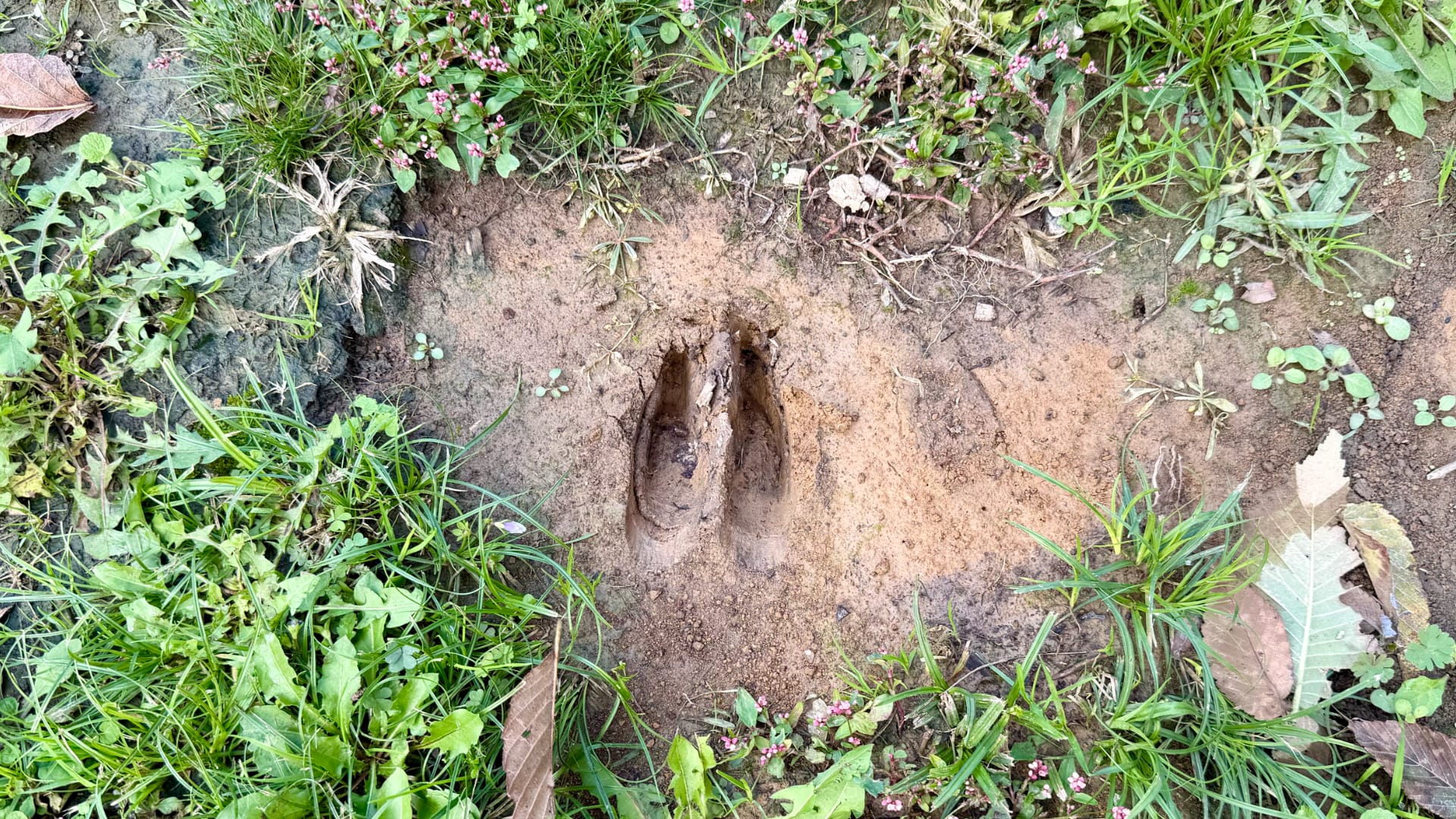
This photo shows clear animal tracks pressed into the muddy ground. The tracks are hoof-shaped and appear to be from a larger animal that walks on two legs, or possibly two feet at a time. Surrounding the tracks are green grasses and small pink flowers, indicating a natural outdoor environment.
🔬 Scientific Phenomena
This image represents the phenomenon of evidence of animal presence and movement. The hoof prints in the mud are direct evidence that an animal has walked through this area. The shape and depth of the prints can tell us about the animal's size, weight, and the type of feet it has. This type of evidence is often called a "track" or "sign" by naturalists and can provide clues about the animal's behavior and habitat.
📚 Core Science Concepts
- Animal Tracks: These are impressions left in soft ground by an animal's feet. They can vary greatly in size and shape depending on the animal.
- Habitat: The environment where an animal lives, providing food, water, and shelter. The presence of grass and plants suggests this is a suitable habitat for certain animals.
- Animal Movement: Animals move to find food, water, shelter, and mates, or to escape danger. Tracks show us where animals have been and give us clues about their movement patterns.
- Adaptations for Movement: The structure of an animal's feet (like hooves) is an adaptation that helps it move efficiently in its environment.
Pedagogical Tip: Encourage students to draw the tracks they see and describe them using descriptive words. This helps them practice observation skills and scientific vocabulary.
UDL Suggestions: Provide a variety of real animal track casts or clear photographs of different animal tracks to allow students to compare and contrast shapes and sizes, catering to visual learners and those who benefit from tactile experiences.
🔍 Zoom In / Zoom Out Concepts
- Zoom In: At a microscopic level, the mud is made up of tiny particles of soil, water, and organic matter. When an animal's hoof presses down, these particles are displaced and compressed, creating the impression. The water in the mud allows it to be molded, and then it hardens as it dries, preserving the print.
- Zoom Out: These tracks are evidence of an animal interacting with its environment. The animal is part of a larger ecosystem, and its movement might be related to finding food (like plants or smaller animals), seeking water, or migrating. The tracks can help scientists understand the animal's role and behavior within that ecosystem.
🤔 Potential Student Misconceptions
- Misconception: All animal tracks are the same.
Clarification: Animals have different types of feet and bodies, so their tracks can look very different. For example, a dog's paw print looks different from a bird's foot print, and a hoof print looks different from both.
- Misconception: Animals only leave tracks when they are walking.
Clarification: Animals can leave other signs of their presence, like chewed leaves, nests, droppings, or fur. Tracks are just one type of evidence.
🎓 NGSS Connections
- 3-LS4-3: Construct an argument with evidence that in a particular habitat some organisms can survive well, some survive less well, and some cannot survive at all.
- K-LS1-1 (Grade K — foundational connection): Use observations to describe patterns of what plants and animals (including humans) need to survive.
💬 Discussion Questions
- What can you tell about the animal that made these tracks just by looking at them? (Bloom's: Analyze | DOK: 2 | SEP: Constructing Explanations and Designing Solutions)
- How are these tracks evidence that an animal was in this place? (Bloom's: Understand | DOK: 1 | SEP: Engaging in Argument from Evidence)
- What do the plants and flowers around the tracks tell us about where this animal might live? (Bloom's: Analyze | DOK: 2 | SEP: Obtaining Evaluating and Communicating Information)
📖 Vocabulary
- Tracks: Marks or a series of marks left in the ground by an animal's foot.
- Hoof: The foot of an animal like a horse, deer, or cow, made of a hard covering.
- Habitat: The natural home or environment of an animal, plant, or other organism.
- Evidence: Signs or information that indicate whether something is true or that something has happened.
🌡️ Extension Activities
- Track Detective: Have students go outside (or use a sandbox in the classroom) to create their own animal tracks using toy animal feet or by pressing their own hands/feet into the sand/mud. Then, have them try to identify which track belongs to which animal.
- Nature Walk Observation Journal: Take students on a nature walk and encourage them to look for signs of animals, such as tracks, feathers, nests, or chewed leaves. Have them draw what they find and write a short description.
🔗 Cross-Curricular Ideas
- ELA: Read books about animals and their habitats. Have students write their own stories about an animal they might see in this environment, including describing its tracks.
- Art: Students can create their own animal track artwork using paint, clay, or by making rubbings of different textured surfaces.
- Social Studies: Discuss how different animals are important to the environment and to people in different communities.
🚀 STEM Career Connection
- Animal Behaviourist — Watches what animals do and works out why they do it.
- Try it: Watch a video of an animal and write down what you think the animal is trying to communicate with its actions. (Practice: Analyzing and Interpreting Data)
- Tools: observation blinds, video recorders, stopwatches, behaviour checklists
- Where they work: zoos, field research stations, farms, universities
- Meet one: Rae Wynn-Grant — Where black bears and people run into each other, and how to keep both safe.
- Median pay: /year — "Zoologists and wildlife biologists"
- Wildlife Biologist — Studies wild animals — what they eat, where they go, and what they need to survive.
- Try it: Draw an animal track and label the parts of the track that tell you about the animal's foot. (Practice: Analyzing and Interpreting Data)
- Tools: binoculars, radio collars, trail cameras, a field notebook
- Where they work: national parks, wildlife refuges, state wildlife agencies, universities
- Meet one: Rae Wynn-Grant — Where black bears and people run into each other, and how to keep both safe.
- Median pay: /year — "Zoologists and wildlife biologists"
- Conservation Biologist — Works out which plants and animals are in trouble, and what would help them recover.
- Try it: Look at pictures of different animal habitats and decide which habitat would be best for a specific animal, explaining why. (Practice: Analyzing and Interpreting Data)
- Tools: population surveys, GPS trackers, habitat maps, trail cameras
- Where they work: nature reserves, conservation charities, government agencies, universities
- Meet one: Tierra Curry — Which plants and animals are closest to disappearing, and what it takes to save them.
- Median pay: /year — "Zoologists and wildlife biologists"
Wage figures are median annual wages for the U.S. occupation named after each one, from the U.S. Bureau of Labor Statistics, Occupational Employment and Wage Statistics (OEWS), national, May 2025. Several careers share one occupation, so their figures match.