📸 Photo Description
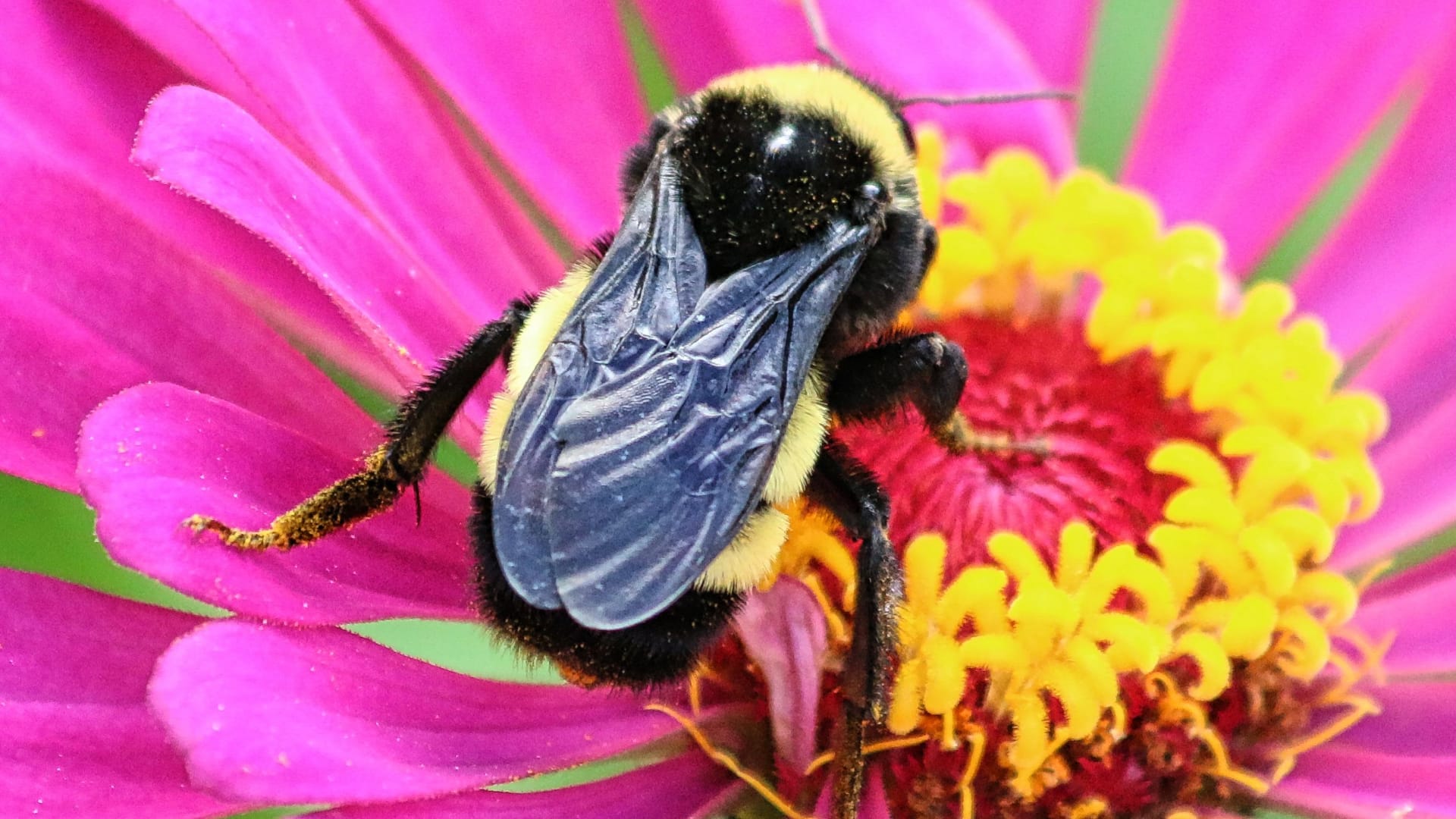
This image shows a fuzzy bumble bee visiting a bright pink and yellow flower. The bee has yellow and black stripes on its body, dark wings, and you can see yellow pollen dust on its legs and body. The bee is using its long tongue to drink nectar from the flower's center.
🔬 Scientific Phenomena
Anchoring Phenomenon: Pollination—the transfer of pollen between flowers by insects.
Why This Happens: Bumble bees visit flowers to collect nectar (a sweet liquid) and pollen (a fine powder) to eat. As the bee moves from flower to flower, pollen sticks to its fuzzy body. When it lands on another flower, some of that pollen rubs off onto that flower's center. This helps flowers make seeds so new plants can grow. It's a partnership—the bee gets food, and the flower gets help making seeds!
📚 Core Science Concepts
- Animal and Plant Relationships: Bees and flowers depend on each other. Bees need food from flowers, and flowers need bees to help them reproduce.
- Structures and Functions: The bee's fuzzy body is perfectly designed to collect pollen, and its long tongue is designed to reach deep into flowers for nectar. Flowers have bright colors and sweet nectar to attract pollinators.
- Life Cycles: Flowers need pollination to produce seeds. Those seeds grow into new plants, continuing the plant life cycle.
- Habitats and Ecosystems: Bumble bees are an important part of ecosystems because they help many plants reproduce. Without pollinators, many plants couldn't survive.
Pedagogical Tip:
Use the "I notice, I wonder, I learned" strategy when showing this photo. Have students first observe ("I notice the bee is fuzzy and covered in yellow powder"), then pose questions ("I wonder why the pollen sticks to the bee?"), and finally explain the science. This builds from observation to understanding—the foundation of scientific thinking.
UDL Suggestions:
Provide multiple ways to engage with this content: (1) Visual learners benefit from close observation of the photo; (2) Kinesthetic learners can act out pollination by moving around the classroom as "bees," transferring colored flour or craft pom-poms from one "flower" (student) to another; (3) Auditory learners benefit from discussions and read-alouds about pollinators. Consider providing a magnified image or live bee photos for students who need clearer visual access.
🎓 NGSS Connections
Performance Expectation:
3-LS1-1: Develop models to describe that organisms have unique and diverse life cycles but all have in common birth, growth, reproduction, and death.
Disciplinary Core Ideas:
- : Growth and Reproduction of Organisms
- : Adaptation
Crosscutting Concepts:
-
-
💬 Discussion Questions
- Why do you think the bee's body is fuzzy instead of smooth? (Bloom's: Analyze | DOK: 2)
- What would happen to flowers if there were no bumble bees to visit them? (Bloom's: Evaluate | DOK: 3)
- How does the flower help the bee, and how does the bee help the flower? (Bloom's: Understand | DOK: 2)
- Can you think of other animals that might help flowers make seeds the same way bees do? (Bloom's: Apply | DOK: 2)
📖 Vocabulary
- Pollination: The movement of pollen from one flower to another, which helps flowers make seeds.
- Pollen: A fine yellow powder made by flowers that helps them create seeds.
- Nectar: A sweet liquid inside flowers that bees and other insects drink as food.
- Pollinator: An animal (like a bee) that carries pollen from flower to flower.
- Adaptation: A special feature of an animal's body that helps it survive and do its job.
🌡️ Extension Activities
Activity 1: Pollination Simulation
Students become "bees" and "flowers." Coat students' hands lightly with washable glitter or flour (the "pollen"). As bees, they visit flower students and transfer the "pollen" by touching. Discuss how pollen moves and why it's important. This kinesthetic experience makes the abstract concept concrete and memorable.
Activity 2: Flower Dissection and Observation
Provide real flowers (tulips, daisies, or zinnias work well). Have students carefully take apart a flower to locate the pollen-producing parts (anthers) and the part that receives pollen (stigma). Use hand lenses to observe pollen grains closely. Create drawings with labels to document their findings.
Activity 3: Create a Pollinator Habitat
Design a classroom garden or window box with flowers that attract bees. Research which flowers are best for pollinators, plant seeds or seedlings together, and observe which insects visit over time. Keep a daily journal with sketches of visiting insects and their behaviors.
🔍 Zoom In / Zoom Out Concepts
Zoom In: Pollen Grains Under a Microscope
If we could shrink down and look at pollen through a powerful microscope, we'd see that each tiny grain of pollen has a bumpy, spiky, or smooth surface depending on the flower type. These special shapes help pollen stick to the bee's fuzzy body—it's like nature's velcro! Inside each pollen grain are special cells that will help make new seeds when the pollen reaches another flower. Scientists can identify which flowers pollen came from just by looking at its shape under a microscope!
Zoom Out: Pollination in Earth's Ecosystems
When we zoom out and see the bigger picture, pollination is one of the most important jobs happening on our entire planet. Without pollinators like bees, butterflies, and hummingbirds, we wouldn't have many of the fruits, vegetables, and plants we need to survive—including almonds, apples, cucumbers, and wildflowers. Pollination connects plants, insects, animals that eat those plants, and humans all together in one big living system. If pollinator populations decline, it affects food chains all around the world.
🤔 Potential Student Misconceptions
Misconception 1: "Bees eat flowers."
Clarification: Bees don't eat the flower petals or leaves. Instead, they drink the sweet nectar from inside the flower (like drinking juice through a straw) and collect pollen to eat as protein. The flower itself stays alive and healthy to make seeds.
Misconception 2: "Pollen is just dirt or dust that happens to stick to bees."
Clarification: Pollen is not waste or dirt—it's a special powder that flowers make on purpose to help create seeds. Flowers actually want pollen to stick to bees! The bright colors and sweet smell of flowers are like advertisements saying, "Come here, bee! We have pollen for you!"
Misconception 3: "Each bee pollinates all the flowers all by itself."
Clarification: One bee visits many flowers, and many bees visit the same flower. It's a team effort! It takes visits from several bees (or sometimes many visits from the same bee) to move enough pollen around so a flower can make lots of healthy seeds.
🔗 Cross-Curricular Ideas
Math Connection: Counting and Patterns
Have students count the number of petals on different flower photos or real flowers. Create a bar graph showing how many petals different flowers have. Discuss patterns: "Do all pink flowers have the same number of petals? Why or why not?" Students can also estimate how many flowers a bee might visit in one day (introduce the concept of "about 50-100") and practice skip-counting by 10s.
ELA Connection: Narrative and Descriptive Writing
Students write from the bee's perspective: "A Day in My Life as a Bumble Bee." Encourage sensory language—what does the flower smell like? How does pollen feel on my legs? What does nectar taste like? Students can also read and discuss pollination stories, then create their own illustrated book about a bee's journey, combining writing with art.
Social Studies Connection: Community Helpers and Interdependence
Just as community helpers (firefighters, teachers, doctors) depend on each other, bees and flowers depend on each other. Discuss how different living things in a community have jobs and help each other survive. Create a classroom "community helper" web showing how bees help farmers, farmers help us get food, and we help protect bee habitats.
Art Connection: Color, Pattern, and Design
Flowers have bright colors and patterns to attract pollinators. Have students design their own imaginary flower using markers, colored pencils, or paint. What colors would attract a bee? What patterns would stand out? Students can also create a mixed-media collage of real flower petals, leaves, and images, then write labels explaining what pollinators might be attracted to their design.
🚀 STEM Career Connection
- Conservation Biologist — Works out which plants and animals are in trouble, and what would help them recover.
- Try it: Propose a solution to help bumble bees find more flowers in an area where flowers are scarce. (Practice: Constructing Explanations and Designing Solutions)
- Tools: population surveys, GPS trackers, habitat maps, trail cameras
- Where they work: nature reserves, conservation charities, government agencies, universities
- Meet one: Tierra Curry — Which plants and animals are closest to disappearing, and what it takes to save them.
- Median pay: /year — "Zoologists and wildlife biologists"
- Botanist — Studies plants — how they grow, how they reproduce, and how they survive where they live.
- Try it: Explain how a flower's structure helps it get pollinated by a bumble bee. (Practice: Constructing Explanations and Designing Solutions)
- Tools: a hand lens, a plant press, a soil probe, field guides
- Where they work: botanical gardens, herbariums, forests and fields, universities
- Meet one: Robin Wall Kimmerer — Mosses — which she calls the coral reefs of the forest — and what Indigenous knowledge teaches about bringing plants back.
- Median pay: /year — "Soil and plant scientists"
Wage figures are median annual wages for the U.S. occupation named after each one, from the U.S. Bureau of Labor Statistics, Occupational Employment and Wage Statistics (OEWS), national, May 2025. Several careers share one occupation, so their figures match.