📸 Photo Description
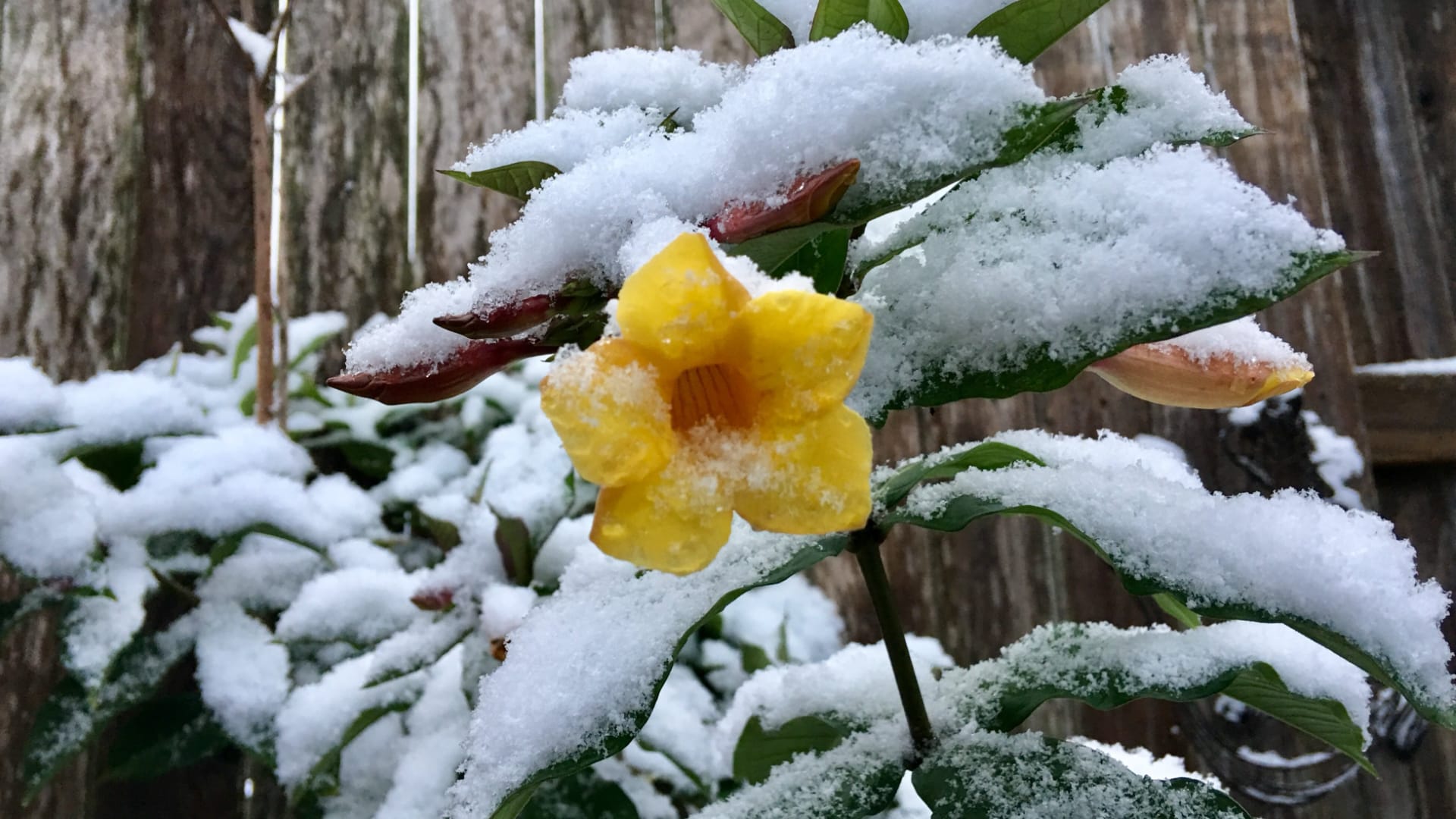
This image shows bright yellow daffodil flowers covered with a thick layer of fresh snow, with green leaves and closed flower buds peeking through the white coating. The wooden fence in the background is also frosted with snow, showing how cold winter weather affects everything in nature. The contrast between the sunny yellow petals and the white snow creates a beautiful example of how plants survive unexpected temperature changes.
🔬 Scientific Phenomena
Anchoring Phenomenon: Early spring flowers blooming during a late-season snow event.
Why This Happens: Daffodils are early bloomers that respond to lengthening days and warming soil temperatures in late winter or early spring. However, unexpected cold snaps can bring snow even after flowers have started to bloom. The flower's waxy petals and the plant's natural antifreeze-like compounds in its cells help protect it from frost damage. This is a real-world example of how plants are adapted to survive in their environment—they have evolved mechanisms to withstand sudden temperature drops that can occur during the transition seasons.
📚 Core Science Concepts
- Plant Adaptations: Plants have special features (like waxy coatings on petals and protective structures in buds) that help them survive cold temperatures and protect their delicate flowers from frost damage.
- Seasonal Changes: Winter and spring temperatures can fluctuate dramatically. Plants respond to day length and soil temperature, sometimes blooming before the last frost, showing how nature's timing isn't always perfectly predictable.
- Weather vs. Climate: A single snow event in spring doesn't mean the climate is changing—it's just one example of weather variation that plants must endure throughout the year.
- The Water Cycle Connection: The snow covering the flowers comes from water that evaporated from oceans and land, condensed into clouds, and fell as precipitation—the same cycle that provides water for plant growth.
Pedagogical Tip:
Use this image as a "before and after" observation opportunity. Show students the photo, then ask them to predict what might happen to the flower. This builds scientific thinking and creates investment in understanding plant resilience. You might follow up with a simple experiment: place cut flowers in a refrigerator and observe them over time to see if they remain fresh despite cold exposure.
UDL Suggestions:
To support diverse learners: (1) Provide real or artificial flowers so students can touch and examine waxy coatings with their hands; (2) Create a visual vocabulary chart with photos of different adaptations; (3) Offer a simplified observation sheet with picture labels for students who need extra support with writing; (4) Allow students to share observations verbally before writing them down.
🎓 NGSS Connections
Performance Expectation: 3-LS4-3 - Construct an argument with evidence that in a particular habitat some organisms can survive well, some survive less well, and some cannot survive at all.
Disciplinary Core Ideas:
- - Adaptation by natural selection: The color, shape, and other features of plants and animals have changed over time in ways that help them survive and reproduce.
- - Biodiversity and humans: Different plants live in different places because they have different needs.
Crosscutting Concepts:
- - Seasonal patterns affect which plants bloom and when.
- - The waxy coating on flower petals serves the function of protecting the flower from cold and water loss.
💬 Discussion Questions
- Why do you think this daffodil flower hasn't been damaged by the snow, even though it's so delicate? (Bloom's: Analyze | DOK: 2)
- What do you think will happen to this flower if the temperature gets warmer and the snow melts? (Bloom's: Predict | DOK: 2)
- How is this flower different from flowers you might see in the summer, and why might those differences help it survive in spring? (Bloom's: Evaluate | DOK: 3)
- Where do you think the snow came from, and how is it connected to water we drink and use every day? (Bloom's: Connect/Understand | DOK: 3)
📖 Vocabulary
- Adaptation: A special feature or behavior that helps a plant or animal survive in its environment.
- Frost: A thin layer of ice crystals that forms when water freezes on surfaces, like on plants and grass.
- Precipitation: Water that falls from clouds to Earth in the form of rain, snow, sleet, or hail.
- Bloom: When a flower opens and shows its colorful petals; the time when a plant produces flowers.
- Resilient: Able to recover quickly or survive difficult conditions; tough and strong.
- Waxy Coating: A shiny, waterproof layer on some plant leaves and flower petals that protects them.
🌡️ Extension Activities
- Flower Hardiness Investigation: Provide students with different types of fresh flowers (daffodils, tulips, roses, carnations). Place half in a freezer for 30 minutes and half at room temperature. Have students observe, sketch, and compare how each type responds to cold. Create a class chart ranking which flowers are most "hardy" (able to survive cold). Students can hypothesize why some flowers survive better than others based on their structure.
- Snow and the Water Cycle Mobile: Students create a three-part hanging mobile showing: (1) evaporation (water rising from a lake or ocean), (2) condensation (clouds forming), and (3) precipitation (snow falling on flowers). Use cotton balls for clouds, blue streamers for water, and white paper for snow. Attach labels and hang in the classroom while discussing how the water cycle connects to the snow in the photo.
- Plant Survival Journal: Over 2-3 weeks, have students observe plants (real or in photos) during temperature changes. Students draw pictures and write simple observations about which plants seem to survive cold snaps best. Create a class graph showing "Plants That Survived Cold" vs. "Plants That Were Damaged." Discuss what features helped the survivors (dark color absorbing heat, waxy coating, low growth close to soil for warmth, etc.).
🔍 Zoom In / Zoom Out Concepts
Zoom In: Inside the Plant Cell
If we could shrink down and look inside the daffodil's flower cells under a microscope, we'd see something amazing! Plant cells contain a special liquid called sap that acts like natural antifreeze. When temperatures drop, this sap doesn't freeze as easily as pure water would. The cell walls are also made of tough cellulose material that can bend and stretch slightly when ice crystals form, preventing the cell from bursting. Additionally, the waxy coating on the petals is made of millions of tiny lipid (fat-like) molecules packed tightly together—so tightly that snow and frost sit on top like a protective blanket rather than soaking into the delicate flower tissue below.
Zoom Out: Spring Ecosystems and Pollinator Timing
When we zoom out and look at the whole ecosystem, this snow-covered daffodil is part of a much larger system. Early spring bloomers like daffodils evolved to flower when pollinators (bees, butterflies, and other insects) are beginning to emerge from winter dormancy. The timing is usually perfectly matched—plants bloom, insects arrive to feed, and seeds develop. However, late-season snow events create a mismatch that can stress the entire spring ecosystem. If many early flowers are damaged by unexpected frost, there may not be enough food for hungry pollinators when they wake up. The broader climate system (influenced by ocean temperatures, jet streams, and atmospheric patterns) determines whether a region gets a late snow, affecting the success or failure of the entire spring renewal cycle across landscapes and food webs.
🤔 Potential Student Misconceptions
Misconception 1: "Delicate flowers will always die in the snow."
Clarification: While some flowers are damaged by frost, many plants have special adaptations that protect them from cold. The daffodil's waxy petals, thick cell sap, and sturdy structure make it surprisingly tough. Students should understand that "delicate-looking" doesn't mean "weak"—nature has equipped plants with hidden protections. We can compare this to how a winter coat protects us: the person inside looks small, but the coat keeps them safe!
Misconception 2: "Snow is always bad for plants because it's cold."
Clarification: While unexpected late snow can harm some plants, snow actually provides insulation for plants sleeping underground. Snow acts like a thick blanket that keeps soil warmer than it would be with just cold air. In this photo, the snow is on top of a flower that's already blooming, so the timing makes it challenging—but the plant has adaptations to handle it. Earlier in winter, snow would have actually helped protect plant roots and bulbs in the soil.
Misconception 3: "The flower will never recover after being covered in snow."
Clarification: Many spring flowers are incredibly resilient! Once temperatures warm up and the snow melts, the daffodil will likely continue to bloom beautifully. The flower in this photo shows that plants can survive temporary harsh conditions. Students can observe this themselves by watching plants after a spring snow—most bounce back quickly when the sun returns.
🔗 Cross-Curricular Ideas
Math Connection: Data Collection and Graphing
Have students collect daily temperature data for one week during spring. Create a line graph showing temperature highs and lows, and mark on the graph when snow fell or when flowers bloomed. Students can practice plotting points, reading a graph, and making predictions about when conditions will be right for flowers to bloom safely. This integrates measurement, graphing, and pattern recognition.
ELA Connection: Narrative Writing and Observation Journals
Students write a short "day in the life" story from the perspective of the daffodil flower. What does it feel like to be covered in snow? What does it see, feel, and experience? Alternatively, students create a simple observation journal: "Dear Flower, I noticed... I wondered... I think..." This develops descriptive writing vocabulary and emotional connections to plants while practicing the scientific habit of detailed observation.
Art Connection: Mixed Media Collage
Students create a mixed-media artwork showing the daffodil in different seasons: spring with snow, late spring in full bloom, summer green, and fall dormant. Use tissue paper, watercolors, cotton balls (for snow), and pressed flowers or leaves. This helps students visualize and remember the complete life cycle of a perennial plant while developing artistic skills.
Social Studies Connection: Cultural Traditions and Flowers
Daffodils are symbols of spring renewal in many cultures and are featured in springtime celebrations worldwide (like Daffodil Day in some countries). Students research how different cultures celebrate spring and the role of flowers in those celebrations. They can create a classroom display of spring flowers from around the world, learning that adaptations to seasonal change are universal challenges that different human communities also celebrate and mark with traditions.
🚀 STEM Career Connection
- Hydrologist — Follows water — where it falls, where it goes underground, and where it comes out again.
- Try it: Build a simple model of a watershed using playdough and a tray, then simulate rain to see where the water flows. (Practice: Developing and Using Models)
- Tools: stream gauges, well probes, flow meters, rain gauges
- Where they work: rivers and reservoirs, water utilities, government surveys, universities
- Meet one: Newsha Ajami — How cities can use water more wisely, especially when there is not enough of it.
- Median pay: /year — "Hydrologists"
- Landscape Architect — Designs outdoor spaces — deciding where water goes, what gets planted, and where people walk.
- Try it: Draw a plan for a small garden, showing where plants will go and how water will drain away. (Practice: Developing and Using Models)
- Tools: site plans, drainage models, plant palettes, CAD software
- Where they work: design practices, parks departments, university campuses, city planning offices
- Meet one: Kotchakorn Voraakhom — Parks built on a slope that soak up flood water — one of hers holds a million gallons.
- Median pay: /year — "Landscape architects"
Wage figures are median annual wages for the U.S. occupation named after each one, from the U.S. Bureau of Labor Statistics, Occupational Employment and Wage Statistics (OEWS), national, May 2025. Several careers share one occupation, so their figures match.
---
Teacher's Note: This phenomenon is perfect for spring lessons when late-season snow occurs in your region. Use it to emphasize that nature is unpredictable and that organisms have evolved amazing strategies to survive. Students find it fascinating that a "delicate" flower can actually be quite tough!