📸 Photo Description
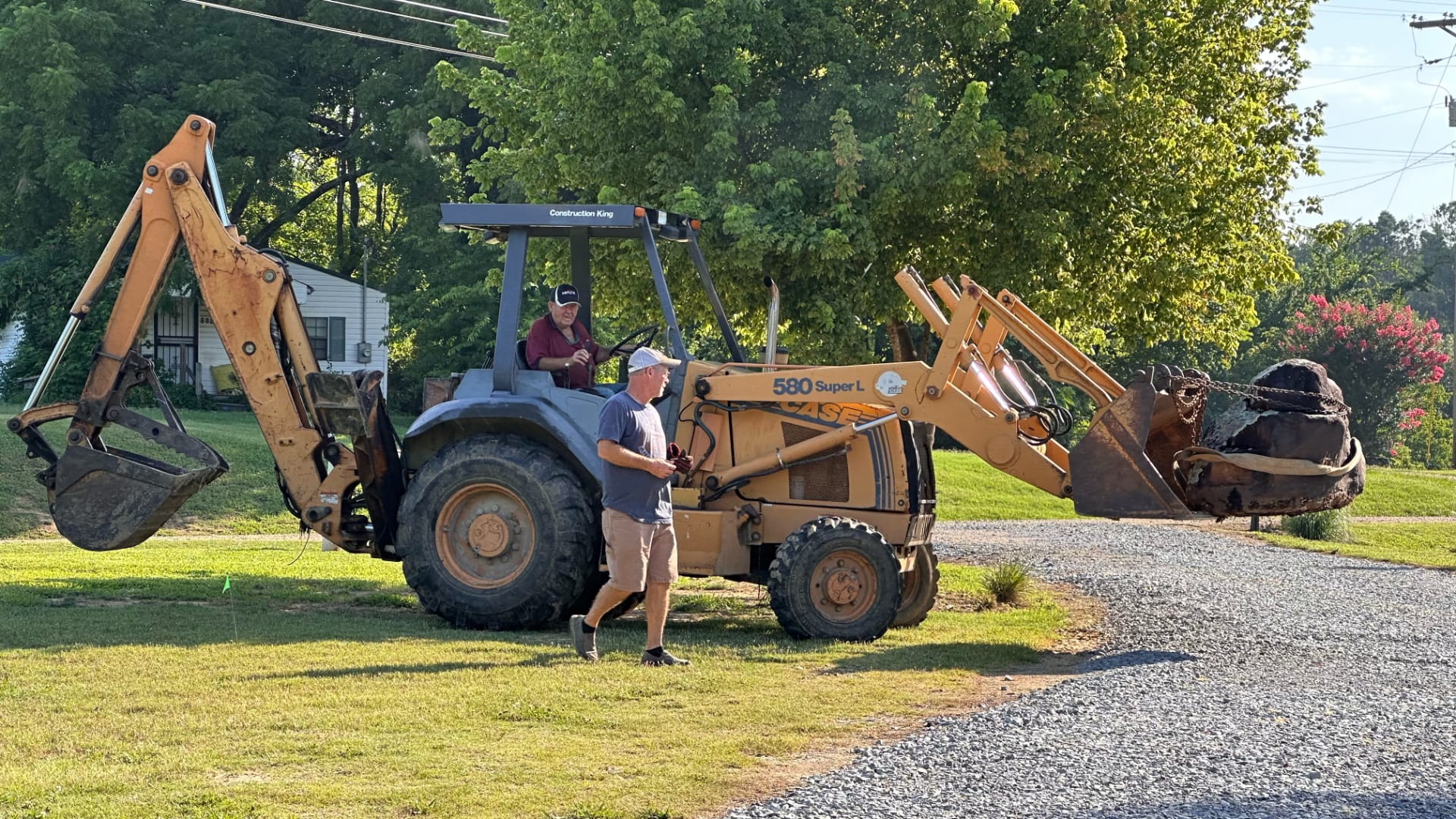
This image shows a large backhoe loader machine at work on a construction site. The machine has a long arm with a bucket on one end that can scoop up dirt and rocks. Two workers are operating and guiding the heavy equipment as it lifts and moves material. The powerful machine demonstrates how forces are used to move heavy objects that people alone could not lift.
🔬 Scientific Phenomena
Anchoring Phenomenon: A backhoe loader using mechanical advantage to lift and move heavy loads that would be impossible for humans to move alone.
Why This Happens (Scientific Explanation):
The backhoe loader demonstrates balanced and unbalanced forces in action. When the machine's hydraulic arm pushes downward with great force, it creates an unbalanced force that lifts the heavy bucket full of dirt upward. The machine's engine provides energy that powers hydraulic fluid through tubes and cylinders. These cylinders push and pull mechanical arms, multiplying the force the operator applies. Without the machine, the dirt-filled bucket would remain on the ground because the downward force of gravity would be balanced with no upward force to overcome it. The backhoe creates an unbalanced force—a larger upward push than the downward pull of gravity—which causes the heavy load to move upward.
📚 Core Science Concepts
- Unbalanced Forces Create Motion: When forces are unequal (one stronger than the other), objects move. The backhoe's powerful upward force is stronger than gravity's downward pull, so the bucket moves up.
- Balanced Forces Keep Objects Still: When forces are equal and opposite, objects stay at rest or move at the same speed. When the backhoe holds the bucket steady in the air, the upward hydraulic force balances the downward force of gravity.
- Simple Machines Multiply Force: The backhoe's arm acts like a lever and pulley system. These simple machines allow a smaller effort force (operator's input) to move a much larger load (the bucket of dirt).
- Energy Transfer: The backhoe's engine converts fuel energy into mechanical energy that moves the hydraulic fluid, which then moves the bucket.
Pedagogical Tip:
When teaching balanced versus unbalanced forces, use the backhoe as a concrete reference point. Ask students: "When is the bucket moving up? When is it still?" This helps them connect the abstract concept of forces to something they can see and understand. Having students physically act out forces—one child pushing one direction while another pushes the opposite way—reinforces these concepts kinesthetically before adding the backhoe example.
UDL Suggestions:
Representation: Provide labeled diagrams of the backhoe with arrows showing forces (use blue arrows for upward hydraulic force, red arrows for downward gravity). Some students may benefit from simplified versions showing just two arrows, while others explore more detailed force diagrams.
Action & Expression: Allow students to demonstrate understanding through multiple modalities: drawing force diagrams, acting out balanced/unbalanced forces with peers, explaining verbally, or building with construction toys. Provide sentence frames for students who need language support: "The bucket moves up because the _____ force is stronger than the _____ force."
Engagement: Connect to students' interests by showing videos of different heavy equipment (cranes, dump trucks, bulldozers) so all learners see forces in machines relevant to their experiences.
🎓 NGSS Connections
Performance Expectation:
3-PS2-1: Plan and conduct an investigation to provide evidence that a pushed or pulled object moves in the direction of the push or pull.
Disciplinary Core Ideas:
- Forces and Motion - The patterns of an object's motion in various situations can be determined by the net force. An object that is not being pushed or pulled at all, or is being pushed or pulled upon by balanced forces, can be observed as stationary.
- Types of Interactions - Objects in contact exert forces on each other.
Crosscutting Concepts:
- The backhoe's engine (cause) creates hydraulic force (effect) that lifts the bucket.
- The backhoe is a system of interconnected parts working together to accomplish a task.
💬 Discussion Questions
- What forces do you see acting on the bucket of dirt? (Bloom's: Understand | DOK: 1)
- Why do you think the backhoe machine is needed to move the bucket instead of workers just picking it up with their hands? (Bloom's: Analyze | DOK: 2)
- If the backhoe operator wanted to hold the bucket completely still in the air, what would need to happen to the forces? (Bloom's: Apply | DOK: 2)
- How might the backhoe be different if it had to move even heavier loads of dirt? (Bloom's: Evaluate | DOK: 3)
📖 Vocabulary
- Force: A push or pull that can make something move, stop, or change direction.
- Balanced Forces: Equal pushes or pulls from opposite directions that keep an object at rest or moving at the same speed.
- Unbalanced Forces: Pushes or pulls that are not equal, which cause an object to move or change how it's moving.
- Gravity: An invisible force that pulls objects downward toward Earth.
- Hydraulic: A system that uses liquid under pressure to create powerful movement in machines.
- Simple Machine: A tool that makes work easier by changing the size or direction of a force.
🌡️ Extension Activities
Activity 1: Force Pair Investigation
Provide students with pairs of objects (a heavy book and a light pencil, for example). Have them practice pushing and pulling each object with different amounts of force. Ask: "When do you need more force?" and "What happens when you push harder?" Create a chart showing balanced versus unbalanced forces with student-generated examples.
Activity 2: Build a Lever Crane
Using craft sticks, straws, tape, and a paper cup, have students construct a simple lever machine similar to a backhoe arm. They can place weights (washers or blocks) in the cup and discover how moving the fulcrum (pivot point) changes how much force is needed to lift the load. This directly demonstrates mechanical advantage.
Activity 3: Force Detective in the Playground
Take students outdoors to identify balanced and unbalanced forces in action: children on a seesaw, swings moving, balls being kicked, or sliding down a slide. Have them sketch or describe each scenario, label the forces with arrows, and determine whether forces are balanced or unbalanced based on whether objects are moving.
🔍 Zoom In / Zoom Out Concepts
Zoom In: Hydraulic Fluid at Work (Microscopic Level)
When you zoom in very close to the backhoe's hydraulic system—so close you'd need a special microscope—you'd see tiny molecules of oil (hydraulic fluid) being pushed through thin tubes. When the operator moves the control lever, it opens a valve that lets pressurized fluid flow into a cylinder. The fluid molecules are squeezed together so tightly that they push against a piston inside the cylinder, creating enormous force. It's like millions of tiny invisible workers all pushing together at the same time! The fluid itself doesn't change—it just moves and gets compressed, transferring the engine's energy to lift the heavy bucket.
Zoom Out: Construction Sites Building Communities (Systems Level)
When you zoom out and look at the big picture, the backhoe loader is just one piece of a much larger community project. Construction sites use heavy equipment like backhoes to build homes, schools, roads, and parks that entire communities use and enjoy. The dirt and rocks the backhoe moves might become the foundation of a new school building where students learn, or the base of a playground where children play. The backhoe is part of a bigger system involving architects (who design buildings), construction workers (who build them), engineers (who plan how to do it), and eventually the families and children who benefit from these new structures. Understanding forces in machines helps us understand how human communities work together to build and improve the places where we live.
🤔 Potential Student Misconceptions
Misconception 1: "The backhoe makes the dirt lighter."
Scientific Clarification: The backhoe doesn't change how heavy the dirt is—gravity still pulls down on it with the same force. Instead, the backhoe's hydraulic system creates an even stronger upward force that is stronger than the downward pull of gravity. Think of it like this: if you and a friend both push on a toy car from opposite directions, and you push harder, the car moves toward your friend. The backhoe pushes up harder than gravity pulls down, so the bucket moves up!
Misconception 2: "The backhoe needs to use more force the higher it lifts the bucket."
Scientific Clarification: The force needed to lift the bucket stays the same whether the backhoe lifts it a little or a lot. Once the bucket is moving upward, the backhoe only needs enough force to balance gravity and keep it moving. The tricky part is starting the lift—that takes more force because the bucket is sitting still on the ground. But once it's moving, the upward force just needs to match gravity's downward pull to keep it going up at a steady speed.
Misconception 3: "Only big machines can move heavy things; people can't use simple machines to lift heavy loads."
Scientific Clarification: People absolutely can use simple machines like levers, pulleys, and ramps to move heavy objects! A backhoe is really just a very powerful engine combined with simple machines (levers and hydraulic cylinders). You can use a simple wooden lever and a rock as a fulcrum to lift something heavy, or use a pulley system to help lift boxes. The difference is that machines like backhoes can create much stronger forces much faster, but the basic idea—using simple machines to multiply force—works for people too!
🔗 Cross-Curricular Ideas
Math Connection: Measuring and Comparing Forces
Have students use spring scales or force gauges to measure how much force is needed to lift different objects (a book, a bucket of water, a bucket of sand). Create a bar graph comparing the forces needed. Then discuss: "If a backhoe can lift 10 times heavier than this bucket, how much force would it need?" This connects forces to quantitative thinking and helps students visualize the scale of machine power.
ELA Connection: Writing Equipment Instruction Manuals
After learning about the backhoe, have students write simple instruction manuals or "How to Use" guides for operating the machine safely. They must explain forces in their writing: "When you pull the lever, it sends hydraulic fluid to push the arm upward. The upward force is stronger than gravity, so the bucket lifts up." This requires students to explain cause-and-effect relationships in clear, sequential language while reinforcing science vocabulary.
Social Studies Connection: Community Helpers and Infrastructure
Research and discuss the jobs of construction workers, heavy equipment operators, and engineers in your community. Create a poster or presentation showing how backhoes and similar machines help build schools, hospitals, parks, and roads that serve the community. Students can interview (or virtually meet with) a local construction worker to learn about their job and how they use forces and machines daily.
Art Connection: Force Diagrams and Machine Illustrations
Have students create colorful, detailed drawings of the backhoe showing forces as arrows. Use different colors for different types of forces (blue for hydraulic push, red for gravity, green for movement). Students can also design their own imaginary machines that use forces to solve a problem (like lifting something, moving something, or digging). This combines artistic expression with scientific understanding of how forces work in systems.
🚀 STEM Career Connection
- Mechanical Engineer — Designs things that move — engines, turbines, joints and gears — and works out the forces on them.
- Try it: Construct a simple pulley system using string, a spool, and a small weight, and explain how it makes lifting the weight easier. (Practice: Constructing Explanations and Designing Solutions)
- Tools: CAD software, 3D printers, force sensors, wind tunnels
- Where they work: engineering firms, factories, design studios, research labs
- Meet one: Shini Somara — How air and water flow around things, worked out on a computer before anything is built.
- Median pay: /year — "Mechanical engineers"
- Civil Engineer — Designs the things a town runs on — roads, bridges, water pipes and drains.
- Try it: Design and build a small tower using only straws and tape that can stand on its own, explaining the forces that keep it upright. (Practice: Constructing Explanations and Designing Solutions)
- Tools: surveying equipment, CAD software, soil tests, load calculations
- Where they work: construction sites, city engineering departments, design firms, transport agencies
- Meet one: Roma Agrawal — How to hold a skyscraper up — she designed the foundations and the spire of the Shard.
- Median pay: /year — "Civil engineers"
Wage figures are median annual wages for the U.S. occupation named after each one, from the U.S. Bureau of Labor Statistics, Occupational Employment and Wage Statistics (OEWS), national, May 2025. Several careers share one occupation, so their figures match.