📸 Photo Description
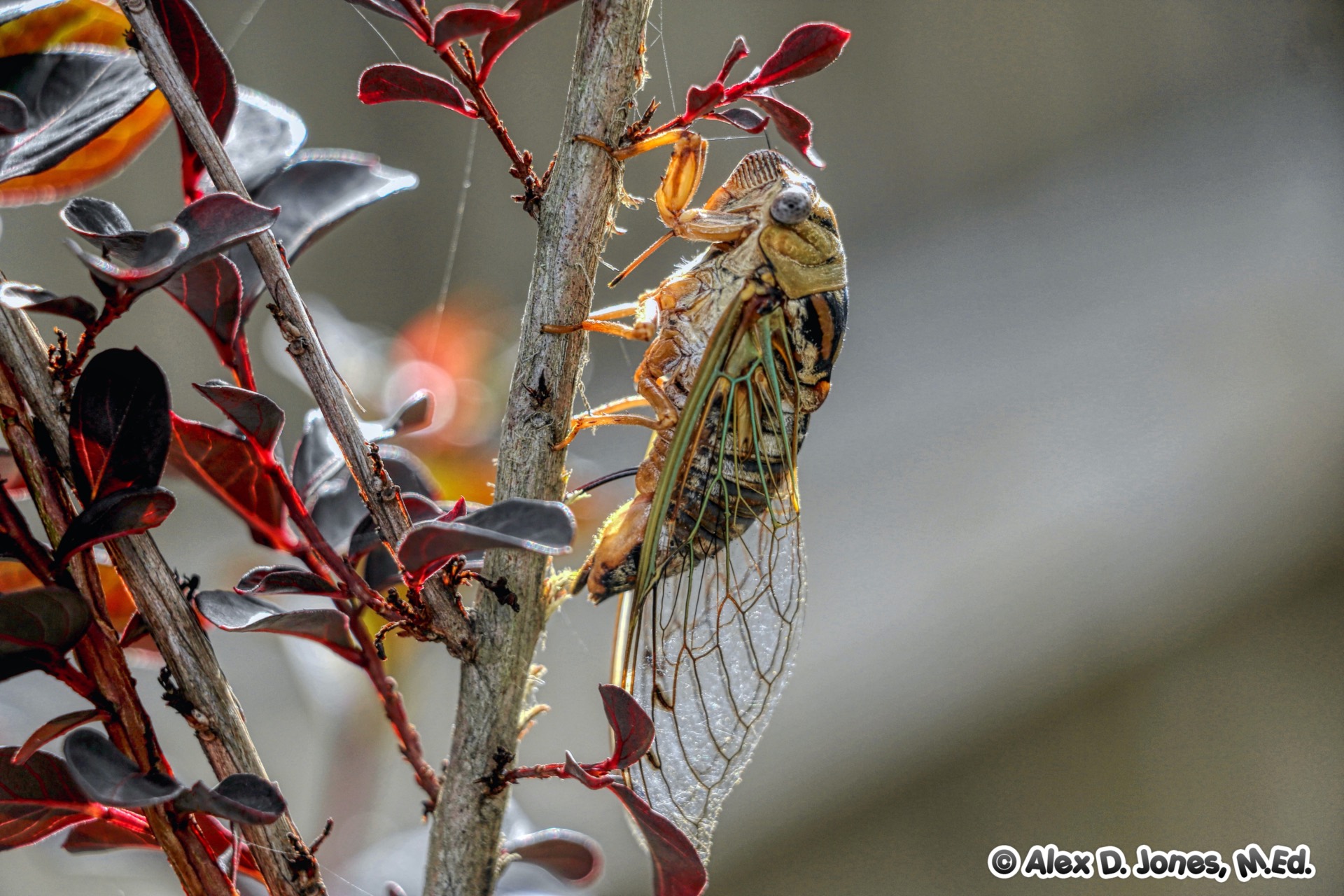
A large cicada sits on a tree branch with colorful red and green leaves. The cicada has clear wings with dark lines, big eyes, and a brown body. You can see the detailed patterns on its wings and the rough bark of the tree branch.
🔬 Scientific Phenomena
This image captures the Anchoring Phenomenon of cicada emergence and life cycle completion. The cicada visible here represents the final adult stage of an insect that has undergone incomplete metamorphosis. This particular cicada has likely recently emerged from underground where it spent years as a nymph, feeding on tree root fluids. The phenomenon occurs when environmental conditions (temperature and soil moisture) trigger the nymph to tunnel to the surface, climb a tree, and molt into its winged adult form to reproduce.
📚 Core Science Concepts
- Life Cycles and Metamorphosis: Cicadas demonstrate incomplete metamorphosis with three stages: egg, nymph, and adult (no pupal stage like butterflies)
- Animal Adaptations: The cicada's clear wings, strong legs for gripping branches, and large eyes are structural adaptations for survival and reproduction
- Habitat and Survival Needs: Cicadas depend on trees for both nymph development (feeding on roots underground) and adult activities (mating and egg-laying)
- Seasonal Changes and Animal Behavior: Cicada emergence is triggered by environmental cues, demonstrating how animals respond to seasonal changes
Pedagogical Tip: Use the "Think-Pair-Share" strategy when introducing cicada life cycles. Have students first think individually about what they notice, then discuss with a partner, and finally share observations with the class. This builds confidence and ensures all students participate.
UDL Suggestions: Provide multiple ways to represent the cicada life cycle by combining visual diagrams, hands-on models using clay or playdough, and audio recordings of actual cicada sounds. This supports learners with different processing strengths and keeps all students engaged.
🔍 Zoom In / Zoom Out Concepts
- Zoom In: At the cellular level, the cicada's wing membranes contain intricate vein patterns that carry hemolymph (insect blood) and provide structural support for flight. The compound eyes contain thousands of individual light-detecting units called ommatidia.
- Zoom Out: Cicadas play crucial roles in forest ecosystems as decomposers (their bodies fertilize soil), food sources for birds and mammals, and soil aerators (their emergence tunnels help water and air reach tree roots). Their synchronized emergence affects entire food webs.
🤔 Potential Student Misconceptions
- Misconception: "Cicadas are the same as locusts and they eat crops."
Clarification: Cicadas are different from locusts. Cicadas feed on tree root fluids and don't damage crops like locusts do.
- Misconception: "Cicadas come out every summer."
Clarification: Different cicada species have different cycles. Some emerge annually, while others emerge every 13 or 17 years in large groups.
- Misconception: "Cicadas bite or sting people."
Clarification: Cicadas are harmless to humans. They don't bite or sting and are only interested in finding mates and laying eggs.
🎓 NGSS Connections
- Performance Expectation: 3-LS1-1 - Develop models to describe that organisms have unique and diverse life cycles but all have in common birth, growth, reproduction, and death
- Disciplinary Core Idea: - Growth and Development of Organisms
- Crosscutting Concept: - Patterns of change can be used to make predictions
💬 Discussion Questions
- What do you notice about the cicada's body parts and how might each part help it survive? (Bloom's: Analyze | DOK: 2)
- How do you think a cicada's life underground as a nymph compares to its life above ground as an adult? (Bloom's: Compare | DOK: 2)
- Why might cicadas emerge in large groups at the same time instead of one by one? (Bloom's: Evaluate | DOK: 3)
- What would happen to the forest ecosystem if cicadas disappeared completely? (Bloom's: Synthesize | DOK: 3)
📖 Science Vocabulary
- Nymph: A young insect that looks similar to the adult but without wings
- Metamorphosis: The process of an animal changing from one form to another as it grows
- Adaptation: A special feature that helps an animal survive in its environment
- Life cycle: All the stages an animal goes through from birth to death
- Emerge: To come out from a hidden or underground place
🔗 Cross-Curricular Ideas
- ELA - Descriptive Writing: Have students write "cinquain poems" about cicadas using sensory words (what they see, hear, feel). Students can describe the cicada's appearance, the sound it makes, and how it feels to touch the rough bark. This connects science observation with creative writing skills.
- Math - Data and Graphing: Create a bar graph showing how long different cicada species stay underground as nymphs (1 year, 2 years, 13 years, 17 years). Students can compare the numbers, order them from shortest to longest, and discuss which cicadas have to wait the longest to become adults.
- Art - Nature Illustration: Students can create detailed drawings or paintings of cicadas on branches, focusing on the intricate patterns of the wings, the texture of the bark, and the colors of the leaves. Provide colored pencils, watercolors, or mixed media to capture the beauty of the photograph.
- Social Studies - Life Cycles in Our Community: Connect cicada life cycles to human life stages (baby, child, teenager, adult). Discuss how all living things go through different stages and have different needs at each stage, helping students understand patterns in nature and in their own lives.
🚀 STEM Career Connection
- Entomologist — Studies insects — how they live, what they eat, and the jobs they do in an ecosystem.
- Try it: Design a simple shelter for a cicada nymph that protects it from predators and the elements. (Practice: Constructing Explanations and Designing Solutions)
- Tools: insect nets, a hand lens, pinning boards, microscopes
- Where they work: museums, farms, insect labs, universities
- Meet one: Corrie Moreau — How ants evolved together with the bacteria that live inside them.
- Median pay: /year — "Zoologists and wildlife biologists"
- Conservation Biologist — Works out which plants and animals are in trouble, and what would help them recover.
- Try it: Brainstorm ways to help protect cicada habitats, such as avoiding pesticide use near trees. (Practice: Constructing Explanations and Designing Solutions)
- Tools: population surveys, GPS trackers, habitat maps, trail cameras
- Where they work: nature reserves, conservation charities, government agencies, universities
- Meet one: Tierra Curry — Which plants and animals are closest to disappearing, and what it takes to save them.
- Median pay: /year — "Zoologists and wildlife biologists"
Wage figures are median annual wages for the U.S. occupation named after each one, from the U.S. Bureau of Labor Statistics, Occupational Employment and Wage Statistics (OEWS), national, May 2025. Several careers share one occupation, so their figures match.