📸 Photo Description
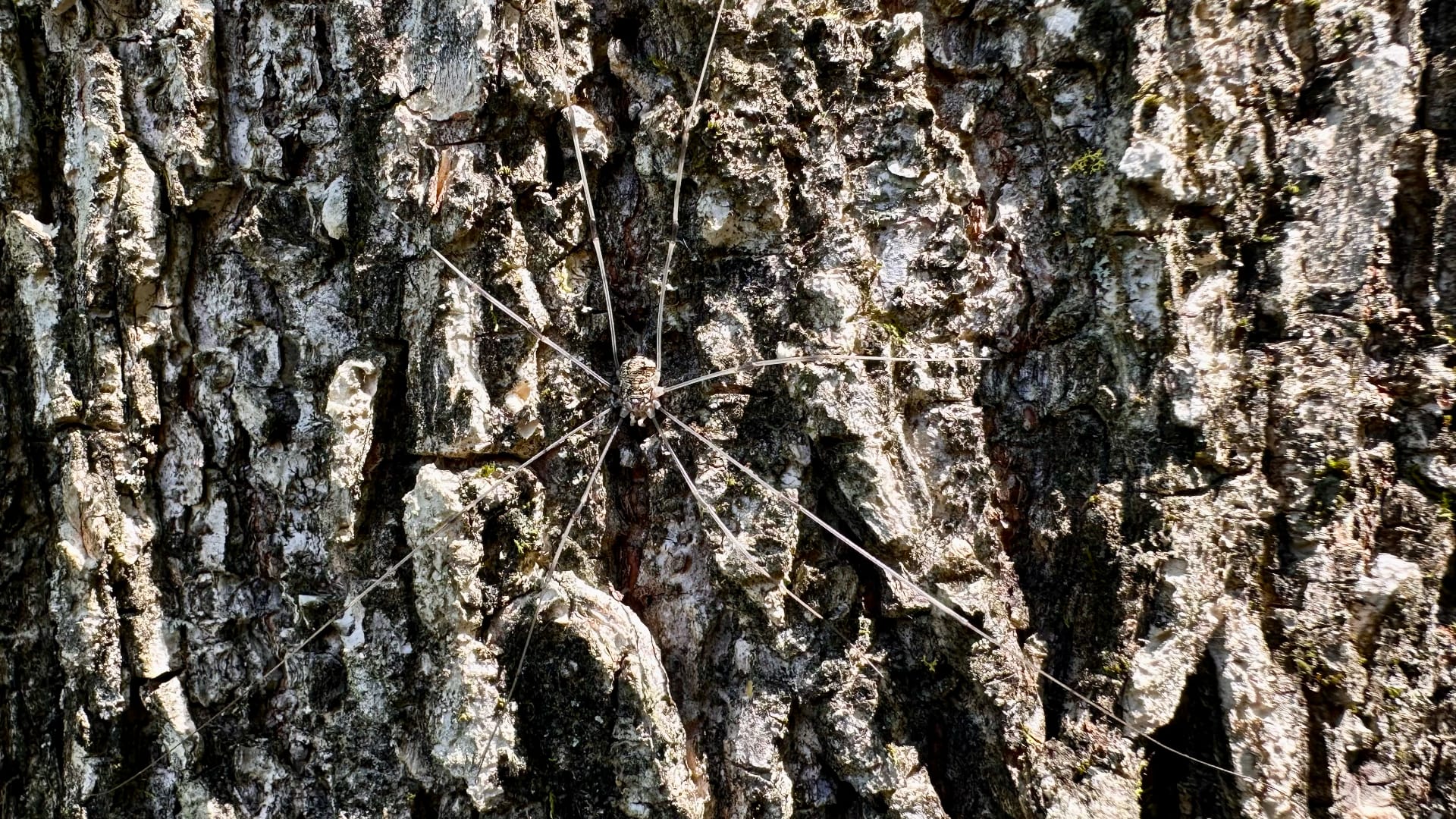
The image shows a close-up view of tree bark. A harvestman, sometimes called a daddy longlegs, is camouflaged against the rough texture and color of the bark. Its long, thin legs are spread out, making it blend in with the surroundings.
🔬 Scientific Phenomena
This image represents the phenomenon of camouflage, where an organism's coloring and patterns help it blend in with its environment. For the harvestman, this camouflage is crucial for its survival. It helps the harvestman hide from predators that might want to eat it, and it can also help it sneak up on prey it wants to catch and eat. The rough texture of the bark and the speckled colors of the harvestman's body mimic the natural patterns of its habitat.
📚 Core Science Concepts
- Adaptation: Organisms have traits, or characteristics, that help them survive in their environment. Camouflage is an adaptation that helps animals hide.
- Habitat: The environment where an animal lives provides for its needs, such as food, water, and shelter. The tree bark serves as both a habitat and a source of camouflage for the harvestman.
- Predator-Prey Relationships: Animals that hunt other animals are called predators, and the animals they hunt are called prey. Camouflage helps prey animals avoid predators and can help predators catch their prey.
Pedagogical Tip: Encourage students to think about why this camouflage works. Ask them: "What would happen if the harvestman was bright blue?" This prompts them to consider the function of the trait.
UDL Suggestions: Provide sentence starters for students who struggle with written explanations, such as "The harvestman is camouflaged because..." or "This helps the harvestman to..."
🔍 Zoom In / Zoom Out Concepts
- Zoom In: Microscopic patterns on the harvestman's body, like tiny scales or hairs, might further break up its outline, making it even harder for predators to see. Also, specialized cells in its skin might allow it to subtly change color to match its immediate surroundings, though this is more common in other animals.
- Zoom Out: This harvestman is part of a larger forest ecosystem. Its camouflage helps it survive within this ecosystem, impacting the populations of both its predators and its prey, and thus contributing to the overall balance of life in the forest.
🤔 Potential Student Misconceptions
- Misconception: All spiders are the same and dangerous.
Clarification: While this creature is an arachnid, it's a harvestman, not a true spider. Harvestmen are harmless to humans and do not produce venom or silk. Many creatures that look similar are harmless and play important roles in their ecosystems.
- Misconception: Animals choose to change their color to hide.
Clarification: Camouflage is usually an inherited trait, meaning animals are born with it. It's not a conscious choice; it's a characteristic that helps them survive over time because those who are better hidden are more likely to live long enough to reproduce.
🎓 NGSS Connections
3-LS4-3: Construct an argument with evidence that in a particular habitat some organisms can survive well, some survive less well, and some cannot survive at all.
💬 Discussion Questions
- How does the harvestman's appearance help it survive on the tree bark? (Bloom's: Understand | DOK: 1 | SEP: Constructing Explanations and Designing Solutions)
- Why is it important for an animal to blend in with its environment? (Bloom's: Understand | DOK: 1 | SEP: Constructing Explanations and Designing Solutions)
- What would happen to the harvestman if it lived on a bright green leaf instead of tree bark? (Bloom's: Analyze | DOK: 2 | SEP: Constructing Explanations and Designing Solutions)
📖 Vocabulary
- Camouflage: A way an animal's body color or pattern helps it blend in with its surroundings to hide from predators or prey.
- Habitat: The natural home or environment where an animal or plant lives.
- Predator: An animal that hunts and eats other animals for food.
- Prey: An animal that is hunted and eaten by another animal for food.
- Arachnid: A group of animals that includes spiders, scorpions, mites, and harvestmen, usually having eight legs.
🌡️ Extension Activities
- Nature Walk & Sketch: Take students on a nature walk in a park or schoolyard. Have them observe different textures and colors in nature (tree bark, leaves, rocks) and sketch them. Then, have them draw an imaginary creature that would camouflage well in one of these environments.
- Camouflage Creations: Provide students with construction paper, crayons, markers, and natural materials like twigs or leaves. Have them create their own "camouflaged" creatures or scenes. Discuss how their creations blend into the background.
🔗 Cross-Curricular Ideas
- Art: Students can create their own camouflage patterns using different colors and shapes, inspired by the harvestman or other animals. They could also try to draw or paint the harvestman blending into its bark habitat.
- ELA: Read stories or poems about animals and their adaptations for survival. Students can write short descriptive paragraphs about the harvestman and its camouflage.
- Social Studies: Discuss how indigenous peoples have historically used natural camouflage for hunting or protection, connecting to cultural uses of the environment.
🚀 STEM Career Connection
- Biomimicry Engineer — Copies a solution nature already found — a burr, a beak, a leaf — and builds it into a design.
- Try it: Design a camouflage pattern for a toy animal that would help it blend in with a piece of tree bark, explaining why you chose those colors and shapes. (Practice: Constructing Explanations and Designing Solutions)
- Tools: microscopes, 3D printers, prototype rigs, CAD software
- Where they work: design studios, research labs, product companies, universities
- Meet one: Ainissa Ramirez — How to make metal stick to glass and ceramics — she invented a solder that does it.
- Median pay: /year — "Engineers, all other"
- Arachnologist — Studies spiders and their relatives — how they hunt, build webs and sense the world.
- Try it: Propose a solution to help a harvestman that is not well-camouflaged in its habitat, explaining how your solution would improve its survival. (Practice: Constructing Explanations and Designing Solutions)
- Tools: a hand lens, collecting vials, high-speed cameras, a field notebook
- Where they work: forests and gardens, museums, insect labs, universities
- Meet one: Sebastian Echeverri — Why jumping spiders dance, and how their colours look different depending on which of their eyes is watching.
- Median pay: /year — "Zoologists and wildlife biologists"
Wage figures are median annual wages for the U.S. occupation named after each one, from the U.S. Bureau of Labor Statistics, Occupational Employment and Wage Statistics (OEWS), national, May 2025. Several careers share one occupation, so their figures match.