📸 Photo Description
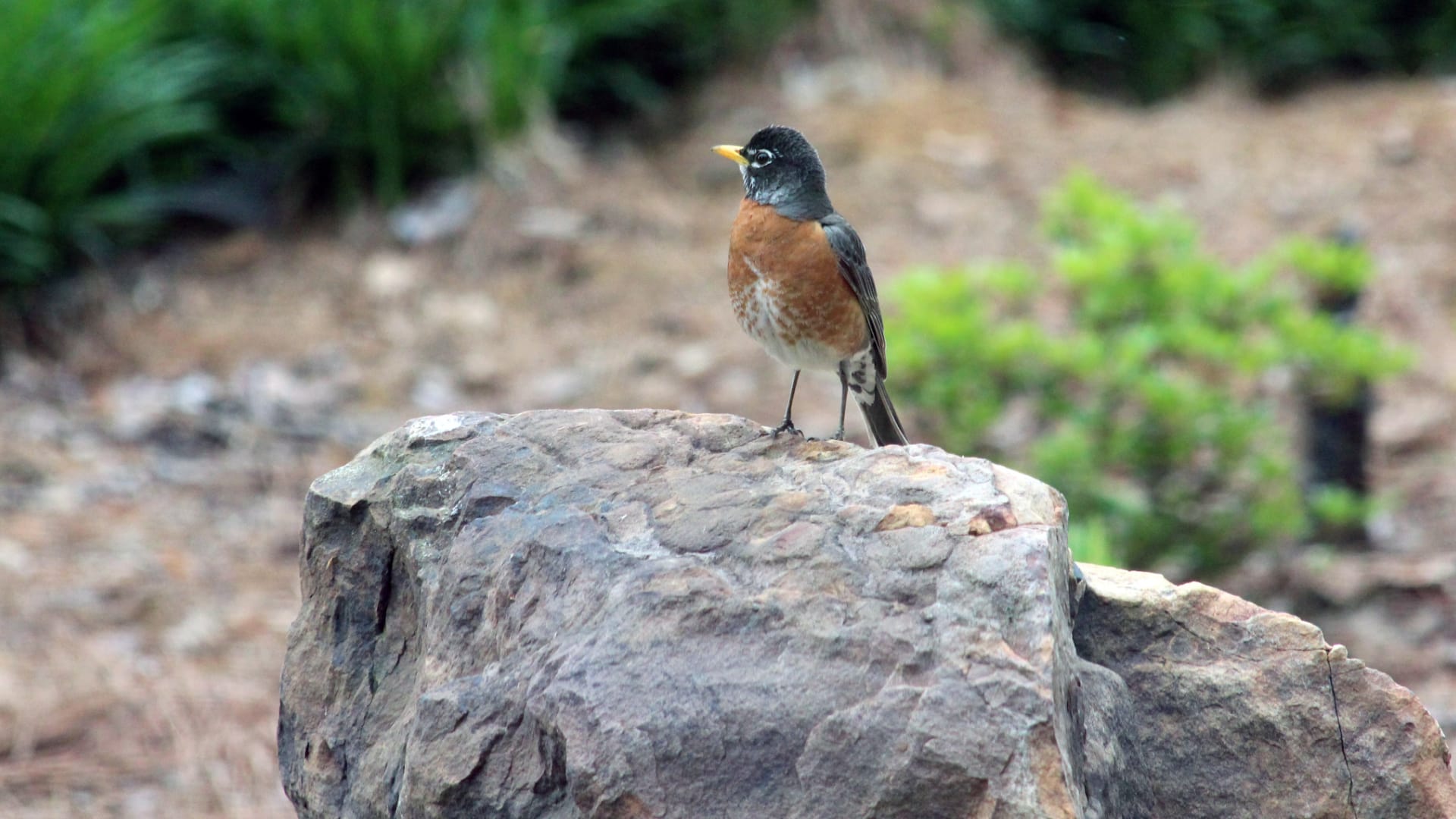
This image shows an American robin perched on a rock. You can see its distinctive features: a dark gray-blue head and back, a rust-colored orange-red breast and belly, and a thin yellow beak. The robin is standing upright on one leg on a gray stone, with dirt and green plants visible in the background.
🔬 Scientific Phenomena
Anchoring Phenomenon: Why does this robin have different colored feathers on different parts of its body?
This coloring pattern, called sexual dimorphism and countershading, serves important purposes in nature. The robin's dark back helps it blend in with trees and soil (camouflage), while its bright orange-red breast helps male robins attract mates and communicate with other robins. The yellow beak is visible because it contains special pigments and helps the bird pick up small food items from the ground. This is an example of how an organism's physical traits help it survive and reproduce in its environment.
📚 Core Science Concepts
- Animal Adaptations: The robin's coloring, beak shape, and body structure are adaptations that help it find food, stay safe from predators, and attract mates. Different body parts are suited for different jobs.
- Variation Within Species: Not all birds look exactly the same, even when they're the same type of animal. Individual robins may have slightly different colors or sizes, which is natural variation in a population.
- Habitats and Ecosystems: Robins live in many different habitats—forests, gardens, parks, and grasslands—where they find food like worms, insects, and berries. They are an important part of their ecosystem.
- Inherited Traits: A robin's orange breast, beak color, and body shape are traits passed down from its parents through genes. These traits help scientists identify different bird species.
Pedagogical Tip:
When teaching about animal adaptations, have students physically act out how the robin uses different body parts. For example, have them crouch like a robin hunting for worms, or stretch their arms like wings to show balance on a rock. This kinesthetic engagement helps third graders internalize the concept that every body part has a purpose.
UDL Suggestions:
Provide multiple means of representation: Show photographs, videos, and illustrations of robins from different angles and in different seasons. Some robins look different in winter versus spring. Offer both realistic images and simplified diagrams labeled with key features. For students with visual processing differences, provide tactile models or bird figurines they can handle while learning.
🎓 NGSS Connections
Performance Expectation:
3-LS1-1 Develop models to describe that organisms have unseen parts (internal structures) that function to support survival, growth, behavior, and reproduction.
Disciplinary Core Ideas:
- - Structure and Function
- - Natural Selection
- - Biodiversity and Humans
Crosscutting Concepts:
-
-
-
💬 Discussion Questions
- Why do you think the robin has a bright orange-red breast? (Bloom's: Analyze | DOK: 2)
Encourages students to think about the purpose of coloring and connect it to survival or communication.
- How is the robin's beak different from a duck's beak, and why might that be? (Bloom's: Evaluate | DOK: 3)
Requires comparing structures and inferring how form relates to function and diet.
- If a robin lived in a snowy area all year, how might its feathers be different? (Bloom's: Create | DOK: 3)
Pushes students to apply understanding of adaptation to a new scenario.
- What do you observe about the robin's body position? Why might it stand this way? (Bloom's: Understand | DOK: 1)
Focuses on observable behavior and introduces the concept of posture as adaptation.
📖 Vocabulary
- Adaptation: A body part or behavior that helps an animal survive and do well in its environment.
- Camouflage: Colors or patterns on an animal that help it hide from other animals by blending in with its surroundings.
- Feather: One of the light, fluffy growths that cover a bird's body and help it fly and stay warm.
- Beak: The hard, pointed mouth part of a bird used to pick up food and drink water.
- Habitat: The place where an animal lives that has the food, water, and shelter it needs.
- Species: A group of animals that look similar and can have babies together (like all American robins).
🌡️ Extension Activities
- Bird Beak Investigation: Provide students with different tools (tweezers, clothespins, chopsticks, spoons) and have them use each "beak" to pick up different foods (cereal, popcorn kernels, crackers, jello). Ask: Which beak works best for different foods? Connect this to how the robin's beak is shaped perfectly for picking worms from the ground. Students can record their findings in a chart.
- Design a Robin Habitat: Give students paper, markers, and craft materials to create a poster or diorama showing where robins live and what they need to survive. Include food sources (worms, insects, berries), water, shelter (trees or bushes), and nesting spots. Have them explain why each element is important.
- Bird Migration Map: If your robin image is from spring or fall, use this as a jumping-off point to explore migration. Show students a map of North America and have them trace or predict robin migration routes. Discuss why birds migrate and what changes in the environment might trigger this behavior. Connect to seasonal changes students observe in your local area.
🔍 Zoom In / Zoom Out Concepts
Zoom In: Cellular Level—Feather Structure & Pigments
If we could look at a robin's feathers under a microscope, we'd see thousands of tiny, interlocking barbules (like the teeth on a zipper) that hold the feather together and make it waterproof. The orange-red and dark gray colors come from special pigments stored in the feather cells—just like how food coloring makes water turn red or blue. These pigments are made by the robin's body and get built into the feather as it grows. Without these pigments, the feather would be white or clear, like the base of a feather before color is added!
Zoom Out: Ecosystem Level—Food Webs & Population Cycles
The robin is part of a much larger ecosystem. Robins eat worms, insects, and berries, which means they depend on soil organisms, plants, and invertebrates to survive. In turn, hawks and cats hunt robins, making robins part of a food web where energy flows from plants → insects → robins → predators. When robin populations grow large in spring, there are more birds eating insects, which helps control pest populations in gardens and farms. When winters are harsh, fewer robins survive, which changes the whole balance of the ecosystem. Understanding one robin helps us understand how entire neighborhoods and forests work together!
🤔 Potential Student Misconceptions
Misconception 1: "The robin's orange breast is painted on or changes color like a mood ring."
Clarification: The orange color is permanent and grows with the feather, just like your hair color. It's there because of special chemicals called pigments that the robin's body puts into the feather as it grows. The color doesn't change based on the robin's mood or emotions—it's always orange-red because that's the robin's species trait. Male robins are born with this color to help them attract mates.
Misconception 2: "Birds don't need different body parts because they can do everything with their wings and beak."
Clarification: Every body part on a robin has an important job. The wings are for flying, the beak is for eating, the feet are for gripping and balance, the eyes are for seeing, and the feathers are for staying warm and dry. Each part is specially designed. If a robin only had wings and a beak, it couldn't stand on a rock, hold onto a branch, see predators coming, or stay warm!
Misconception 3: "All robins look exactly the same, so they're all identical copies."
Clarification: While all American robins have the same general pattern (orange breast, gray back, yellow beak), individual robins look slightly different from each other—some are bigger, some have brighter orange, and some have more spots. Male robins look different from female robins (females are paler). This variation is natural and normal, just like how people in your family might have similar features but don't look exactly the same.
🔗 Cross-Curricular Ideas
Math Connection: Measuring & Data
Have students measure the height of robins in your schoolyard or park using hand-spans or standard rulers. Create a bar graph showing how many robins they see each day over a week. Students can count robin sightings, track the number of worms a robin might eat (estimate 10–15 per day), and calculate how many worms a robin eats in a week or month. This integrates measurement, graphing, and multiplication concepts.
ELA Connection: Descriptive Writing & Bird Journals
Ask students to write detailed descriptions of the robin using sensory words: "The robin's breast is bright orange-red like a sunset" or "Its beak is thin and yellow like a pencil." Have them keep a "Bird Watching Journal" where they write or draw observations about robins they see, using the vocabulary from the lesson (adaptation, camouflage, habitat). Create a class book of robin observations and illustrations to practice sequencing and descriptive writing.
Social Studies Connection: Local Wildlife & Community
Explore how robins fit into your local community and neighborhood. Take a nature walk to identify robin habitats near your school—parks, gardens, yards with trees. Discuss how humans and robins share the same spaces and what responsibilities we have to protect wildlife habitats. Connect to seasonal changes and how communities prepare for different seasons (spring migration, fall preparation). Students can create a community map showing "robin-friendly" places in your neighborhood.
Art Connection: Color Mixing & Pattern Design
Using watercolors or tempera paint, have students mix colors to match the robin's orange breast and gray-blue back. Explore how different amounts of red, yellow, and blue create different shades. Students can practice painting feather patterns or design their own imaginary bird with realistic coloring. Create a "Bird Gallery" of student artwork and discuss why they chose certain colors and patterns for their birds.
🚀 STEM Career Connection
- Conservation Biologist — Works out which plants and animals are in trouble, and what would help them recover.
- Try it: Design a safe place for robins to build a nest, explaining why your design would protect them. (Practice: Constructing Explanations and Designing Solutions)
- Tools: population surveys, GPS trackers, habitat maps, trail cameras
- Where they work: nature reserves, conservation charities, government agencies, universities
- Meet one: Tierra Curry — Which plants and animals are closest to disappearing, and what it takes to save them.
- Median pay: /year — "Zoologists and wildlife biologists"
- Ornithologist — Studies birds — how they fly, what they eat, where they nest, and where they travel.
- Try it: Explain why a robin's bright breast might help it find a mate, using evidence from the lesson. (Practice: Constructing Explanations and Designing Solutions)
- Tools: binoculars, spotting scopes, leg bands, sound recorders
- Where they work: wildlife refuges, bird observatories, parks, universities
- Meet one: Corina Newsome — How seaside sparrows in salt marshes lose nests to rising water — nests built higher escape the flooding but become easier for predators to find.
- Median pay: /year — "Zoologists and wildlife biologists"
Wage figures are median annual wages for the U.S. occupation named after each one, from the U.S. Bureau of Labor Statistics, Occupational Employment and Wage Statistics (OEWS), national, May 2025. Several careers share one occupation, so their figures match.
---
Teacher Note: This lesson works well as part of a larger unit on animal adaptations, local wildlife, or seasonal changes. Consider timing the activity in spring when robins are most visible in many regions!