📸 Photo Description
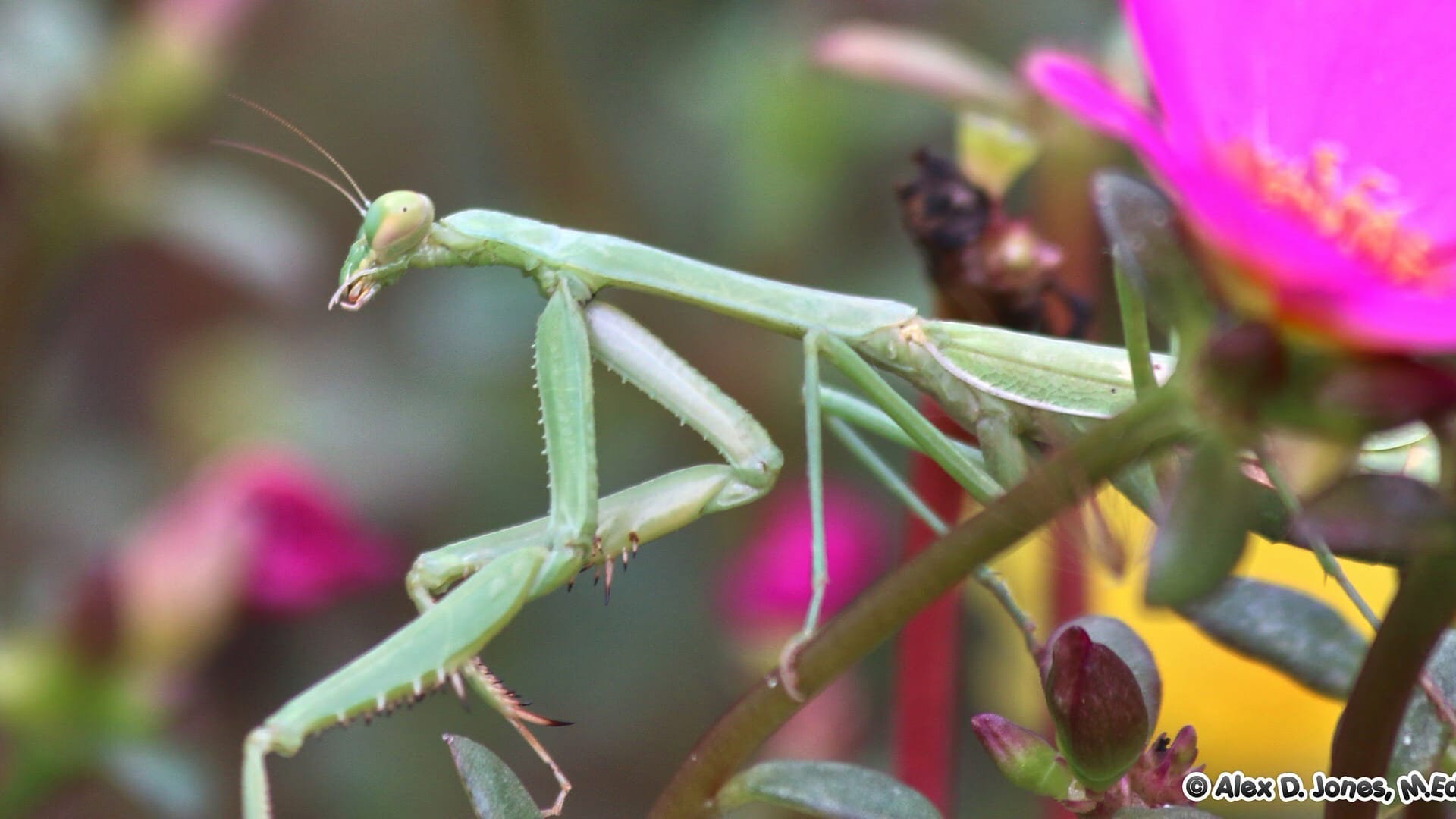
This image shows a praying mantis perched on a plant stem. The mantis is green with long, thin legs and antennae. It is surrounded by pink and yellow flowers, suggesting it is in a garden or natural outdoor setting.
🔬 Scientific Phenomena
The photo captures an example of an animal living in its habitat and interacting with its environment. The praying mantis, an insect, is well-camouflaged within the plants, which helps it survive by hiding from predators and ambushing prey. This camouflage is a trait that aids in its survival within its specific habitat.
📚 Core Science Concepts
- Adaptation and Survival: Praying mantises have physical characteristics, like their green color, that help them blend in with plants. This camouflage is an adaptation that helps them survive in their environment by protecting them from predators and helping them catch food.
- Organism-Environment Interaction: The praying mantis lives in a habitat that provides it with food (insects) and shelter. Its body structure is suited for life on plants.
- Traits: The praying mantis has specific physical traits, such as its specialized forelegs for catching prey and its body shape and color for camouflage.
Pedagogical Tip: When discussing camouflage, prompt students to think about why an animal would need to blend in. Guide them to consider both avoiding being eaten and catching food.
UDL Suggestions: Provide students with a variety of images of different animals in their habitats. Ask them to sort the animals based on how their physical features help them survive in that specific environment. This allows for choice and caters to different learning styles.
🔍 Zoom In / Zoom Out Concepts
- Zoom In: At a microscopic level, the praying mantis's skin cells contain pigments that determine its green color. This coloration is a result of genetic information passed from parent mantises.
- Zoom Out: This praying mantis is part of a larger ecosystem. It plays a role in controlling insect populations, and it is also a food source for larger animals like birds.
🤔 Potential Student Misconceptions
- Misconception: Students might think the praying mantis's green color is just because it's a "plant bug."
- Clarification: The green color is an adaptation, a trait that helps the mantis survive by making it hard for other animals to see it. It's not just random; it provides an advantage in its environment.
- Misconception: Students might think all insects in a garden are the same or serve the same purpose.
- Clarification: Different insects have different roles in the environment. The praying mantis is a predator, while other insects might be pollinators or decomposers.
🎓 NGSS Connections
3-LS4-3: Construct an argument with evidence that in a particular habitat some organisms can survive well, some survive less well, and some cannot survive at all.
2-LS4-1 (Grade 2 — foundational connection): Make observations of plants and animals to compare the diversity of life in different habitats.
4-LS1-1 (Grade 4 — where this learning leads): Construct an argument that plants and animals have internal and external structures that function to support survival, growth, behavior, and reproduction.
💬 Discussion Questions
- How does the praying mantis's body help it survive in the garden? (Bloom's: Analyze | DOK: 2 | SEP: Constructing Explanations and Designing Solutions)
- What might happen to the praying mantis if it were bright red and lived in a green garden? (Bloom's: Analyze | DOK: 2 | SEP: Constructing Explanations and Designing Solutions)
- Based on the image, what does the praying mantis likely eat, and how does its body help it eat that food? (Bloom's: Analyze | DOK: 2 | SEP: Constructing Explanations and Designing Solutions)
📖 Vocabulary
- Praying Mantis: A type of insect known for its long body and how it holds its front legs in a "praying" position.
- Habitat: The natural home or environment of an animal, plant, or other organism.
- Camouflage: The use of colors and patterns to blend in with the surroundings to hide from predators or catch prey.
- Adaptation: A special feature or behavior that helps an organism survive in its environment.
- Predator: An animal that hunts and kills other animals for food.
🌡️ Extension Activities
- Camouflage Creation Station: Provide students with construction paper in various colors and patterns. Have them draw or cut out pictures of different animals and then glue them onto backgrounds to see which ones are best camouflaged. Discuss why certain colors and patterns work better in different environments.
- Habitat Dioramas: Students can create shoebox dioramas representing different habitats (forest, desert, garden, ocean). They can then choose or draw animals that live in those habitats and explain how the animals are suited for that environment.
🔗 Cross-Curricular Ideas
- ELA: Read books about insects and their adaptations. Students can write a descriptive paragraph about the praying mantis, focusing on its physical characteristics and how they help it survive.
- Art: Students can draw or paint the praying mantis, focusing on capturing its colors and textures to represent its camouflage.
- Math: Students can measure the length of the praying mantis in the image (using a scale if provided or estimating) and compare it to the lengths of other insects.
🚀 STEM Career Connection
- Ecologist — Studies how living things depend on each other and on the place they live.
- Try it: Argue why a praying mantis's camouflage is an important adaptation for its survival in its ecosystem. (Practice: Engaging in Argument from Evidence)
- Tools: quadrat frames, measuring tapes, GPS units, a field notebook
- Where they work: forests, grasslands, wetlands, universities
- Meet one: Sandra Díaz — What a plant's leaves, wood and shape tell you about how it lives — and how those traits add up across a whole ecosystem.
- Median pay: /year — "Environmental scientists and specialists, including health"
- Biologist — Studies living things of every kind and what keeps them alive.
- Try it: Present evidence that shows how a praying mantis's physical traits, like its color, help it interact with its environment. (Practice: Engaging in Argument from Evidence)
- Tools: microscopes, sample jars, measuring tools, a field notebook
- Where they work: laboratories, field sites, museums, universities
- Meet one: Sandra Díaz — What a plant's leaves, wood and shape tell you about how it lives — and how those traits add up across a whole ecosystem.
- Median pay: /year — "Biological scientists, all other"
Wage figures are median annual wages for the U.S. occupation named after each one, from the U.S. Bureau of Labor Statistics, Occupational Employment and Wage Statistics (OEWS), national, May 2025. Several careers share one occupation, so their figures match.