📸 Photo Description
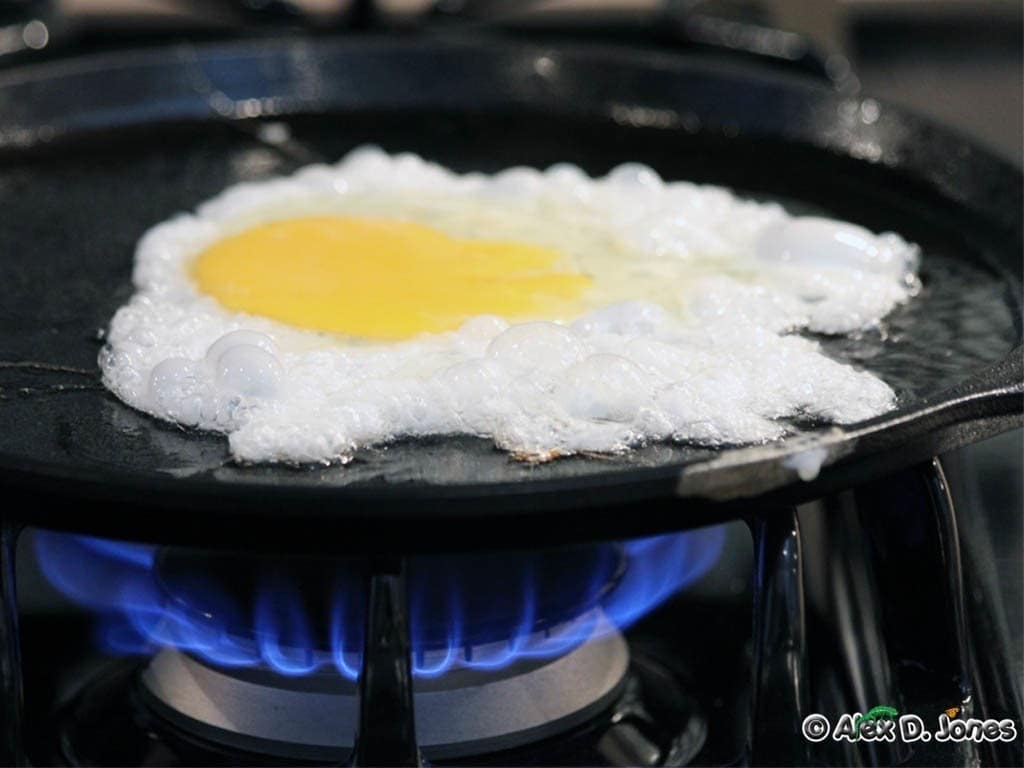
This image shows a fried egg cooking on a dark skillet over a blue gas flame. The egg white has turned from clear and runny to white and solid, while the yellow yolk in the center remains soft. Heat from the stove is causing the egg to change from its raw state into a cooked meal.
🔬 Scientific Phenomena
Anchoring Phenomenon: Heat energy from the stove is causing the egg proteins to permanently change structure—a process called denaturation.
Why It's Happening: When thermal energy (heat) is applied to the egg, it causes the protein molecules in both the white and yolk to unwind and bond together in new ways. This creates a solid or semi-solid texture that cannot be reversed back to raw. The egg white denatures at a lower temperature (~60°C) than the yolk (~65°C), which is why we see different rates of cooking. This is a chemical change—not just a temperature change, but an actual transformation of the material itself.
📚 Core Science Concepts
- Thermal Energy Transfer: Heat flows from the hot skillet into the egg, raising the egg's temperature and causing physical and chemical changes.
- States of Matter & Phase Change: The egg changes from a liquid/semi-liquid state to a more solid state. While not a traditional phase change (like ice to water), it demonstrates how heat affects matter's properties.
- Chemical Change vs. Physical Change: Cooking an egg is a chemical change because the proteins are permanently altered at the molecular level—you cannot return the egg to its raw state just by cooling it.
- Temperature & Energy: Different parts of the egg cook at different rates because different proteins denature at different temperatures, showing that thermal energy affects materials in specific ways.
Pedagogical Tip:
Use the egg-cooking phenomenon as a concrete, relatable anchor. Third graders have likely eaten eggs! Ask them to predict what will happen BEFORE cooking, then observe carefully during cooking. This builds scientific thinking by connecting real-world experiences to abstract concepts like "thermal energy."
UDL Suggestions:
Provide multiple means of engagement by offering choice in how students document observations: drawings, written descriptions, or labeled diagrams. Use real eggs or high-quality videos for students who benefit from visual/tactile learning. Create a word wall with "thermal energy," "heat," "cooking," and "change" so all learners can reference vocabulary independently.
🎓 NGSS Connections
Performance Expectation: 2-PS1-4 Construct an argument with evidence that some changes caused by heating or cooling can be reversed and some cannot.
Disciplinary Core Ideas:
- (Matter and Its Interactions)
- (Types of Interactions)
Crosscutting Concepts:
-
-
---
💬 Discussion Questions
- What changes do you notice happening to the egg as it cooks? (Bloom's: Observe | DOK: 1)
- Why do you think the egg white cooks before the yolk? (Bloom's: Analyze | DOK: 2)
- If we let the cooked egg cool down in the refrigerator, will it turn back into a raw egg? Why or why not? (Bloom's: Evaluate | DOK: 3)
- What other foods do you eat that change when they are heated? What changes do you observe? (Bloom's: Apply | DOK: 2)
📖 Vocabulary
- Thermal Energy: The heat energy from something hot that can make other things warmer.
- Heat: The flow of thermal energy from something hot to something cooler.
- Cooking: Using heat to change how food looks, feels, and tastes.
- Protein: A material found in eggs and other foods that changes shape when heated.
- Denaturation: When heat causes the proteins in food (like eggs) to permanently change and become firm or solid.
- Chemical Change: A change that creates a completely new material that cannot be changed back.
🌡️ Extension Activities
- Egg Cooking Prediction & Observation Chart: Have students predict what the raw egg will look like at different cooking stages (1 minute, 2 minutes, 3 minutes), then observe a live egg cooking (or watch a video). Have them record observations with labeled drawings and compare to their predictions. This builds hypothesis testing skills.
- Temperature & Cooking Investigation: Using boiled eggs, provide students with eggs cooked for different lengths of time (3 minutes, 5 minutes, 7 minutes, 10 minutes). Have them cut or observe the eggs and record how the yolk changes from runny to soft to fully cooked. Discuss how time and temperature work together to cause change.
- Heat Transfer Exploration: Use warm water, thermometers, and various materials (cloth, plastic, foil, paper) to investigate which materials transfer heat fastest. Ask: "If you were cooking an egg, which material would cook it fastest?" This connects the egg phenomenon to heat transfer properties.
🔍 Zoom In / Zoom Out Concepts
Zoom In (Microscopic Level):
When you zoom in really, really small—smaller than you can see without a special microscope—you'd see tiny protein molecules in the egg white. Imagine proteins like twisted-up telephone cords. When heat is applied, these "cords" unwind and tangle together with other proteins nearby. This tangling is what makes the egg white go from clear and runny to white and solid. The heat gives the protein molecules extra energy to move around and bond in new ways. This is denaturation happening at the molecular level!
Zoom Out (Kitchen & Home System):
When you zoom out and look at the bigger picture, cooking an egg is just one tiny part of how we prepare food in our homes and communities. The stove, the skillet, the egg, and the person cooking all work together as a system. The gas flame provides energy, the skillet transfers that energy to the egg, and the cook controls when the egg is ready to eat. This same thermal energy system is used in restaurants, school cafeterias, and bakeries all around us. Understanding how heat changes food helps us cook healthier meals and understand why different foods need different cooking times!
🤔 Potential Student Misconceptions
Misconception #1: "If I cool down a cooked egg, it will turn back into a raw egg."
Clarification: A cooked egg will NOT turn back into a raw egg, even if you put it in the refrigerator or freezer. Cooking is a chemical change, which means the proteins have permanently changed their structure. Cooling it down only makes it cold—it doesn't undo the chemical change that heat caused. Think of it like coloring a white shirt with a permanent marker: cooling it down won't make the color disappear!
Misconception #2: "Heat just makes things hotter; it doesn't change what they are."
Clarification: Heat doesn't just change temperature—it can actually change what something IS! When you cook an egg, the heat energy changes the egg's proteins so much that you create a brand-new material with different properties. The cooked egg is no longer "raw egg that got hot"—it's a chemically different food. Heat can cause this kind of permanent change in many foods, like bread baking or chocolate melting and then hardening.
Misconception #3: "The egg white and yolk cook at the same time at the same speed."
Clarification: The egg white actually cooks FASTER than the yolk because the proteins in the white denature at a lower temperature (about 60°C) than the proteins in the yolk (about 65°C). This is why you can see the white turn solid while the yolk is still runny. Different materials in food cook at different temperatures and speeds!
🔗 Cross-Curricular Ideas
Math Connection: Cooking Times & Temperatures
Create a simple chart or graph showing cooking times for eggs cooked to different levels (soft-boiled: 3-4 minutes; medium-boiled: 6-7 minutes; hard-boiled: 10-12 minutes). Have students measure cooking times using timers and record data. They can then create a bar graph showing "How long does an egg take to cook?" This builds data collection and graphing skills while reinforcing the science concept that time + heat = change.
ELA Connection: Recipe Writing & Descriptive Language
Have students write their own "How to Cook an Egg" recipe or instructional text. Encourage them to use descriptive words for what they observe: "The egg white looks cloudy and thick." "The yolk is still bright yellow and runny." This combines science vocabulary with writing skills. Students can illustrate their recipes and create a classroom cookbook, building both literacy and communication of scientific observations.
Art Connection: Observational Drawing & Color Study
Provide students with raw eggs, cooked eggs (at different stages), and art supplies. Have them draw or paint what a raw egg looks like versus a cooked egg, focusing on color changes (clear to white, bright yellow yolk to slightly duller). Create a visual display showing the "life cycle" of a cooking egg through student artwork. This helps students carefully observe changes and express scientific thinking through art.
Social Studies Connection: Food Preparation Around the World
Explore how different cultures cook eggs in different ways (fried, boiled, scrambled, baked in dishes). Create a simple chart showing "How People Cook Eggs Around the World." Have students discuss: What tools do different cultures use? Are eggs an important food everywhere? This builds cultural awareness while connecting science to real-world food practices and family traditions.
🚀 STEM Career Connection
- Food Scientist — Studies what food is made of, why it spoils, and how to keep it safe and nourishing.
- Try it: Observe an egg cooking and record the changes in its appearance and texture over time. (Practice: Obtaining, Evaluating, and Communicating Information)
- Tools: pH meters, test kitchens, incubators, texture analysers
- Where they work: food companies, testing laboratories, government safety agencies, universities
- Meet one: Mario Ferruzzi — How the body takes in nutrients from food, and how to make everyday foods more nourishing.
- Median pay: /year — "Food scientists and technologists"
- Chemist — Studies what substances are made of and what happens when you combine them.
- Try it: Compare a raw egg to a cooked egg and describe the evidence that a chemical change has occurred. (Practice: Obtaining, Evaluating, and Communicating Information)
- Tools: fume hoods, balances, spectrometers, glassware
- Where they work: laboratories, manufacturing plants, testing facilities, universities
- Meet one: Tebello Nyokong — Dyes that can be switched on by laser light to destroy cancer cells and leave healthy ones alone.
- Median pay: /year — "Chemists"
Wage figures are median annual wages for the U.S. occupation named after each one, from the U.S. Bureau of Labor Statistics, Occupational Employment and Wage Statistics (OEWS), national, May 2025. Several careers share one occupation, so their figures match.