📸 Photo Description
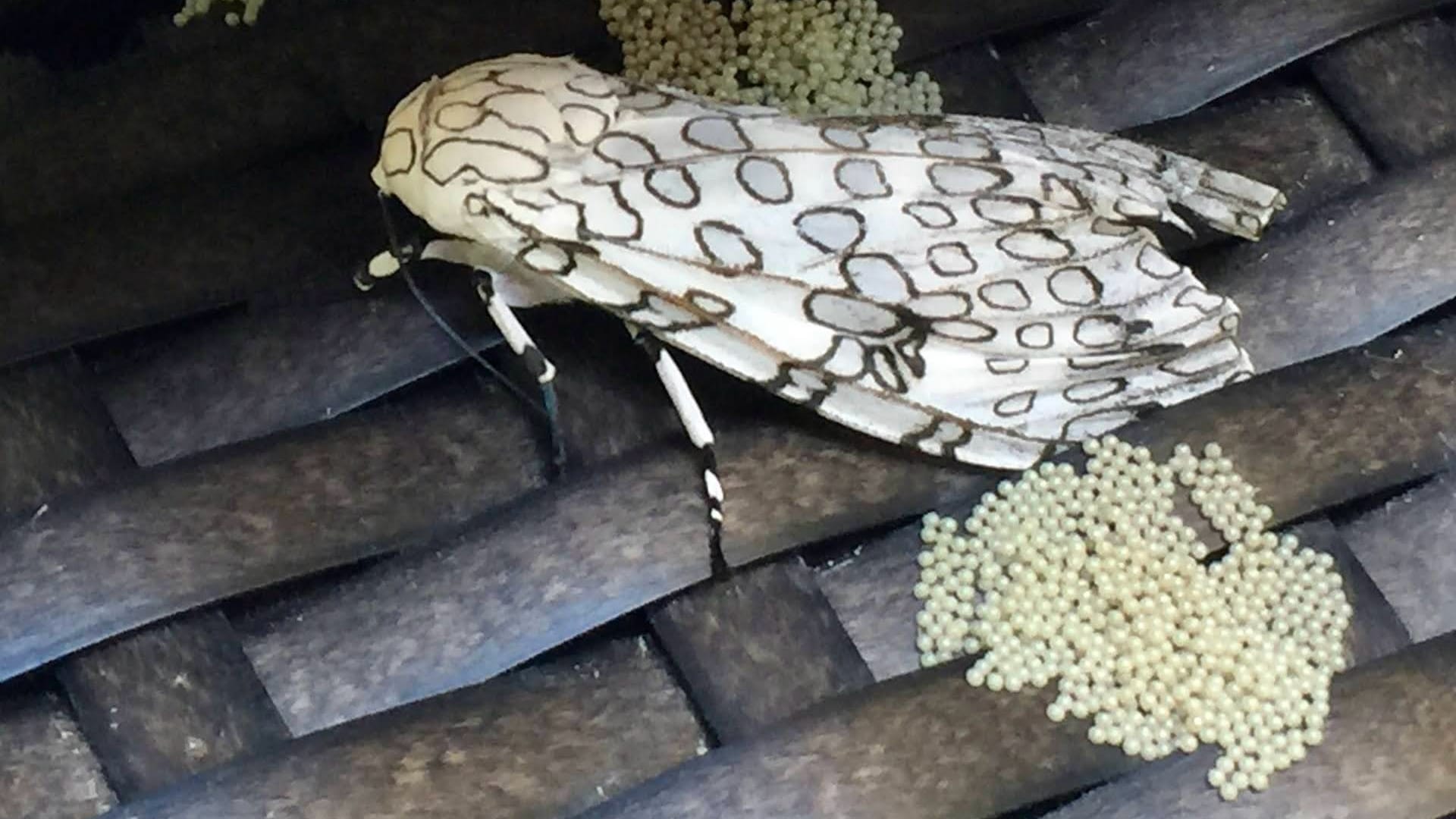
This image shows a Giant Leopard Moth with its distinctive white wings covered in brown circular spots, resting on dark branches. Beside the moth are clusters of pale yellow eggs—the beginning stage of the moth's life cycle. The moth's long, thin legs and feathery antennae are clearly visible, showing features that help scientists identify this species.
🔬 Scientific Phenomena
Anchoring Phenomenon: Complete Metamorphosis in Insects
This image captures a critical moment in the life cycle of an insect. The Giant Leopard Moth displays complete metamorphosis, which means it goes through four completely different life stages: egg, larva (caterpillar), pupa (chrysalis), and adult moth.
Why this happens scientifically: Insects undergo metamorphosis because their bodies are completely reorganized during development. This allows them to have specialized body structures for each stage—the caterpillar is designed for eating leaves, while the adult moth is designed for finding mates and laying eggs. This strategy helps the species survive because different life stages use different food sources and habitats, reducing competition within the species.
📚 Core Science Concepts
- Life Cycles of Insects: All insects go through distinct life stages. The Giant Leopard Moth progresses from eggs → caterpillars → pupae → adult moths over several months.
- Adaptation & Structure: The moth's spotted white wings, fuzzy body, and feathery antennae are adaptations—special features that help it survive, find food, and reproduce.
- Growth & Development: Each stage of the moth's life cycle is specially suited to its needs. Eggs are tiny and laid in clusters; caterpillars are eating machines; pupae rest and change internally; adults fly and reproduce.
- Biodiversity & Classification: Leopard moths belong to the insect family and are classified as Lepidoptera (butterflies and moths), identifiable by their patterned wings and body structure.
Pedagogical Tip:
Use this image as a visual anchor throughout your unit on insect life cycles. Have students track the moth's development stages by creating a four-pocket folder or wall display. Revisit the photo at each stage of instruction to reinforce how the same organism looks dramatically different at each lifecycle phase—this concrete visual reference helps Third Graders hold multiple concepts simultaneously.
UDL Suggestions:
Representation: Provide the life cycle as both a visual diagram AND a simple written sequence to support different learners. Some students may need the image labeled with arrows showing the progression.
Action & Expression: Allow students to show their understanding through multiple modalities—drawing the life cycle, arranging picture cards in order, acting out each stage, or building a 3D model. This accommodates kinesthetic and visual learners while supporting English Language Learners.
Engagement: Connect to students' prior experiences by asking if they've ever found caterpillars in gardens or seen moths near porch lights, making the abstract concept personally relevant.
🎓 NGSS Connections
Performance Expectation:
3-LS1-1: Develop models to describe that organisms have unique and diverse life cycles but all animals have in common birth, growth, reproduction, and death.
Disciplinary Core Ideas:
- Growth and Development of Organisms
- Variation of Traits
Crosscutting Concepts:
- (The predictable pattern of the moth's four-stage life cycle)
- (How each life stage's body structure matches its job)
💬 Discussion Questions
- "Look at the eggs in the picture. What do you think will come out of these eggs, and how do you know?" (Bloom's: Understand | DOK: 2)
Students apply prior knowledge about insect life cycles to make predictions.
- "Why do you think the moth has to lay so many eggs at once instead of just laying one or two?" (Bloom's: Analyze | DOK: 3)
Students think critically about survival strategies and predation.
- "Compare the adult moth's wings to its body. What do the spotted white wings help the moth do that its fuzzy body cannot?" (Bloom's: Analyze | DOK: 2)
Students examine how structure relates to function.
- "If a caterpillar eats leaves, but an adult moth drinks nectar, why do you think they need different food sources at different times in their lives?" (Bloom's: Evaluate | DOK: 3)
Students reason about resource availability and ecological niches.
📖 Vocabulary
- Metamorphosis: The amazing change an insect goes through when it transforms from one body shape to a completely different body shape (like a caterpillar becoming a moth).
- Life Cycle: All the different stages an animal goes through from birth to death, including growing and having babies of its own.
- Adaptation: A special feature or behavior that helps an animal survive and thrive in its environment (like the moth's spotted wings for camouflage).
- Larva: The stage of an insect that looks like a worm or caterpillar and eats lots of leaves before becoming an adult.
- Pupa: The resting stage where an insect's body completely reorganizes inside a protective shell before becoming an adult.
- Antennae: Long, thin feelers on an insect's head that help it smell, touch, and sense the world around it.
🌡️ Extension Activities
- "Butterfly/Moth Life Cycle Drama" — Divide students into four groups, each representing one life stage (egg, caterpillar, pupa, adult). Have students use their bodies to show what that stage looks like and does. First, narrate the story of the moth's life while students act it out in sequence; then, let student narrators guide the "living life cycle." This builds kinesthetic understanding and reinforces vocabulary.
- "Spot the Differences: Adapt the Moth" — Provide students with an outline of the moth and challenge them to redesign its features for a different environment (desert, forest, garden). What would change? Why? Students draw modifications and explain their thinking, connecting structure to function and adaptation to survival.
- "Egg Cluster Investigation" — Provide images of actual eggs from different insects (butterfly, dragonfly, beetle) and have students compare them using hand lenses. Create a chart: How many eggs? What color? What size? What shape? This builds observation skills and shows diversity in reproductive strategies across insect species.
🔍 Zoom In / Zoom Out Concepts
Zoom In: Cellular Level – Inside the Egg
When you look at a moth egg under a microscope, you would see it's not solid like a marble. Inside the tiny egg, there are special cells that are already starting to divide and organize themselves into the shape of a tiny caterpillar! The egg has a thin, protective shell (called the chorion) that keeps the developing caterpillar safe and moist. Even though we can't see it with our eyes, the caterpillar's body is being "built" cell by cell inside that small, pale yellow egg. This is why scientists say the moth's life cycle actually starts before the egg hatches—the baby caterpillar is already growing and changing inside!
Zoom Out: Ecosystem Level – Food Web & Habitat Connection
The Giant Leopard Moth doesn't live alone—it's part of a much larger living system called an ecosystem. When the caterpillars hatch from these eggs, they will eat specific plants (like plants from the mulberry and grape families). Those plants depend on soil, water, and sunlight to grow. The adult moths become food for birds, spiders, and other predators, and they pollinate flowers while drinking nectar. When the moth dies, its body returns nutrients to the soil, feeding the plants that caterpillars eat. This circle of life shows how the moth is connected to plants, predators, decomposers, and the entire forest or garden habitat where it lives. One moth's life cycle connects to hundreds of other organisms!
🤔 Potential Student Misconceptions
Misconception 1: "The caterpillar grows wings inside and becomes a moth."
Scientific Clarification: During metamorphosis, the caterpillar's body doesn't just grow wings—it completely reorganizes at the cellular level. Inside the pupa, the caterpillar's old body parts (like chewing mouth parts and legs for crawling) are broken down, and brand-new body parts (like wings and a long, tube-shaped mouth for drinking) are built from special cells. It's not growing; it's a total rebuilding! This is why it's called "complete" metamorphosis—the organism changes completely, not just a little bit.
Misconception 2: "All the eggs will hatch into moths."
Scientific Clarification: Not all eggs survive to become adult moths. Many eggs might not hatch because they dry out, get eaten by predators, or get infected with disease. This is why the moth lays so many eggs (sometimes hundreds!) at once—even if only a few survive to adulthood, the species can continue. This helps Third Graders understand that laying many eggs is a survival strategy, not a guarantee.
Misconception 3: "The moth is done growing once it becomes an adult."
Scientific Clarification: Adult moths stop growing in size, but they are not "done" with their life cycle. An adult moth's main job is to find a mate, lay eggs, and start the cycle all over again. The adult stage is actually the reproductive stage, where the moth's body is designed to do one very important job: creating the next generation. After laying eggs, the adult moth's life is complete.
🔗 Cross-Curricular Ideas
Math Connection: "Counting & Graphing Egg Clusters"
Use the egg image to teach counting, estimation, and graphing. Ask students to estimate how many eggs are in the cluster shown (build number sense with visual estimation). Then have students create a bar graph comparing the number of eggs laid by different insects (moths, butterflies, dragonflies, beetles). Students can practice addition and subtraction by predicting how many caterpillars will hatch if half of the eggs survive, or comparing egg counts across different insect species.
ELA Connection: "Life Cycle Story Writing"
Have students write or dictate a narrative story from the perspective of one egg in the cluster. "My Journey: From Egg to Moth" — Students can write simple sentences describing each stage: "First, I was a tiny egg. Then, I hatched into a hungry caterpillar. Next, I became a pupa and rested inside my chrysalis. Finally, I became a beautiful moth!" This builds sequential writing skills, vocabulary use, and narrative comprehension while reinforcing life cycle concepts.
Art Connection: "Spotted Wing Design & Camouflage Art"
Have students examine the moth's spotted pattern and discuss why spots might help the moth hide from predators. Then, provide students with white paper "wings" and have them create their own spotted moth design using markers, paint, or collage materials. Display their designs against different colored backgrounds (green leaves, tree bark, flowers) to explore how color and pattern help animals blend into their environments. This connects art to adaptation and camouflage concepts.
Social Studies Connection: "Insects in Different Cultures"
Research how different cultures around the world view moths and butterflies. Some cultures see moths as symbols of change and transformation; others use them in art and storytelling. Have students create a "Moth Around the World" poster showing how different communities interact with or celebrate insects. This builds cultural awareness while reinforcing the idea that the moth's life cycle and metamorphosis are meaningful to humans across many societies.
🚀 STEM Career Connection
- Entomologist — Studies insects — how they live, what they eat, and the jobs they do in an ecosystem.
- Try it: Make a flipbook showing the four stages of a moth's complete metamorphosis. (Practice: Developing and Using Models)
- Tools: insect nets, a hand lens, pinning boards, microscopes
- Where they work: museums, farms, insect labs, universities
- Meet one: Corrie Moreau — How ants evolved together with the bacteria that live inside them.
- Median pay: /year — "Zoologists and wildlife biologists"
- Conservation Biologist — Works out which plants and animals are in trouble, and what would help them recover.
- Try it: Design a simple poster that shows the life cycle of a moth and why it's important to protect them. (Practice: Developing and Using Models)
- Tools: population surveys, GPS trackers, habitat maps, trail cameras
- Where they work: nature reserves, conservation charities, government agencies, universities
- Meet one: Tierra Curry — Which plants and animals are closest to disappearing, and what it takes to save them.
- Median pay: /year — "Zoologists and wildlife biologists"
Wage figures are median annual wages for the U.S. occupation named after each one, from the U.S. Bureau of Labor Statistics, Occupational Employment and Wage Statistics (OEWS), national, May 2025. Several careers share one occupation, so their figures match.
---
Instructional Note: This lesson positions students to understand that organisms change dramatically throughout their lives while maintaining species identity. Use the moth's striking transformation to hook student curiosity and anchor abstract concepts about growth, adaptation, and life processes in concrete, observable reality.