📸 Photo Description
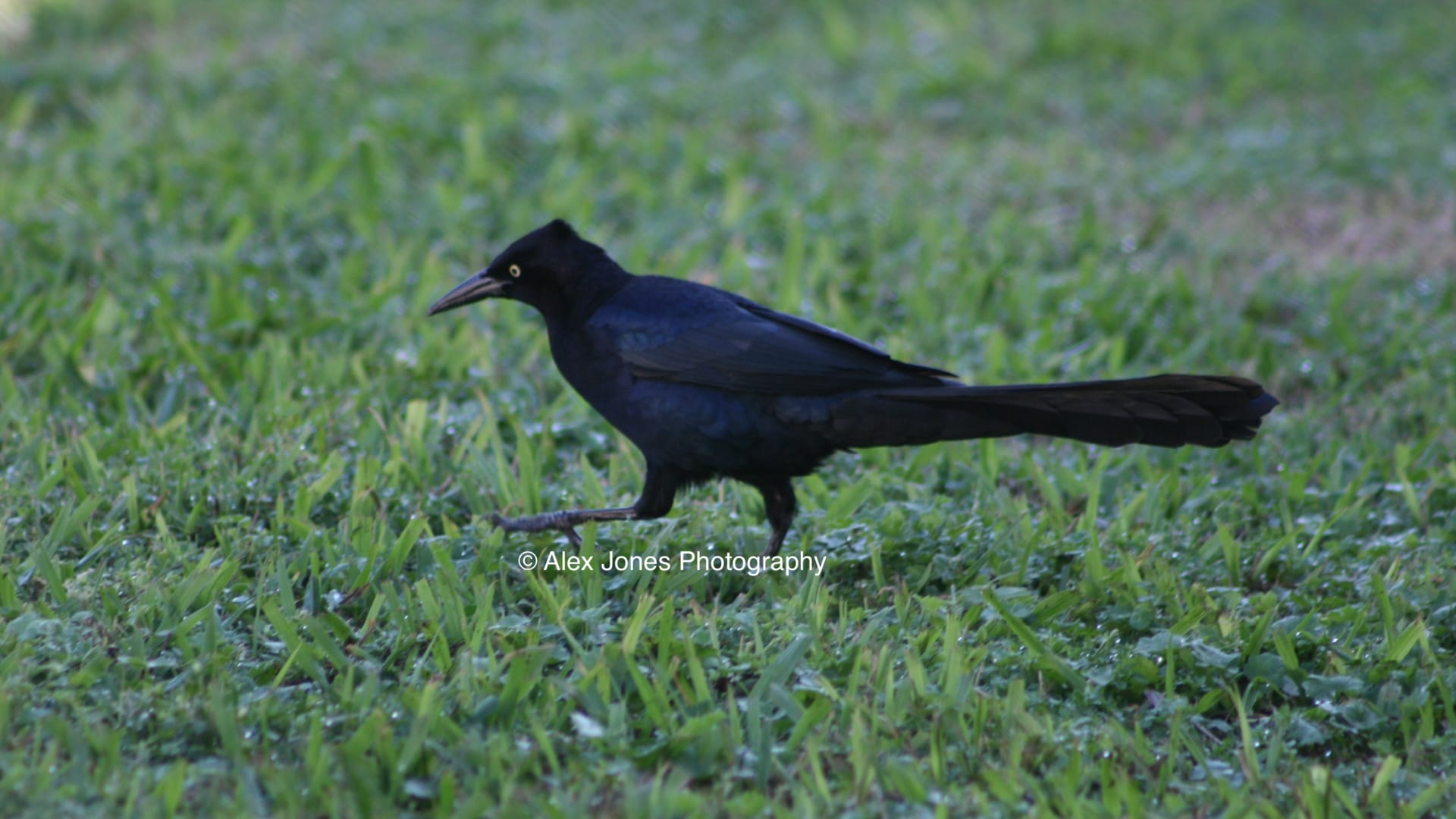
A black bird with a long tail and pointed beak stands on green grass covered with small water drops. The bird has dark feathers that look blue-black and bright yellow eyes. It appears to be looking for food on the wet ground.
🔬 Scientific Phenomena
The Anchoring Phenomenon shown here is animal adaptation for survival in specific environments. This blackbird demonstrates how body structures (morphology) are perfectly matched to function and habitat needs. The pointed beak is adapted for probing soil and grass for insects and worms, while the strong legs allow for ground foraging. The bird's behavior of searching on wet grass shows how animals respond to environmental conditions that make food sources more accessible.
📚 Core Science Concepts
- Animal Body Structures and Functions: The bird's beak shape, leg structure, and eye placement are specifically adapted to help it find food and survive in its environment.
- Behavioral Adaptations: Animals change their actions based on environmental conditions - wet grass makes it easier to find worms and insects.
- Habitat Requirements: Living things need specific environmental conditions (food, water, shelter) to survive and thrive.
- Observable Characteristics: Scientists can learn about an animal's lifestyle by carefully observing its physical features and behaviors.
Pedagogical Tip: Use the "See-Think-Wonder" thinking routine with this image. Have students first describe what they see, then share what they think is happening, and finally ask questions about what they wonder. This builds observation skills and scientific questioning.
UDL Suggestions: Provide multiple ways for students to share observations by offering options like drawing, verbal descriptions, or acting out the bird's movements. This supports different learning styles and communication preferences.
🔍 Zoom In / Zoom Out Concepts
- Zoom In: At the cellular level, the bird's beak contains specialized nerve endings that help it detect vibrations from moving prey underground. The eye structure has different types of cells that allow the bird to see colors and movement that help locate food.
- Zoom Out: This bird is part of a larger ecosystem food web, helping control insect populations while also serving as prey for larger animals. The bird's role connects to soil health, plant growth, and the overall balance of the local environment.
🤔 Potential Student Misconceptions
- Misconception: All birds eat the same food and have the same beak shape.
Clarification: Different bird species have different beak shapes that match what they eat - seed-eaters have thick beaks, while insect-eaters like this blackbird have pointed beaks.
- Misconception: Animals choose their body parts like people choose clothes.
Clarification: Animals are born with body structures that their parents passed down to them through inheritance, not by choice.
- Misconception: Birds only look for food when they're hungry.
Clarification: Birds spend most of their day searching for food because they need lots of energy to maintain their body temperature and stay active.
🎓 NGSS Connections
- Performance Expectation: 3-LS4-3 - Construct an argument with evidence that in a particular habitat some organisms can survive well, some survive less well, and some cannot survive at all.
- Disciplinary Core Ideas: - Environmental changes affect organisms, and - Variation of characteristics among individuals of the same species
- Crosscutting Concepts: - Students can identify how the bird's beak shape causes it to be successful at finding certain types of food
💬 Discussion Questions
- How does the bird's beak shape help it get food from the ground? (Bloom's: Analyze | DOK: 2)
- What might happen to this bird if all the grass in its habitat disappeared? (Bloom's: Evaluate | DOK: 3)
- What other animals have you seen that use their body parts in special ways to get food? (Bloom's: Apply | DOK: 2)
- Why do you think the bird is looking for food on wet grass instead of dry grass? (Bloom's: Analyze | DOK: 2)
📖 Science Vocabulary
- Adaptation: A special body part or behavior that helps an animal survive in its home.
- Habitat: The place where an animal lives and finds everything it needs to survive.
- Foraging: The way animals search for and gather food.
- Environment: All the living and non-living things around an animal.
- Characteristic: A special feature or trait that describes how something looks or acts.
🔗 Cross-Curricular Ideas
- ELA - Writing Connection: Have students write a short story from the bird's perspective about a day spent foraging for food. They can describe what the bird sees, feels, and finds on the wet grass. This connects narrative writing skills with science observations.
- Math - Data Collection: Students can conduct a simple "bird feeding observation" by placing different types of food (seeds, crackers, insects) on grass and recording which foods the bird visits most. They can create tally marks and simple bar graphs to show their data.
- Art - Nature Sketching: Students can draw detailed pictures of the bird's beak from different angles and compare it to beaks of other birds (robins, parrots, woodpeckers). They can create a visual poster showing "Beaks Around the World" with colored pencils or watercolors.
- Social Studies - Animal Habitats Around the World: Research what blackbirds eat and where they live in different countries. Students can locate these places on a world map and compare how the bird's behavior might change in different climates (hot vs. cold, wet vs. dry).
🚀 STEM Career Connection
- Conservation Biologist — Works out which plants and animals are in trouble, and what would help them recover.
- Try it: Design a poster that explains why blackbirds need certain things in their environment to survive, like insects and safe places to nest. (Practice: Constructing Explanations and Designing Solutions)
- Tools: population surveys, GPS trackers, habitat maps, trail cameras
- Where they work: nature reserves, conservation charities, government agencies, universities
- Meet one: Tierra Curry — Which plants and animals are closest to disappearing, and what it takes to save them.
- Median pay: /year — "Zoologists and wildlife biologists"
- Ornithologist — Studies birds — how they fly, what they eat, where they nest, and where they travel.
- Try it: Observe a bird for 10 minutes and record its actions, then explain how those actions help it survive. (Practice: Constructing Explanations and Designing Solutions)
- Tools: binoculars, spotting scopes, leg bands, sound recorders
- Where they work: wildlife refuges, bird observatories, parks, universities
- Meet one: Corina Newsome — How seaside sparrows in salt marshes lose nests to rising water — nests built higher escape the flooding but become easier for predators to find.
- Median pay: /year — "Zoologists and wildlife biologists"
Wage figures are median annual wages for the U.S. occupation named after each one, from the U.S. Bureau of Labor Statistics, Occupational Employment and Wage Statistics (OEWS), national, May 2025. Several careers share one occupation, so their figures match.