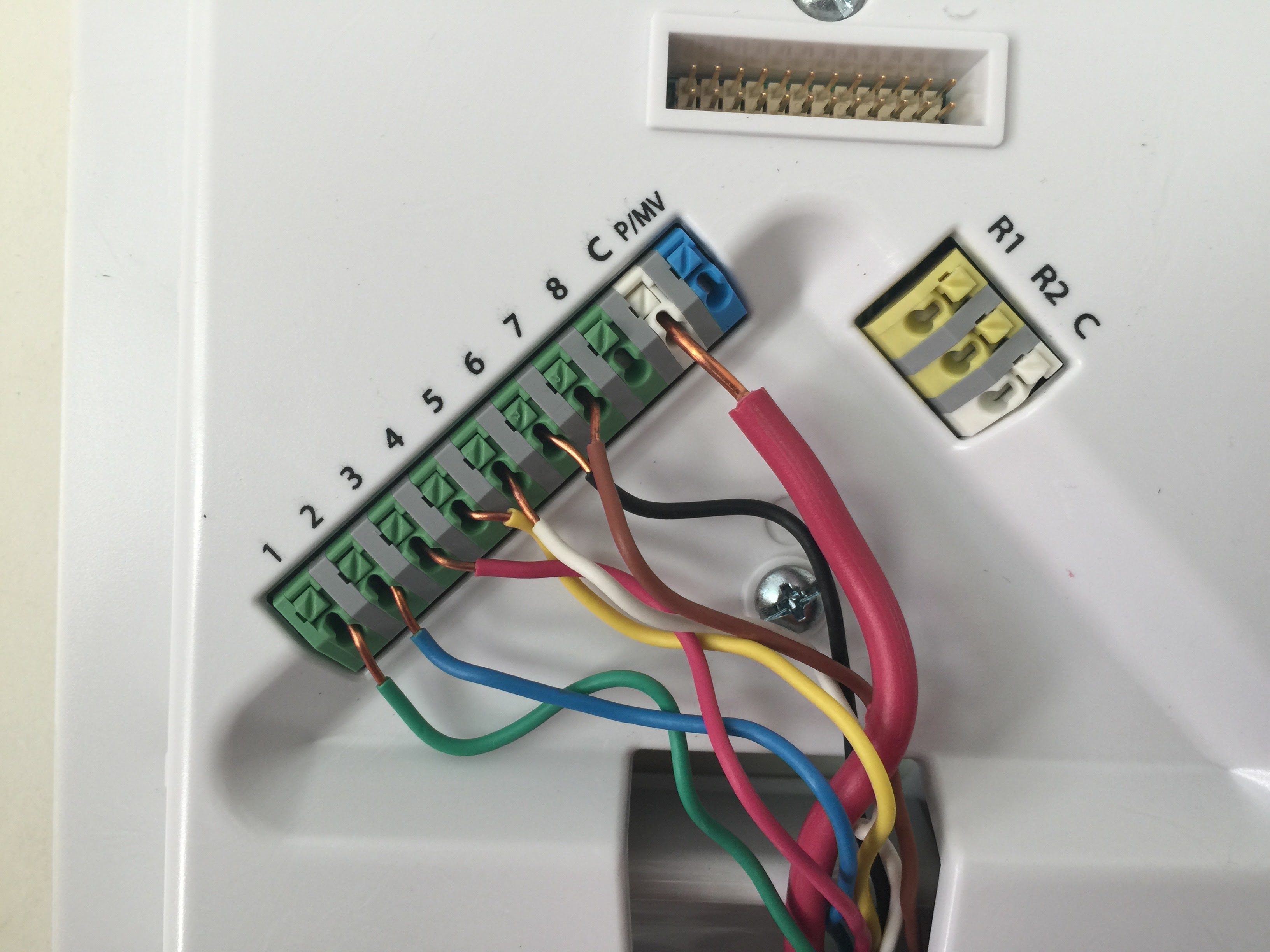
📸 Photo Description
This image shows a circuit board with wires connected to different colored terminals (green, blue, yellow, pink, and black). The wires are connected to numbered ports labeled 1-8, a blue section labeled "P/MV," and a yellow section labeled "R1, R2, C." Multiple colored wires carry electricity through the circuit, similar to how roads carry cars to different places.
🔬 Scientific Phenomena
Anchoring Phenomenon: Electricity flowing through different pathways to light up devices or make them work.
Why This Happens: Electricity needs a complete path (circuit) to travel from a power source through wires and devices, and back to the starting point. Think of it like a water slide—water flows down because there's a path for it to follow. In this circuit board, the colored wires create pathways for electricity to flow to different components (like lights, sounds, or sensors). When the circuit is complete with no breaks, electricity can move, and devices turn on. When a wire is disconnected or broken, the circuit is "open," and electricity stops flowing—just like closing a gate stops water flow.
📚 Core Science Concepts
- Circuits: A complete loop or pathway that electricity travels through. Electricity needs a beginning, a middle, and a way to return home to work.
- Conductors: Materials (like copper wires and metal) that allow electricity to flow easily through them. The colored wires in the photo are conductors.
- Open and Closed Circuits: A closed circuit has a complete path for electricity to travel (devices work). An open circuit has a broken path (devices don't work).
- Electrical Components: Different parts of a circuit, such as power sources, wires, switches, lights, or buzzers that work together.
Pedagogical Tip:
Third graders benefit from tactile, kinesthetic learning. Before introducing wiring diagrams, have students physically model circuits by holding hands in a circle (closed circuit) and then breaking the circle (open circuit). This concrete experience helps them understand electricity's need for a complete path before moving to abstract circuit boards.
UDL Suggestions:
Multiple Means of Representation: Provide circuit diagrams alongside real circuit photos. Use consistent color coding (e.g., red always means power, black always means ground) to support visual learners and students with color blindness. Include tactile models or raised-line diagrams for students who are blind or have low vision.
Multiple Means of Engagement: Allow students to choose their own materials for circuit-building activities—some may prefer pre-assembled kits, while others may explore with wire and batteries independently. This choice supports autonomy and motivation.
🎓 NGSS Connections
Performance Expectation:
3-PS2-3: Ask questions to determine the effect of placing objects in the path of an apparent source of motion. (This PE connects to understanding how circuits can be interrupted or completed.)
Disciplinary Core Ideas:
- - Forces and Motion: Electricity flows through closed circuits and can be interrupted by opening the circuit.
Crosscutting Concepts:
- - A circuit is a system of connected parts working together.
- - Closing or opening a circuit causes devices to turn on or off.
💬 Discussion Questions
- What do you think will happen if we remove one of the colored wires from this circuit board? (Bloom's: Predict | DOK: 2)
- Why do you think the wires in this circuit are colored differently? How might the different colors help us? (Bloom's: Analyze | DOK: 2)
- If you wanted to build a circuit to light up a lamp in your bedroom, what parts would you need, and how would you connect them? (Bloom's: Create | DOK: 3)
- How is a circuit similar to a path or road you might walk or drive on? (Bloom's: Analyze | DOK: 2)
📖 Vocabulary
- Circuit: A closed loop that electricity travels through, like a circle with no breaks.
- Conductor: A material (usually metal) that lets electricity flow through it easily, like copper wire.
- Electricity: A form of energy that flows through wires and powers devices like lights and toys.
- Switch: A device that opens or closes a circuit to turn something on or off.
- Power Source: The thing that provides electricity, like a battery or outlet.
🌡️ Extension Activities
- Circuit Challenge Game: Provide students with battery packs, LED lights, and copper wire. Challenge them to build a simple circuit to light up an LED. Have them predict what will happen if they remove one wire, then test their prediction. This hands-on exploration reinforces the concept of open vs. closed circuits.
- Circuit Mapping: Give students a large poster board and ask them to draw the "path" that electricity takes through an imaginary home (from the power source to lights, appliances, and back). Have them use colored markers and discuss where switches would interrupt the circuit and why that's important.
- Story of a Spark: Have students create a short picture book or comic strip showing the "journey" of electricity through a circuit from start to finish. They can personify the electricity as a character traveling along the wire roads, stopping when it hits an open switch, and arriving at a "destination" (light, buzzer, fan) when the circuit is closed.
🔍 Zoom In / Zoom Out Concepts
Zoom In: Electrons on the Move
If we could shrink down super tiny—smaller than a grain of sand—we'd see electrons (teensy particles inside atoms) zooming through the copper wires like a river of invisible runners. These electrons are so small we can't see them, but when millions and millions of them move together through a wire, that's what we call electricity! The colored wires act like highways, guiding these electron runners along the correct path. When a circuit is open, it's like closing the highway—the electrons stop moving and can't reach their destination.
Zoom Out: Electricity Powers Our Whole Community
Imagine zooming way, way up in the sky to see your entire neighborhood, city, or town. That circuit board in the photo is just one tiny piece of a much bigger electrical system that powers everything around us—streetlights, schools, hospitals, homes, and playgrounds. Massive power plants generate electricity, and it travels through giant wires on poles and under streets to reach every building. Every light switch, outlet, and device in your school and home is part of this enormous network of circuits. Without understanding how circuits work, communities couldn't deliver electricity safely to keep people warm, help doctors help patients, and power the technology we use every day.
🤔 Potential Student Misconceptions
Misconception 1: "Electricity is used up as it travels through a wire."
Clarification: Electricity doesn't get "used up" like fuel in a car. Instead, electricity flows in a circle through a closed circuit. The same electrons that leave the battery return to it after powering a device. What does get used is the battery's energy, which converts to light, heat, or motion in the device. Think of it like a merry-go-round: the horses go around and around the same track; they don't disappear.
Misconception 2: "Bigger wires always mean more electricity flows."
Clarification: The thickness of the wire (called gauge) matters, but it's not the only thing controlling how much electricity flows. The power source (like a battery's voltage) and any resistors in the circuit determine the flow. Thicker wires can safely carry more electricity without overheating, but a thin wire connected to a strong battery will still have electricity flowing through it—it just might get hot and be unsafe. It's like water pipes: bigger pipes can carry more water, but the water pressure from the pump matters too.
Misconception 3: "Electricity travels really, really fast—instantly."
Clarification: While electricity does travel very, very fast (about the speed of light through wires!), it doesn't travel instantly. There's a tiny delay—so small we don't notice it in our homes—but scientists can measure it. Also, electricity doesn't just "shoot" to its destination; it flows continuously through the entire circuit when the path is complete, not just to one spot.
🔗 Cross-Curricular Ideas
Math Connection: Mapping the Circuit
Have students count the numbered terminals (1–8) on the circuit board and create a simple graph or chart showing how many wires connect to each terminal. Students could also measure the lengths of different colored wires using rulers and compare which color is longest or shortest. This reinforces counting, measurement, and data organization skills while deepening understanding of circuit components.
ELA Connection: "Letter from Electricity"
Ask students to write a creative letter from the perspective of electricity traveling through the circuit board. "Dear Circuit, Today I started at the battery and traveled through the red wire to terminal 3…" This narrative writing activity helps students sequentially explain the path electricity takes while developing storytelling and descriptive language skills.
Social Studies Connection: Electricity Then and Now
Have a brief discussion: "What would life be like without electricity?" Students could create a before-and-after Venn diagram comparing homes 100 years ago (without electrical circuits) to modern homes (with many circuits). This connects to understanding how technology changes societies and communities, and builds historical thinking.
Art Connection: Circuit Design and Patterns
Provide students with colored paper, markers, and string to design their own "circuit board art." They can create colorful, symmetrical patterns using the circuit board as inspiration, arranging colored wires (string) in aesthetically pleasing ways. This activity celebrates the visual elegance of circuits while developing fine motor skills and artistic expression. Display finished designs in the classroom to show how science and art can work together.
🚀 STEM Career Connection
- Electrician — Installs and repairs the wiring that carries electricity safely through a building.
- Try it: Use a battery, wires, and a light bulb to create a closed circuit, then disconnect one wire to show how it becomes an open circuit and the light goes out. (Practice: Constructing Explanations and Designing Solutions)
- Tools: wire strippers, voltage testers, conduit benders, circuit testers
- Where they work: homes and schools, construction sites, factories, electrical contractors
- Median pay: /year — "Electricians"
- Electrical Engineer — Designs the circuits and systems that move electricity where it is needed.
- Try it: Experiment with connecting multiple light bulbs in a series and parallel circuit to see how the brightness changes. (Practice: Constructing Explanations and Designing Solutions)
- Tools: oscilloscopes, circuit boards, multimeters, simulation software
- Where they work: power companies, electronics firms, research labs, universities
- Meet one: Danielle George — The radio receivers that let giant telescopes hear signals from space.
- Median pay: /year — "Electrical engineers"
Wage figures are median annual wages for the U.S. occupation named after each one, from the U.S. Bureau of Labor Statistics, Occupational Employment and Wage Statistics (OEWS), national, May 2025. Several careers share one occupation, so their figures match.
---
Teacher Tip: Start with conceptual understanding before introducing schematic symbols. Real circuits and tactile exploration are the foundation for third graders. Safety reminder: Use low-voltage circuits (batteries, not wall outlets) for all student activities, and always supervise electrical activities closely.