📸 Photo Description
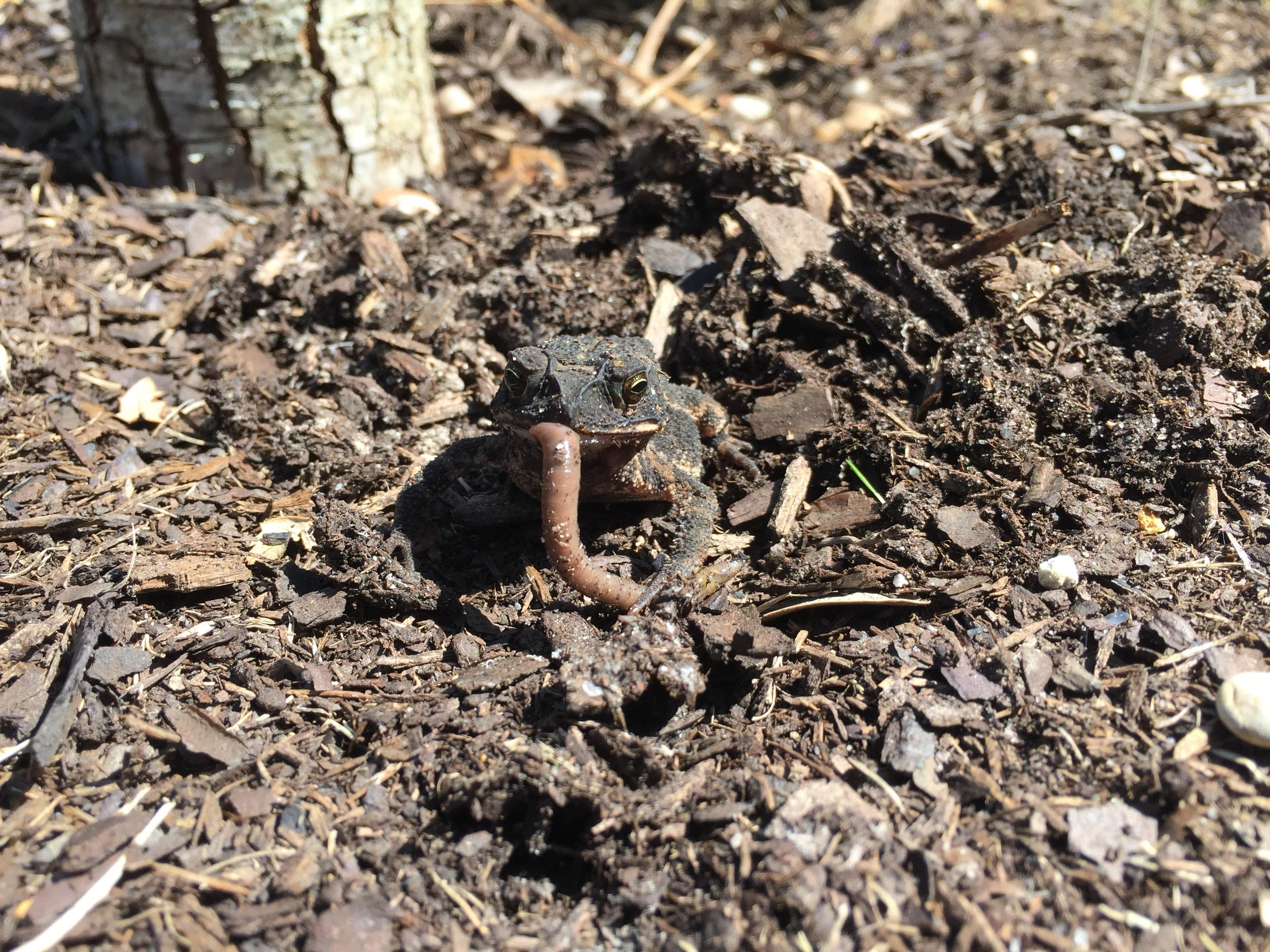
A toad is shown on the ground, eating a worm. The toad's mouth is around the worm, and the worm's body is partly visible. The toad is camouflaged against the brown soil and wood chips.
🔬 Scientific Phenomena
This image depicts a predator-prey interaction, specifically a toad consuming a worm. This interaction is a fundamental part of the ecosystem where energy and nutrients are transferred between organisms. The toad, a consumer, obtains energy by eating the worm, which is also a consumer (or detritivore, depending on its diet).
📚 Core Science Concepts
- Producers and Consumers: Organisms that make their own food (like plants) are producers. Organisms that eat other organisms for energy are consumers. In this image, the toad is a consumer, and the worm is its food source, making it prey.
- Food Chains: A food chain shows how energy is transferred from one living thing to another. This image represents a small part of a food chain, showing a link between a toad and a worm.
- Adaptations for Survival: Toads have adaptations like camouflage to help them blend in with their environment, making it easier to catch prey like worms or to avoid being eaten by predators. Worms also have adaptations that help them survive, such as burrowing into the soil.
Pedagogical Tip: Encourage students to observe and draw the toad and worm, noting any observable adaptations. This can lead to discussions about how these features help the animals survive.
UDL Suggestions: Provide visual aids such as diagrams of food chains or pictures of different animal adaptations to support understanding. For students who struggle with fine motor skills, offer adapted drawing tools or allow them to create a 3D model of the interaction using playdough.
🔍 Zoom In / Zoom Out Concepts
- Zoom In: At a microscopic level, the toad's digestive system would be breaking down the worm's tissues into smaller molecules that the toad can use for energy and growth. This involves chemical processes and specialized cells.
- Zoom Out: This interaction is part of a larger ecosystem, like a garden or forest floor. The toad and worm are connected to other organisms; for example, the worm might eat decaying leaves (decomposers), and the toad might be eaten by a larger animal like a hawk or fox. This illustrates the interconnectedness of life in a habitat.
🤔 Potential Student Misconceptions
- Misconception: Students might think that all animals eat plants.
Clarification: While some animals eat plants (herbivores), many animals eat other animals (carnivores) or both plants and animals (omnivores). The toad in the image is a carnivore, eating another invertebrate.
- Misconception: Students might think that food chains are always simple, linear paths.
Clarification: Food chains are simplified models. In reality, ecosystems have complex food webs where animals eat many different things and are eaten by many different predators.
🎓 NGSS Connections
- 3-LS4-3: Construct an argument with evidence that in a particular habitat some organisms can survive well, some survive less well, and some cannot survive at all.
- K-LS1-1 (Grade K — foundational connection): Use observations to describe patterns of what plants and animals (including humans) need to survive.
💬 Discussion Questions
- What is the toad doing, and why is it important for the toad? (Bloom's: Understand | DOK: 1 | SEP: Obtaining Evaluating and Communicating Information)
- How does the way the toad looks help it survive in its environment? (Bloom's: Apply | DOK: 2 | SEP: Constructing Explanations and Designing Solutions)
- What might happen if there were no worms for the toads to eat? (Bloom's: Analyze | DOK: 3 | SEP: Analyzing and Interpreting Data)
- Can you describe another example of an animal eating another animal? (Bloom's: Apply | DOK: 2 | SEP: Obtaining Evaluating and Communicating Information)
📖 Vocabulary
- Toad: A type of amphibian with bumpy skin that often lives on land.
- Worm: A long, soft-bodied animal that usually lives in the soil.
- Consumer: An organism that gets its energy by eating other organisms.
- Predator: An animal that hunts and eats other animals.
- Prey: An animal that is hunted and eaten by another animal.
- Habitat: The natural home or environment where an animal lives.
🌡️ Extension Activities
- Build a Worm Habitat: Students can create a classroom worm habitat (vermicomposting bin) using soil, shredded paper, and food scraps. They can observe worms' behaviors and what they eat over time.
- Food Chain Mobile: Students can draw or print pictures of different organisms (producers, consumers, decomposers) and create a mobile to represent a simple food chain or food web.
🔗 Cross-Curricular Ideas
- ELA: Read books about toads, worms, and other animals that live in gardens or forests. Students can write their own short stories about a day in the life of a toad or worm.
- Art: Students can create detailed drawings or paintings of the toad and worm, focusing on their textures and camouflage. They could also sculpt the animals from clay.
- Math: Students can measure the length of worms (if applicable in a habitat project) and create bar graphs to compare lengths. They could also count the number of different animals observed in a local habitat.
🚀 STEM Career Connection
- Conservation Biologist — Works out which plants and animals are in trouble, and what would help them recover.
- Try it: Research one animal that eats worms and explain what it needs to survive. (Practice: Obtaining, Evaluating, and Communicating Information)
- Tools: population surveys, GPS trackers, habitat maps, trail cameras
- Where they work: nature reserves, conservation charities, government agencies, universities
- Meet one: Tierra Curry — Which plants and animals are closest to disappearing, and what it takes to save them.
- Median pay: /year — "Zoologists and wildlife biologists"
- Herpetologist — Studies reptiles and amphibians — snakes, lizards, frogs and turtles.
- Try it: Find a picture of a frog and present to the class one adaptation that helps it catch food. (Practice: Obtaining, Evaluating, and Communicating Information)
- Tools: snake hooks, pitfall traps, temperature probes, a field notebook
- Where they work: deserts and wetlands, zoos, natural history museums, universities
- Meet one: Earyn McGee — What happens to desert lizards when the streams they live near dry up.
- Median pay: /year — "Zoologists and wildlife biologists"
Wage figures are median annual wages for the U.S. occupation named after each one, from the U.S. Bureau of Labor Statistics, Occupational Employment and Wage Statistics (OEWS), national, May 2025. Several careers share one occupation, so their figures match.